The Wine Spectator Top 100 2026 is expected in mid-November, and the list makes more sense once you know what happens before No. 1 appears. It is not a ranking of the year’s 100 highest scores. Wine Spectator’s editors start with thousands of blind-tasted wines, then weigh quality, value, availability in the United States and an editorial “X-factor” before revealing the Top 10 as a countdown and, later, the full list.
ⓘ We may earn a commission when you book through links on this page — at no extra cost to you. Affiliate Disclosure
- When
- Mid-November 2026 (TBC)
- Who
- Wine Spectator senior editors
- Wines tasted
- 10,200+ in 2025
- Criteria
- Quality, value, availability and X-factor
- Where
- top100.winespectator.com
In this article
How the Wine Spectator Top 100 2026 is chosen
Wine Spectator says its wines are reviewed blind in its New York and Napa Valley offices: tasters do not know the producer or price, although they know the variety and/or region. In 2025, editors reviewed more than 10,200 newly released wines, and more than 5,500 scored 90 points or higher. That pool became the starting point for the annual Top 100.
From there, the ranking changes from a score table into an editorial selection. Quality is still the base: every Top 100 wine must have earned at least 90 points. But three other factors matter. Value asks what the bottle delivers for its price. Availability considers how many cases were made or imported into the United States. The final X-factor covers the excitement, story and broader significance editors see in a wine.
That explains the part readers often miss. A 96-point wine does not automatically rank above a 95-point wine, and a rare bottle does not automatically beat a widely available one. In 2025, the No. 1 wine had 95 points, while the No. 2 had 96. The list is designed to identify the most compelling wines of the review year, not simply to sort scores from high to low.
For an American reader, availability is especially important. The list is global, but the availability criterion is explicitly tied to cases made or imported for the U.S. market. That gives the ranking a practical U.S. dimension.
How the countdown works
Wine Spectator has not yet announced the 2026 reveal dates, so mid-November is the useful planning window, not a confirmed appointment. The 2025 rollout shows the mechanics without turning last year’s calendar into a 2026 prediction.
In 2025, the countdown began on Monday, November 10. Nos. 10 and 9 appeared first, followed by Nos. 8 and 7 on Tuesday, Nos. 6 and 5 on Wednesday, then Nos. 4, 3 and 2 on Thursday. The Wine of the Year, No. 1, was revealed on Friday, November 14. The complete Top 100 followed on Monday, November 17.
That staggered release is part of the editorial format. The Top 10 get individual attention before the rest of the ranking becomes searchable as a complete list. Detailed profiles of the 2025 picks then appeared in Wine Spectator’s December 31 issue.
For 2026, the sensible approach is simple: watch the official Top 100 site once November begins, but do not book around an unannounced date. This page will be updated when Wine Spectator publishes the schedule, then again when the 2026 Wine of the Year and the full list are available.
The 2025 list: who won last year
The 2025 Wine of the Year was Château Giscours Margaux 2022, a 95-point Bordeaux priced at $68 with 15,000 cases made. The placement illustrates the system: a wine can take No. 1 without holding the highest score in the Top 10 because score is only one of four considerations.
The rest of the first ten made that point from several directions. Ridge Lytton Springs Dry Creek Valley 2023 was No. 3 at 95 points. Produttori del Barbaresco Barbaresco 2021 reached No. 7 at 94 points. Castello di Ama Chianti Classico San Lorenzo Gran Selezione 2021 was No. 9 at 95 points. Four of the Top 10 came from Sonoma County.
Across all 100 wines, the United States placed 33, Italy and France 20 each, and Spain eight. Tuscany alone accounted for 10 wines, including five Chianti Classico bottlings. Those figures are a 2025 snapshot, not quotas for 2026.
The price distribution was just as revealing. Thirty-four wines cost $30 or less, while 14 were priced at $100 or more. The average was 93 points and $58, and 38 wines were making their first appearance in the Top 100. The list mixes established names, new entries, accessible bottles and collector territory.
What to watch for in 2026
The safest way to read the 2026 edition before it exists is to watch the inputs, not to guess the winner. Wine Spectator’s candidate pool comes from wines reviewed during the year, and release cycles differ by region. In the 2025 list, California’s 2023 vintage featured prominently, while France’s return was driven in large part by 2022. The mix will move as newer releases enter the review calendar, but that does not point to a predetermined country, grape or estate.
Geography is another useful baseline. The United States led the 2025 count, while Italy and France were tied behind it. Tuscany had an unusually strong showing, and Sonoma supplied four of the Top 10. None of those results creates a 2026 quota. The editors’ four criteria are applied to the wines in front of them, and the X-factor leaves room for a producer, region or project that did not dominate the previous edition.
Value and availability are worth following for the same reason. Last year’s list ranged from sub-$30 bottles to wines above $100, with a $58 average. A high score gets a wine into contention; a combination of price, U.S. availability and editorial significance can determine how far it goes.
So the Wine Spectator Top 100 2026 should be treated as a fresh editorial snapshot, not a sequel with an expected cast. The useful question is not “Who will win?” but “Which new releases best fit the same four-part test?”
The 2025 winners you can actually visit
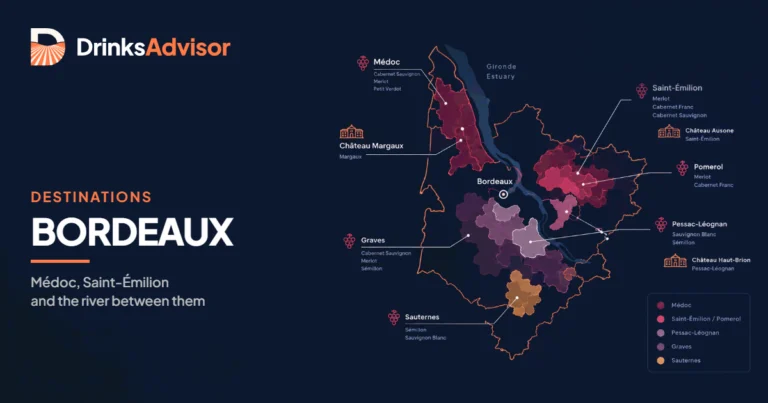
Two of the 2025 Top 10 make an unusually clean bridge from the ranking to a wine trip. Château Giscours, the Wine of the Year, is in Margaux on Bordeaux’s Left Bank and welcomes visitors for estate tours and tastings. If Giscours is the reason for the trip, our Bordeaux wine travel guide explains how Margaux fits into the wider region, while our guide to château stays in Bordeaux covers places to sleep among the vineyards rather than in the city.
Giscours can be one appointment on a Médoc day, but the D2 corridor contains enough classified estates to justify several nights on the Left Bank. That is especially true if you want to taste without repeatedly crossing Bordeaux from one bank to the other.
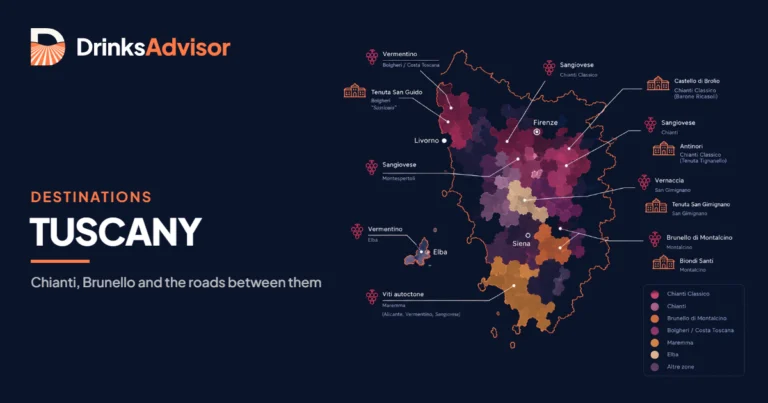
Castello di Ama offers the same opportunity in Tuscany. Its San Lorenzo Gran Selezione 2021 finished No. 9, and the estate’s current visit program includes the wine in a tasting focused on Ama’s terroir. The winery sits in Gaiole in Chianti, so it fits naturally into a broader Tuscany wine country itinerary. If you are staying in Florence, one of our Chianti wine tours from Florence solves the driving problem; if wine is the center of the trip, staying at a vineyard hotel in Tuscany gives you more time between appointments.
Stay near the 2025 Wine of the Year
Hotels and château rooms around Margaux, a short drive from Château Giscours.
How it compares with Italy’s wine guides
Wine Spectator’s Top 100, Gambero Rosso’s Vini d’Italia and the Slow Wine Guide can all steer a serious buyer toward good Italian wine, but they are not trying to answer the same question.
Gambero Rosso is Italy-only and built around blind, multi-stage panel tasting. Its Tre Bicchieri system is categorical rather than a global 1-to-100 countdown: wines pass through regional commissions and a final round, and wines scoring above 90 in the final earn Tre Bicchieri. It is useful for reading the depth of an Italian region or appellation rather than asking which bottle is “No. 1” globally. Our preview of Gambero Rosso Italian Wines 2027 covers the new edition.
Slow Wine looks wider still at the producer: its collaborators visit the wineries in person, and its best-known awards separate different kinds of merit. The Chiocciola recognizes estates aligned with Slow Food’s organoleptic, territorial and environmental values; the Bottiglia recognizes excellent overall wine quality; the Moneta highlights value. Winery visits and the context around agriculture and place are part of the guide’s identity, as our look at the Slow Wine Guide 2027 explains.
Wine Spectator is the more useful of the three when you want a compact, global list with a U.S. buying lens. Gambero Rosso is stronger for a structured reading of Italian wine quality, while Slow Wine adds the farming, producer and territory questions that a score cannot answer. The rankings overlap, but the editorial jobs are different.
Until the 2026 countdown starts, the 2025 list is the best guide to the mechanics: blind tasting creates the pool, then quality, value, U.S. availability and the X-factor shape the final order. That is why the No. 1 wine does not need the highest score, and why a widely available bottle with a strong story can outrank a rarer wine with an extra point.
We will update this Wine Spectator Top 100 2026 page when Wine Spectator confirms the schedule, then replace the backward-looking sections with the new winners and what changed from 2025. If you are planning a trip in the meantime, Bordeaux and Tuscany are the two 2025 regions where the Top 10 already connects directly to estates you can visit.