Sonoma wine country is bigger, looser and more varied than its famous neighbor over the Mayacamas. Napa is one valley; Sonoma County is a patchwork of 19 appellations, from the old mission town of Sonoma to foggy Pinot Noir vineyards near the Pacific and the Zinfandel benches above Healdsburg. This guide covers the four areas worth knowing, when to go, how to get around and where to base yourself.
ⓘ We may earn a commission when you book through links on this page — at no extra cost to you. Affiliate Disclosure
- Best time to go
- April to June for green hills and quiet tasting rooms; September and October for the harvest
- Nearest airport
- Charles M. Schulz Sonoma County Airport (STS) near Santa Rosa; San Francisco (SFO) and Oakland (OAK) for more flights
- Getting around
- Rental car or private driver; Healdsburg and the town of Sonoma both have tasting rooms within walking distance
- Typical budget
- $$ to $$$$, from a small inn in the Russian River Valley to a resort with a spa in Healdsburg
- Signature grapes
- Chardonnay and Pinot Noir in the cool west; Cabernet Sauvignon and Zinfandel in the warmer valleys
In this article
Understanding Sonoma’s four wine areas
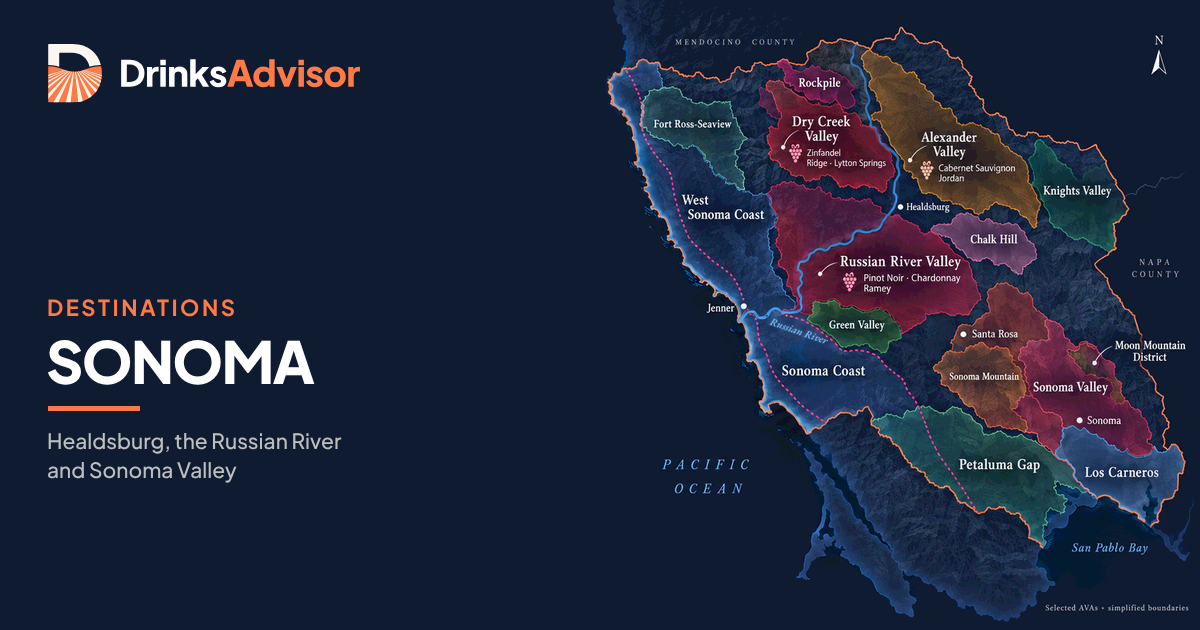
Sonoma County has 19 American Viticultural Areas, around 59,000 acres of vineyards and more than 425 wineries, most of them family-owned. Chardonnay is the most planted grape, followed closely by Pinot Noir, Cabernet Sauvignon and Zinfandel. The Sonoma County Winegrowers, the growers’ commission, publishes the map and the numbers.
Nineteen appellations is too many to plan around. For a visitor, the county falls into four areas, each with its own town, its own grapes and its own pace. The key is the Pacific: fog pours in through gaps in the coastal hills, so the west is cool and the inland valleys to the north and east are warm. Pinot Noir follows the fog; Cabernet and Zinfandel follow the sun.
Sonoma Valley — the historic town and the Valley of the Moon
The Sonoma Valley runs north from San Pablo Bay along Highway 12, through the town of Sonoma, Glen Ellen and Kenwood. It is the closest part of the county to San Francisco and the most historic: the town is built around a large plaza with the old mission and adobe buildings, and Buena Vista, founded by Agoston Haraszthy in 1857, still pours wine just east of it.
The plaza itself is lined with tasting rooms and restaurants, so a first afternoon needs no car. At the southern end, the Carneros district straddles the line with Napa and is cooled by the bay, which makes it a source of Chardonnay, Pinot Noir and sparkling wine. Further north the valley warms up and the reds get bigger.
Russian River Valley — Pinot Noir in the fog
West of Santa Rosa, the Russian River Valley is the county’s best-known address for Pinot Noir and Chardonnay. Mornings are often gray until the fog burns off, and the vineyards sit among apple orchards, redwood groves and small farm roads around Sebastopol, Forestville and Guerneville.
Wineries here are spread out and mostly small, which suits a slow day with two or three appointments. Westside Road, which follows the river toward Healdsburg, links many of the Pinot Noir producers and is one of the prettiest drives in the county.
Healdsburg, Dry Creek and Alexander Valley
Healdsburg is the center of northern Sonoma and the most polished base in the county: a shaded plaza ringed by tasting rooms, restaurants and hotels. Three valleys meet near town. Dry Creek Valley, to the west, is Zinfandel country, with old vines planted in the 1880s and 1890s; Alexander Valley, to the east, is warmer and known for Cabernet Sauvignon.
You can spend a day in Healdsburg on foot and another on the back roads of Dry Creek, where many family wineries still pour in barns and on porches. If you only have one base for a first trip to Sonoma wine country, this is the one most travelers choose.
Sonoma Coast and West County
The Sonoma Coast appellation stretches along the Pacific side of the county, and its coolest vineyards sit on ridges a few miles from the ocean. Pinot Noir and Chardonnay are its specialties, often lean and high in acid. Visitor infrastructure is thin: few tasting rooms are in the vineyards themselves, and many producers pour in Sebastopol or by appointment only.
Come out here for the landscape as much as the wine. Highway 116 follows the Russian River to the sea at Jenner, and Highway 1 runs along the cliffs to Bodega Bay. A day on the coast is a good break between two days of tastings.
For the curious — what an AVA is
An American Viticultural Area is a grape-growing region defined by the federal government on the basis of its geography and climate. Unlike a European appellation, it does not set rules on grapes, yields or winemaking: it only guarantees where the fruit was grown. AVAs can also sit inside one another. A bottle labeled Russian River Valley is also, by definition, Sonoma County wine, and a producer with vineyards in several parts of the county may simply use the broader name.
When to visit Sonoma wine country
The best time to visit Sonoma wine country is late spring, from April to June, or the harvest months of September and October. In spring the hills are still green, the mustard has finished flowering between the vines and tasting rooms are calm on weekdays. Harvest brings the most energy, the busiest weekends and the highest hotel rates.
Picking usually starts in August with the grapes for sparkling wine and runs into October for the late reds. Summer is warm inland, especially in Alexander Valley and the northern Sonoma Valley, while the Russian River Valley and the coast stay cool and often foggy until midday. Pack layers whatever the month.
Winter, from November to March, is the quietest and cheapest season. Some days are rainy, but the wineries stay open, the restaurants are easier to book and you will often have a tasting room to yourself.
How to get around
Flying in. Charles M. Schulz Sonoma County Airport (STS), about seven miles northwest of downtown Santa Rosa, is the closest airport to the vineyards, with nonstop flights from West Coast cities such as Seattle, Los Angeles and San Diego and from a few hubs including Las Vegas, Denver and Phoenix. Most travelers fly into San Francisco or Oakland instead: the town of Sonoma is about an hour’s drive from the Golden Gate in light traffic, Healdsburg about an hour and a half.
By train. The SMART train runs from the ferry terminal at Larkspur, in Marin County, north through Petaluma and Santa Rosa to Windsor, its northern end since May 2025. It is useful for reaching Santa Rosa without a car, and there is a station about a mile and a half from the airport terminal, but it does not reach the wineries. An extension to Healdsburg is planned for late 2028.
By car. A car is the practical way to cover Sonoma wine country: Highway 101 is the north–south spine, Highway 12 runs through the Sonoma Valley and Highway 116 heads west to the coast. Distances look short on the map, but country roads are slow and the four areas are far apart, so plan one area per day. California’s drink-driving limit is 0.08 percent blood alcohol for drivers 21 and over, and every tasting counts toward it. If two of you want to taste freely, a private driver for the day is worth the cost.
Compare rental rates on DiscoverCars →
Where to stay
Choose your base by the wine you want to drink, because driving across the county every day eats into tasting time. Two or three nights in one place, with one day trip, works better than moving around.
- Healdsburg: the most hotels at the top end, the best restaurants and tasting rooms on foot, with Dry Creek, Alexander Valley and the Russian River all within twenty minutes.
- Town of Sonoma and Glen Ellen: the easiest base from San Francisco, with the historic plaza, spa hotels and the Sonoma Valley wineries on the doorstep. Napa is a short drive east through Carneros.
- Russian River Valley: small inns and cottages among the vines and redwoods around Forestville and Guerneville, for a quieter trip built around Pinot Noir.
- Santa Rosa: the county’s largest city, with more choice and lower rates, central for every area but with less wine country charm.
At the top end, Montage Healdsburg sits on a hillside of oaks above the town, and the Fairmont Sonoma Mission Inn & Spa is built on hot springs just north of Sonoma’s plaza. Harvest weekends sell out first. If you plan to split the trip between the two counties, our pick of Napa Valley wine resorts covers the other side of the Mayacamas. For specific hotels on this side, our guide to where to stay in Sonoma covers wine country hotels and inns.
What to do
Sonoma tastings tend to be more relaxed than Napa’s, and more of them happen with the winemaker or the family behind the label. Many wineries ask for a reservation, especially for seated tastings and on weekends, so book the visits that matter before you arrive.
- Taste around a plaza: Healdsburg and the town of Sonoma both have enough tasting rooms within a few blocks for an afternoon on foot.
- Compare Pinot Noir across the fog line: a morning in the Russian River Valley and an afternoon on the Sonoma Coast show how much a few miles of cooler air change the wine.
- Drink old-vine Zinfandel where it grows on the benches of Dry Creek Valley, at family wineries that have farmed there for generations.
- Visit California wine history at Buena Vista outside the town of Sonoma, and walk the plaza and the mission.
- Drive to the ocean along the Russian River to Jenner, then south on Highway 1 to Bodega Bay.
For booked tastings with set prices and times, our guide to the best wine tastings in Napa Valley shows how the reservation system works on the other side of the hills, and the same habits apply here.
Natural and biodynamic wine in Sonoma
Sustainability is the county’s calling card. In 2014 the Sonoma County Winegrowers set out to certify every vineyard as sustainable, and by September 2019 they reported that 99 percent of the vineyard acreage had been certified. That is a broad farming standard, not an organic label, so it tells you less about a single bottle than it seems.
For organic and biodynamic farming you need to look estate by estate. Benziger Family Winery in Glen Ellen and DeLoach Vineyards in Santa Rosa both hold Demeter biodynamic certification, and Bartholomew Estate near the town of Sonoma farms CCOF-certified organic vineyards. Sonoma County Tourism keeps a list of organic and biodynamic wineries you can visit. Our guide to organic vs biodynamic vs natural wine explains what each claim actually means.
Practical tips for US travelers
- Plan one area per day. Healdsburg to the town of Sonoma is close to an hour by car; trying to taste in both on the same day means more driving than drinking.
- Book weekends early. Saturdays from late summer to October fill up first, both for hotels and for seated tastings. Weekdays are easier and often more personal.
- Eat between tastings. Picnic areas are common at Sonoma wineries, and a lunch stop keeps three tastings in a day comfortable.
- Dress in layers. A foggy, cool morning in the Russian River Valley can turn into a hot afternoon in Alexander Valley.
- Getting bottles home. Many small producers sell wine you will not find in stores. Wineries can usually ship within the US, and our guide to shipping wine home to the US covers the rules for bottles bought abroad.
Where to start in Sonoma wine country
For a first trip, give Sonoma wine country three nights in Healdsburg: one day on foot around the plaza and in Dry Creek Valley, one along Westside Road and the Russian River, and one out to the coast or down Highway 12 to the Sonoma Valley. With a fourth night, move to the town of Sonoma for the history and the southern valley.
Many visitors pair the trip with Napa, which is a short drive across the hills. Our Napa Valley wine country guide covers the other half of the trip. Read Sonoma as a map of climates rather than a list of names: the west for Pinot Noir and Chardonnay, the north for Zinfandel and Cabernet, the Sonoma Valley for history.