Napa Valley wine resorts fall into two camps: the ones that farm their own ground, and the ones that borrow the view. The difference shows up at breakfast, when you can either walk to a barrel room or you cannot. These eight run from Carneros up to Calistoga, and every entry says exactly what sits on the property — a bonded winery, a tasting room, planted vines, or a hillside above them.
ⓘ We may earn a commission when you book through links on this page — at no extra cost to you. Affiliate Disclosure
In this article
How we chose these Napa Valley wine resorts
Wine on the grounds, or at the fence line. Six of the eight have a winery, a tasting room or planted vines on their own land. At Harvest Inn the vineyard starts where the lawn ends and belongs to the winery next door; Auberge du Soleil sits in an olive grove on the hillside above the Rutherford vines. Both entries say so instead of implying otherwise.
Every one is a resort, not a room. A spa or a pool, somewhere to eat without getting back in the car, and enough ground to spend a whole day on. Napa has excellent four-room inns and they deserve their own page; this is not it.
Everything here is checkable. Guest ratings and nightly rates come from our booking partner and carry the date we read them. Acreage, room counts, vineyard plantings and restaurant awards come from the property’s own published material, or from the winery that farms the land. Where we could not verify something, we left it out.
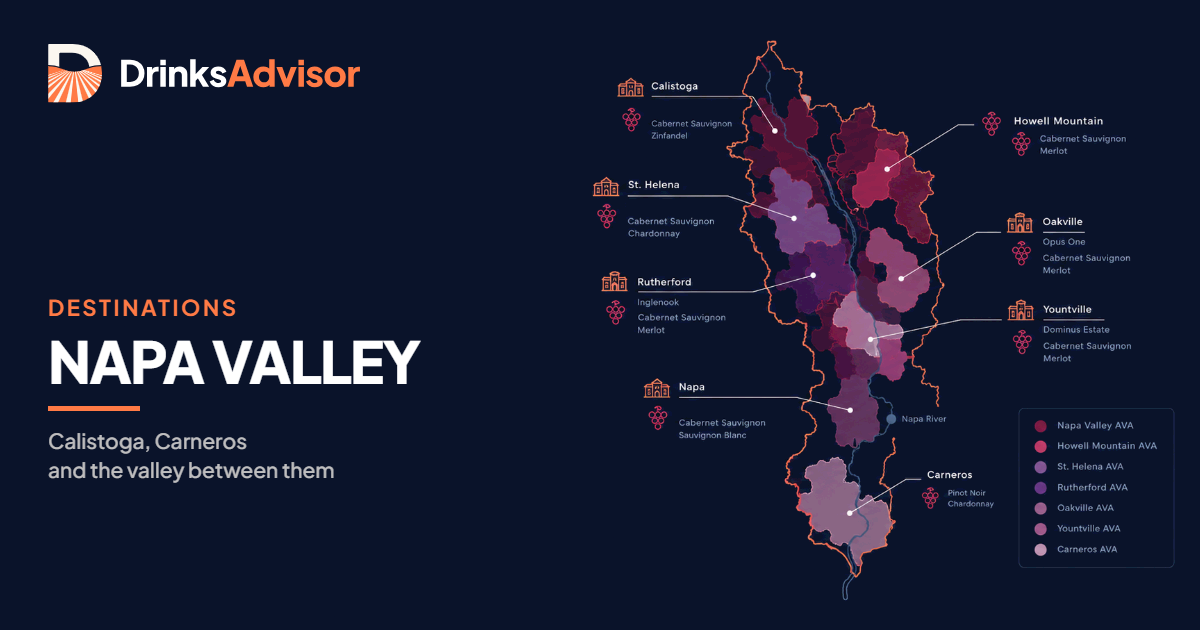
We are not ranking them. The order runs south to north, because in Napa that line is the trip: the valley narrows, the days get hotter, Pinot Noir gives way to Cabernet Sauvignon, and the drive back to San Francisco gets longer with every mile. Our full criteria are published in Our Editorial Methodology. If you are still deciding on the region itself, start with our Napa Valley travel guide, which explains how the valley’s four wine areas differ and what a tasting actually costs.
Carneros and the city of Napa
The cool end of the valley, open to the bay and its fog, and the first wine country you reach coming up from San Francisco. Carneros plants Pinot Noir and Chardonnay where the rest of Napa plants Cabernet, the properties are large because the land was ranch land, and the trade-off is distance: the famous Cabernet appellations are all still ahead of you.
1. Stanly Ranch, Auberge Collection — Carneros
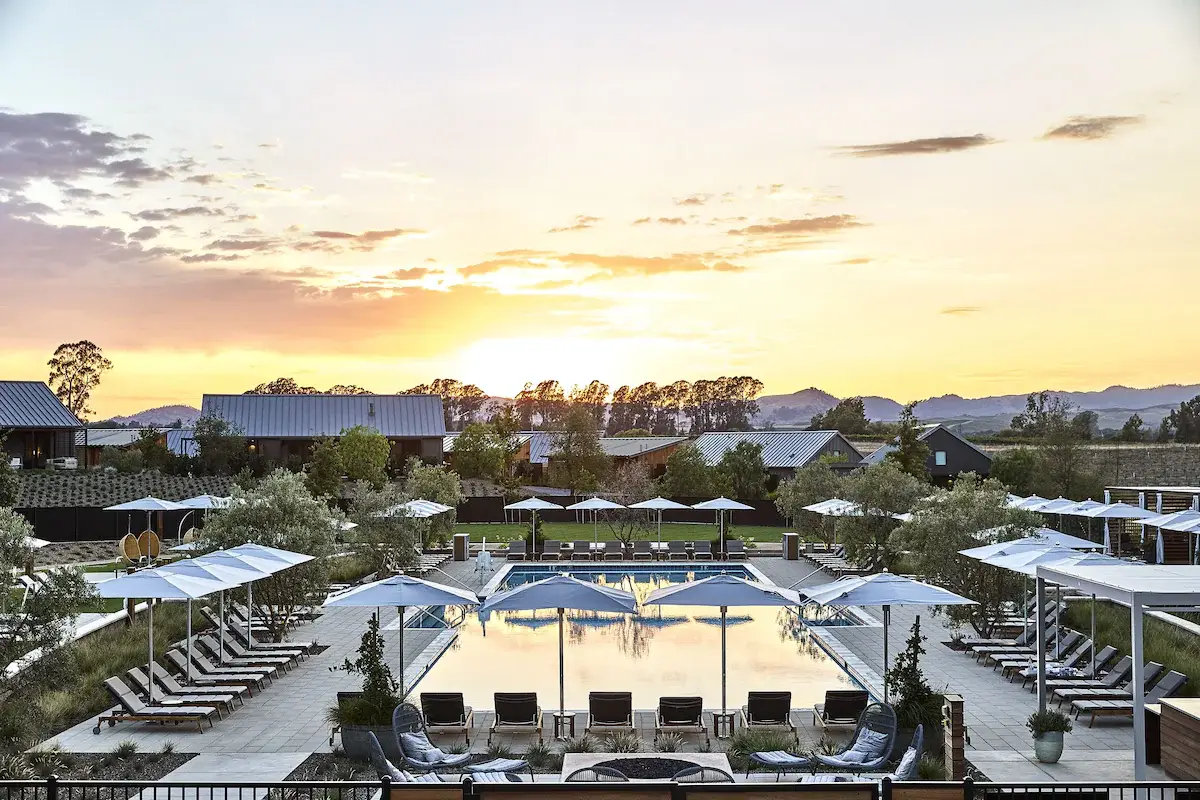
The newest property on this page and by a long way the largest. Stanly Ranch opened on April 29, 2022, on 712 acres of vineyard and ranch land in Carneros, with two and a half miles of Napa River frontage, and Auberge calls it a working ranch and winery rather than a hotel with a view of one.
The 135 cottages and guest rooms are low, pale and spread thin across the property, which is the point: what you are buying is sky. Halehouse, the wellness building, fills a day on its own, and the food is split three ways: Bear for dinner, Gavel for coffee, Basin Bar beside the pool. It is also the shortest drive from San Francisco of anything on this list, which makes it an easy first or last night.
What you’ll taste. Carneros: the cool-climate corner where Napa grows Pinot Noir and Chardonnay rather than Cabernet.
Good to know
Check Availability on Expedia →
2. Carneros Resort and Spa — Carneros
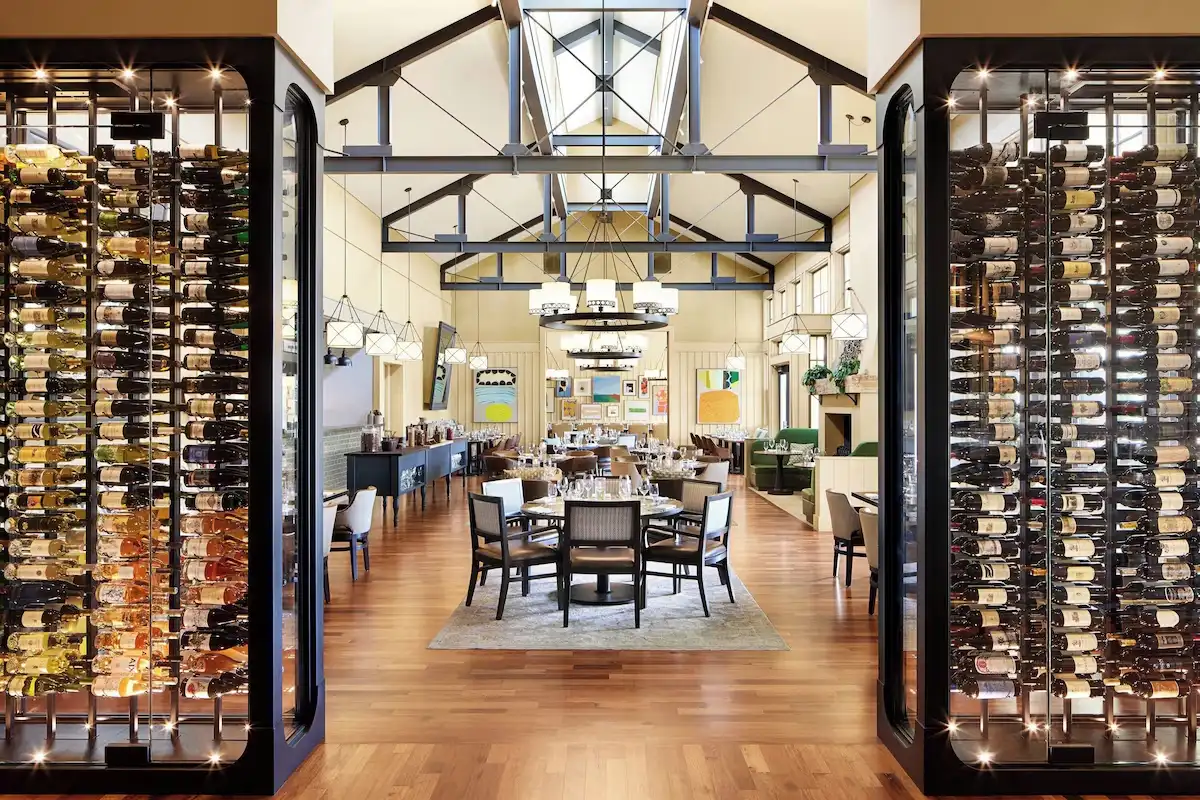
Twenty-eight acres surrounded by rolling vineyards, laid out as a small farm town rather than a hotel: 100 cottages, residences and homes on lanes around a square, with corrugated metal roofs and private gardens that read more like agriculture than luxury. It has aged well, and 388 guest reviews say so.
Three kitchens cover the day: FARM Restaurant + Bar in the evening, the all-day Boon Fly Café, and the guest-only Hilltop Dining Room. The detail that earns the property its place here is POST, the resort’s own tasting venue, which means a proper seated tasting is a walk across the square rather than a drive and an appointment. Of the two pools, the adults-only one looks straight over the vines.
What you’ll taste. Carneros, poured on the property at POST, with the rest of the appellation a short drive in either direction.
Good to know
Check Availability on Expedia →
3. The Meritage Resort and Spa — Napa
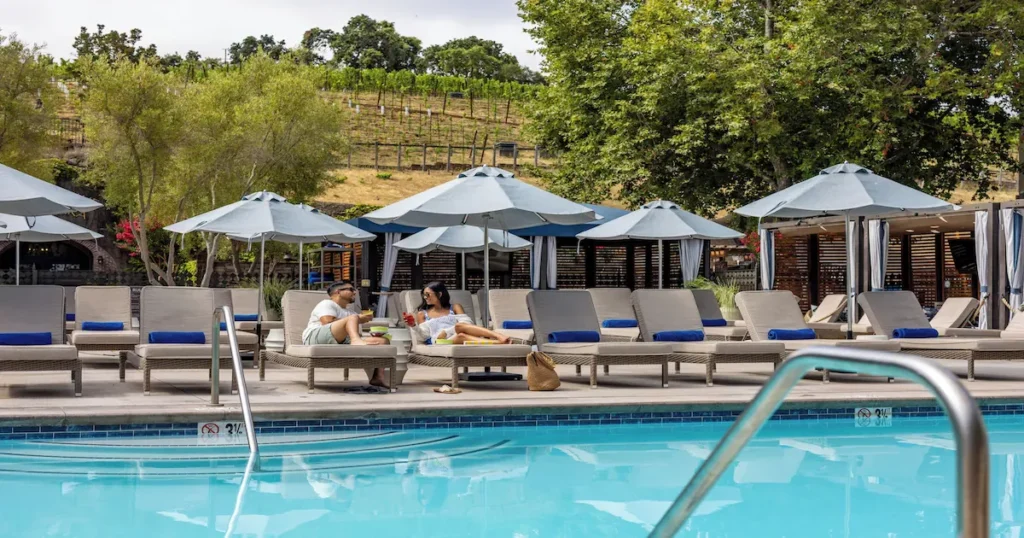
Be clear about what this is. The Meritage is a 36-acre resort on Bordeaux Way, at the southern entrance to the valley, and it does conferences and weddings at scale. It is not a vineyard estate and it does not pretend to be one. It is on this page for what sits underneath it: Spa Terra is built inside a wine cave, and the treatment rooms are in the rock.
Two tasting rooms operate on the property, Trinitas Cellars and Anarchist Wine Co., and a vineyard with a walking trail runs up the hillside behind the buildings. It is the least expensive of these Napa Valley wine resorts to come with wine of its own, and the guest score is the honest trade: 8.2 against 9.2 to 9.6 for everything else here. You are buying access and a wine cave, not seclusion.
What you’ll taste. Two portfolios poured on site, without leaving the property or booking an appointment elsewhere.
Good to know
Check Availability on Expedia →
Book it
Basing yourself at the south end of the valley?
Carneros and the city of Napa are the cheapest beds in the valley and the shortest drive from San Francisco. See the full list of Napa Valley properties and what is open for your dates.
Yountville and Rutherford
The middle of the valley is where Napa eats. Yountville is the one wine town here you can cross on foot in ten minutes, and it carries more celebrated kitchens per resident than anywhere else in California. Rutherford, immediately north, is Cabernet country proper: a bench of gravel soils that put the valley on the map.
4. The Estate Yountville — Yountville
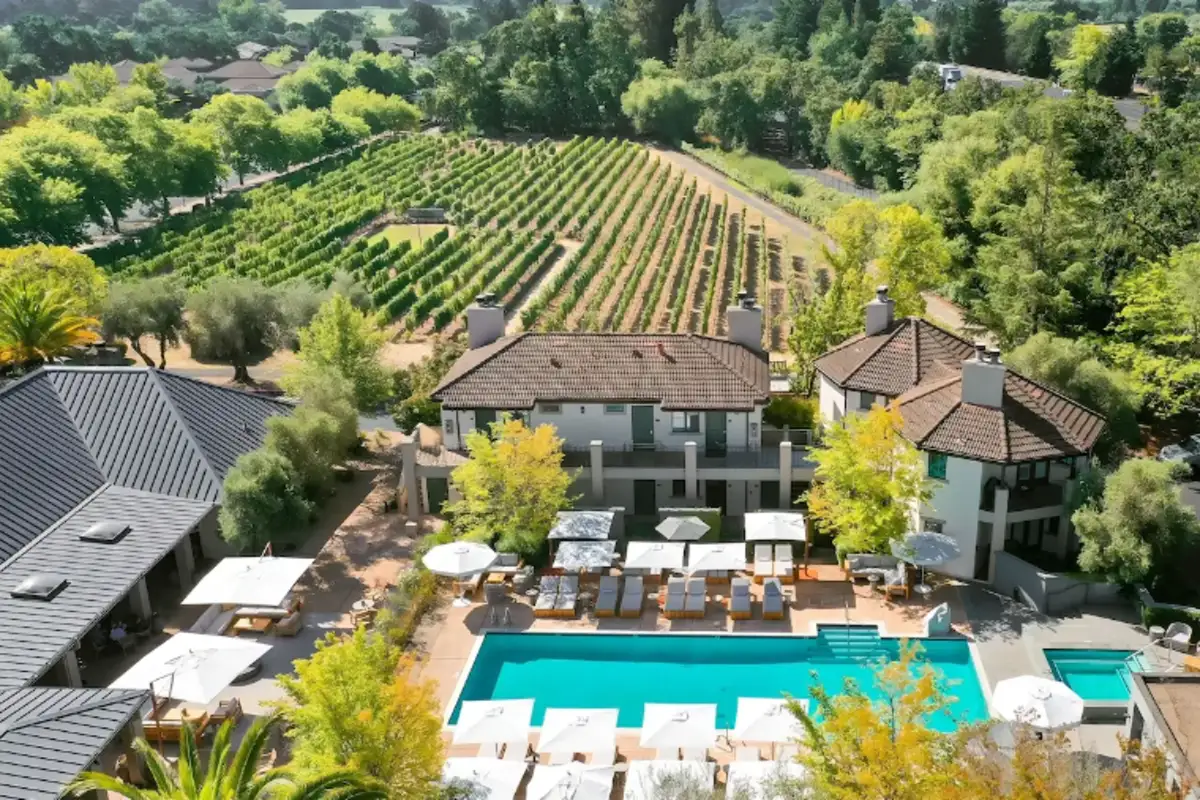
Twenty-two acres in the middle of a village sounds like a contradiction until you walk it. The Estate is two hotels sharing one set of grounds: the more formal Hotel Villagio and the lighter, airier Vintage House, plus a five-bedroom villa, with vineyards, gardens and three pools between them. The gate opens onto Washington Street, which means dinner in Yountville does not involve a car or a designated driver.
Wine here comes to the guest: the estate runs a weekly Sip & Savor reception and seasonal events on the lawns, and the concierge desk is the fastest route into tasting appointments that are otherwise booked out. For a first trip, or a group that will not agree on one itinerary, this is the most forgiving address on the page.
What you’ll taste. Whatever the village is pouring: the estate’s own receptions, then a short walk to the tasting rooms on Washington Street.
Good to know
Check Availability on Expedia →
5. Auberge du Soleil — Rutherford
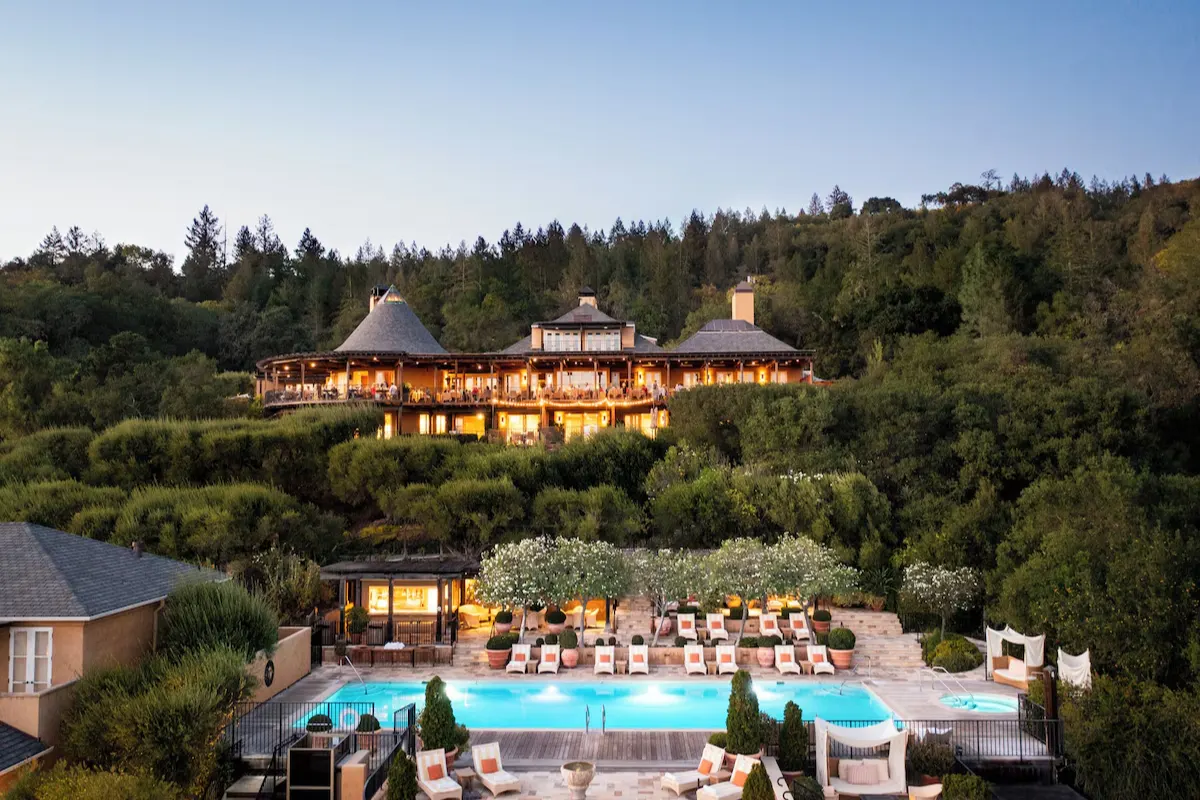
The one property here with no vines of its own, and the one nobody would leave off the list. Auberge du Soleil stands on 33 acres of heritage olive and oak on a terraced hillside above Rutherford, looking down the length of the valley rather than along a single row. The restaurant opened in 1981 and the inn followed five years later, which is the reverse of how these things are usually built and explains why the food still leads.
There are 50 rooms and suites, a full-service spa, a pool cut into the slope, and one Michelin star as of 2025. The template it invented is now everywhere in wine country, and it is still the version that works best: you are above the vineyards rather than in them, and on a hot August afternoon that elevation is worth more than a row of Cabernet outside the window. Be clear before booking that the vines belong to the neighbours.
What you’ll taste. Rutherford Cabernet Sauvignon, from a list built over four decades, with the growers a few minutes downhill.
Good to know
Check Availability on Expedia →
St. Helena and Calistoga
Up-valley the floor narrows to a couple of miles between two ranges, the afternoons get hot, and the Cabernet gets bigger to match. St. Helena is the valley’s working town, with a main street of shops and a highway that crawls at five o’clock. Calistoga, at the top, is a spa town first and a wine town second, on geothermal water and on the volcanic soils of its own appellation.
6. Alila Napa Valley — St. Helena
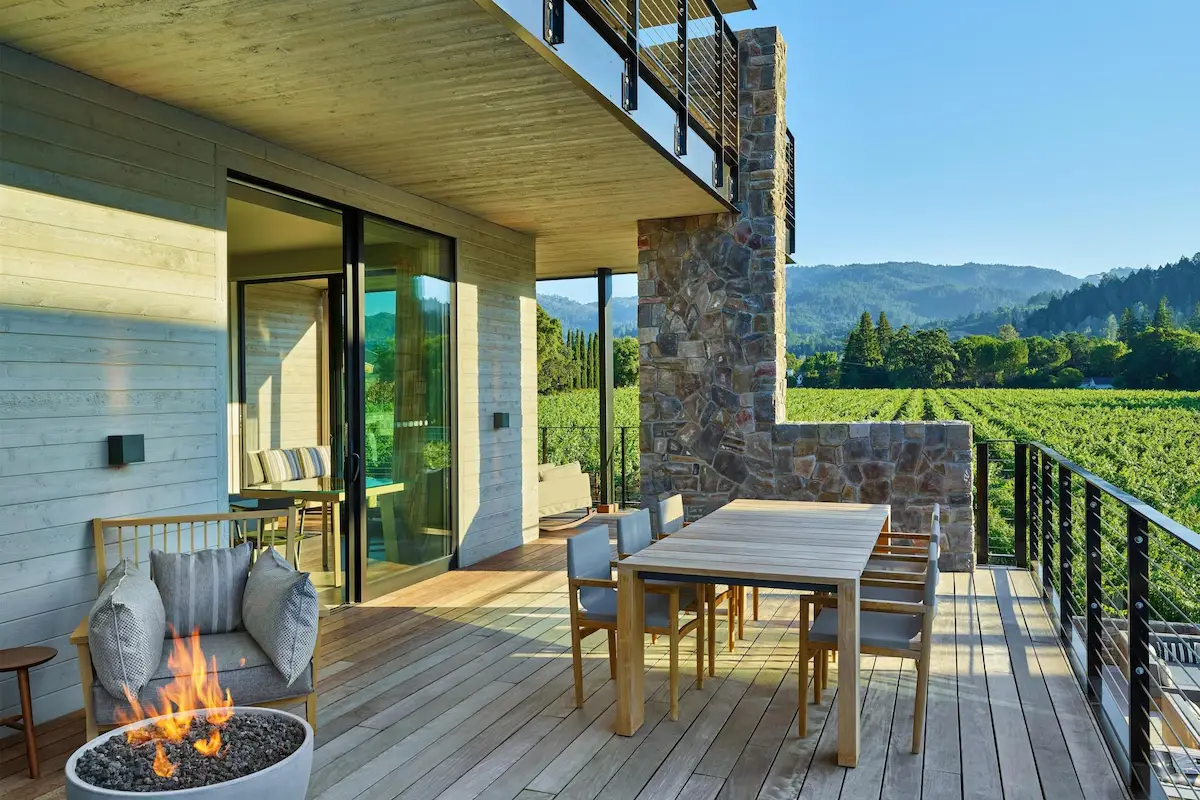
Adults only, 64 rooms and suites, and a vineyard that begins at the end of the terrace. Alila stands on Main Street at the southern edge of St. Helena, with one of the valley’s oldest continuously operating wineries, Beringer, immediately next door, and the architecture is deliberately quiet: low stone and glass, oversized balconies, outdoor fireplaces, nothing that competes with the rows.
The restaurant, Violetto, occupies a restored 1907 Georgian-style farmhouse on the property, by a century the oldest thing on the site, and Spa Alila handles the afternoon. The adults-only policy decides it either way: it is why couples book here and why families should look at The Estate Yountville instead.
What you’ll taste. St. Helena Cabernet Sauvignon, with Beringer and the rest of upper Main Street inside a short walk or a two-minute drive.
Good to know
Check Availability on Expedia →
7. Harvest Inn — St. Helena
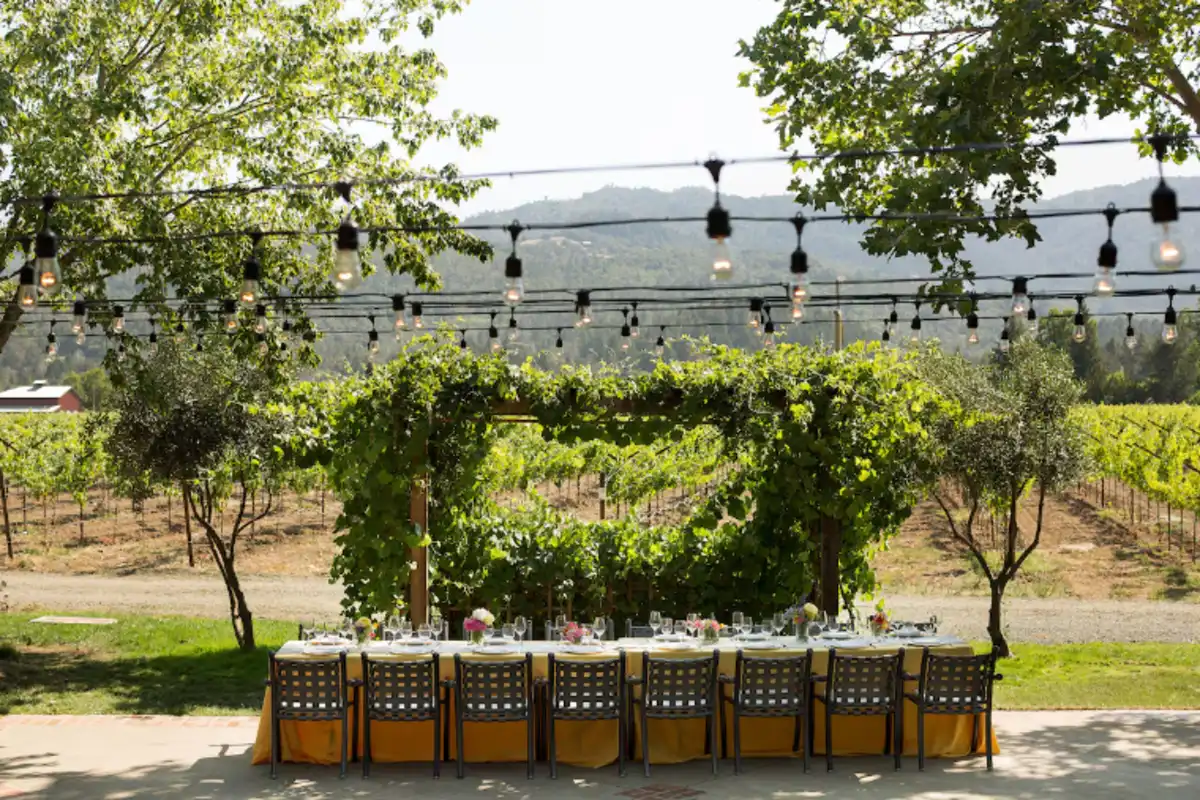
The cheapest bed on this page by a wide margin, and the one where the vineyard is closest to the pillow. Harvest Inn sits at One Main Street, on the lot that fronts Highway 29 at the southern end of St. Helena, and the 14-acre Leonardini Vineyard lies directly behind it.
Be precise about the relationship, because it is the point of the entry: the vineyard is not the inn’s. It belongs to the Leonardini family of Whitehall Lane Winery, who bought it in 1993 and replanted it to Cabernet Sauvignon in 2014 and 2016 on the gravelly sandy loam of the St. Helena appellation. What the inn gives you is the fence line. The grounds are old and shaded, with redwoods and fruit trees, two pools, two hot tubs and the Harvest Table restaurant; the building went up in 1979 and reads like a place that has had forty years to settle.
What you’ll taste. St. Helena Cabernet Sauvignon, starting with the vineyard you can see from the lawn and the winery that farms it.
Good to know
Check Availability on Expedia →
8. Four Seasons Resort and Residences Napa Valley — Calistoga
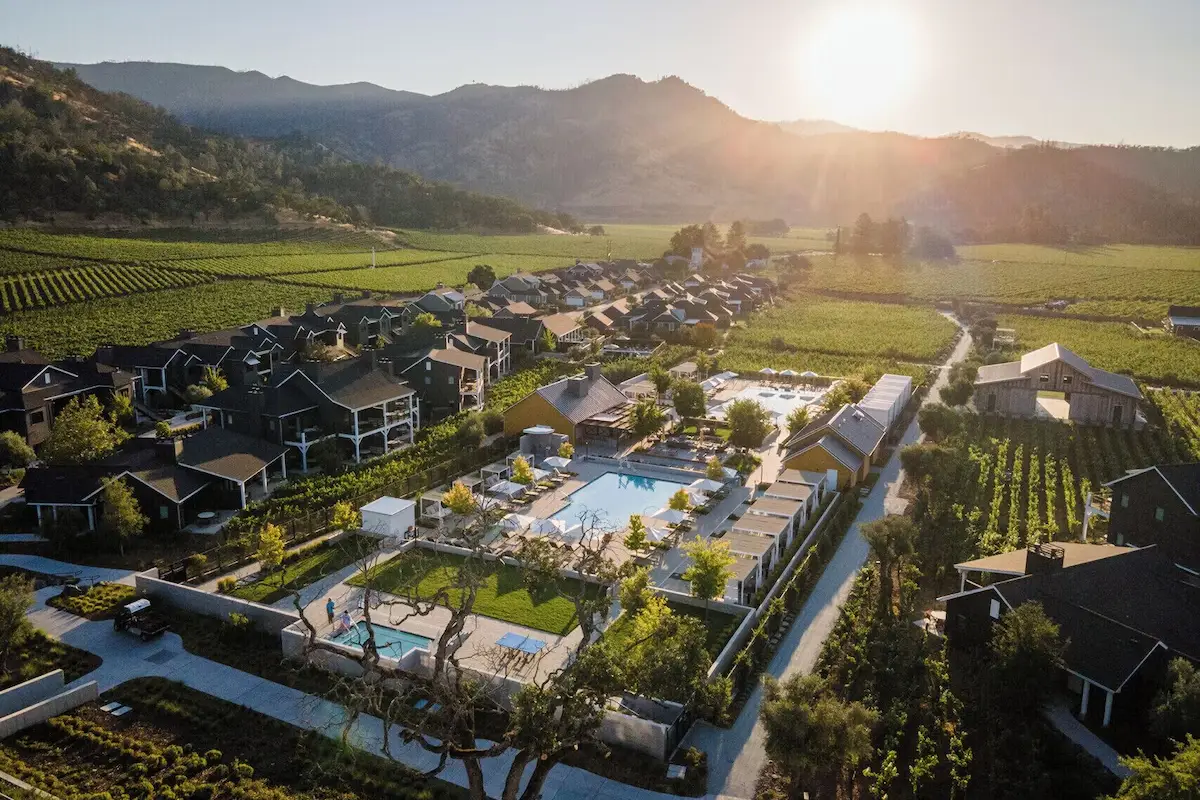
The only property on this page with a working winery of its own. Elusa Winery stands on the grounds at 400 Silverado Trail North, farming a 4.7-acre vineyard that has been replanted to Cabernet Sauvignon for the Calistoga appellation, with Thomas Rivers Brown making the wine alongside Jon Keyes. Guests get guided tastings; the Vineyard Rooms look onto the work from their terraces, which between late August and October means watching fruit come in over breakfast.
It is the most expensive room here and the one that needs the least driving to justify itself: the winery is a walk, the spa runs to eight treatment rooms with a steam room and sauna, and Calistoga’s main street is a couple of minutes away. Ninety-two reviews is a small sample next to Harvest Inn’s thousand, so read that 9.6 as early rather than settled.
What you’ll taste. Calistoga Cabernet Sauvignon, made on the property from the vineyard you are looking at.
Good to know
Check Availability on Expedia →
Book it
Staying up-valley, in St. Helena?
St. Helena has the smallest bed stock of the valley’s wine towns and sits within reach of both Rutherford and Calistoga. See what is still open there for your dates.
When to book
Book the room and the tastings in the same week. Napa runs on appointments in a way that surprises first-time visitors: most wineries take guests by reservation rather than walk-in, and the small ones publish few slots. Pick the town, book the room, then let the concierge open doors that are already full. That is the practical argument for these Napa Valley wine resorts over a rented cottage.
May and June are the best all-round window. The vines are in leaf, the valley is fully staffed, the afternoons are warm rather than punishing, and harvest has not taken over the cellars. April is beautiful and wetter; July and August are hot up-valley, which is when Carneros and its fog start to look clever.
Harvest runs from roughly late August into October, and Napa calls it crush. Visits still happen, but they are shorter, the cellars are working rather than performing, and rates are at their highest. If the point of the trip is to watch wine being made, come then; if it is to taste and swim, come in May.
Rates here move more than they do in Europe. Every price on this page is for the same two midweek nights, May 11 to 13, 2027, read on September 15, 2026. A weekend in October on the same properties will not look like this. Prices are indicative and set by our booking partners.
Getting there
All eight need a car. Napa Valley has no commuter rail: the Wine Train is an excursion with a kitchen attached, not transport between towns, and Highway 29 is the only practical way north, with the quieter Silverado Trail running parallel on the eastern side. Most visitors fly into San Francisco or Oakland and drive up. Book the car well ahead for September and October: compare rental rates in Napa on DiscoverCars →
Check Availability on DiscoverCars →
One planning note that matters more in Napa than in most wine regions, because the distances between appointments are longer than they look. California’s blood alcohol limit is 0.08 percent for drivers 21 and over, and lower for commercial drivers and anyone under 21. Tasting rooms expect spitting and will hand you the bucket without comment. Our Napa Valley travel guide covers the driving, the reservation culture and the four wine areas in more detail, and if you would rather compare a different kind of wine estate first, our Bordeaux château stays are the European equivalent of this page.
Choosing between these Napa Valley wine resorts
The decision is really about how much of the wine you want on your own side of the fence. Four Seasons Napa Valley is the only one that makes it where you sleep, and it charges accordingly. Carneros Resort and The Meritage put a tasting room on the property at very different prices and in very different settings. Stanly Ranch sells space, Alila sells quiet, The Estate Yountville sells a village you can walk, and Auberge du Soleil sells the view down the valley that everyone else is trying to buy a piece of.
If budget is the constraint, Harvest Inn is the outlier: under $500 for a bed with a working Cabernet vineyard behind it, in the town most people want to be in. Whichever you choose, book the room first and build the tastings around it. In Napa the appointments are harder to get than the bed, and the property you sleep at is the one that can make the calls.