Bordeaux wine travel starts with a decision most guides skip: which side of the river. The Left Bank and the Right Bank are forty minutes apart, grow different grapes, and sell themselves in completely different ways — one through a classification written in 1855, the other through a village of limestone caves that reshuffles its rankings every ten years. This guide covers how the areas differ, when to go, how to move between them, and what to expect once you are there.
ⓘ We may earn a commission when you book through links on this page — at no extra cost to you. Affiliate Disclosure
- Best time to go
- May and June, then September to mid-October
- Nearest airport
- Bordeaux–Mérignac (BOD); Tram A reaches the city center in about 35 minutes
- From Paris
- Direct TGV from Montparnasse to Bordeaux Saint-Jean in a little over two hours
- Getting around
- A car for the Médoc; the train works for Saint-Émilion
- Typical budget
- $$ to $$$$, from a village guesthouse to a classified château
- Signature grapes
- Cabernet Sauvignon on the Left Bank, Merlot on the Right; Sémillon and Sauvignon Blanc for whites
In this article
Understanding Bordeaux’s wine areas
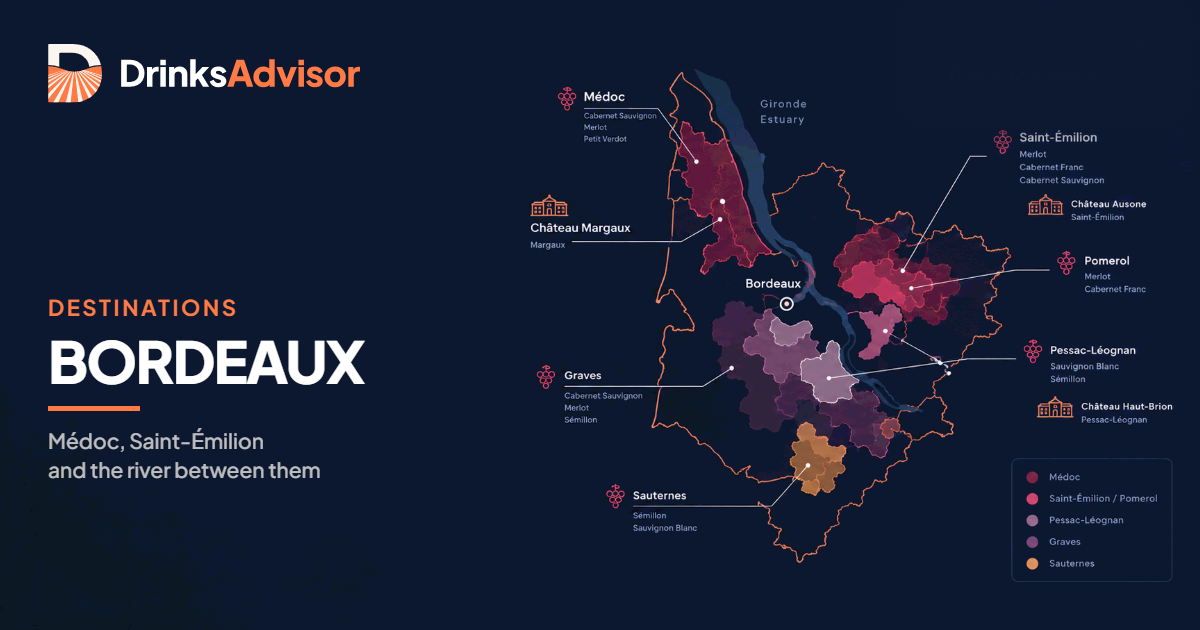
The region’s own trade body groups Bordeaux into six winegrowing families, and they map neatly onto how a trip actually works. Here is the version worth having in your head before you book anything.
The Médoc — the Left Bank, and the famous names
North of the city, on a narrow strip between the Gironde estuary and the Atlantic pine forest, the Médoc makes red wine and nothing else. Cabernet Sauvignon leads the blends here, and the gravel soils that suit it are the reason the appellations are strung along the river rather than spread evenly across the peninsula.
There are eight appellations: Médoc and Haut-Médoc, plus the six communal names (Saint-Estèphe, Pauillac, Saint-Julien, Margaux, Listrac-Médoc and Moulis). Pauillac alone holds three of the five first growths, which is why the D2 road through it is the most driven stretch of vineyard in France.
For a traveler, the Médoc is the least spontaneous part of Bordeaux. The estates are large, the gates are closed, and almost everything runs by appointment. It is also the part where a booked visit feels most like being let in somewhere.
Graves and Pessac-Léognan — reds and serious dry whites
South of the city, and in places inside its suburbs, Graves is the only part of Bordeaux classified for both red and white wine. Pessac-Léognan, carved out as its own appellation in 1987, holds all of the classified estates, including Château Haut-Brion, the one non-Médoc property in the 1855 list.
This is the easiest wine country to reach from central Bordeaux, and the best answer for anyone who wants a half day rather than a full one.
Sauternes and Barsac — the sweet wines, and the fog that makes them
Where the cold Ciron meets the warmer Garonne, autumn mornings produce fog and the afternoons burn it off. That cycle encourages Botrytis cinerea, the noble rot, which shrivels ripe Sémillon on the vine and concentrates what is left.
The consequence is the most labor-intensive harvest in France: pickers go through the same vineyard several times over several weeks, taking only the berries that are ready. The appellation covers around 1,200 hectares across five communes, and a tasting here is worth building a morning around even if you think you don’t like sweet wine. Ask to try one with something salty rather than with dessert.
Saint-Émilion — the Right Bank’s village
Across the Dordogne, everything changes scale. Merlot leads the blends, the estates are small enough to be family businesses, and the town itself is part of the attraction: a medieval village built on limestone, with a monolithic church carved down into the rock beneath the square.
In December 1999 the Jurisdiction of Saint-Émilion became the first vineyard landscape inscribed on the UNESCO World Heritage list, covering around 5,000 hectares across eight villages, not just the town.
Its classification is also the one that moves. Revised roughly every ten years, the 2022 edition lists 85 châteaux: two Premiers Grands Crus Classés A, twelve B, and 71 Grands Crus Classés.
Pomerol and Fronsac — no classification, no shortage of demand
Pomerol has no official classification at all, which has done nothing to slow its prices. It is small, almost entirely Merlot, and there is no visitor infrastructure to speak of: no village square of tasting rooms, few estates with the staff to receive drop-ins. Neighboring Fronsac is the value alternative, with more of the hills and fewer of the waiting lists.
The traveler’s takeaway: on the Right Bank, book further ahead and expect smaller rooms.
Entre-Deux-Mers and Blaye-Bourg — the quiet halves
Between the two rivers, Entre-Deux-Mers is the countryside part of the region, known for dry white wine and dotted with bastide towns and abbeys. North of the city, on the right bank of the estuary, Blaye and Bourg are hillier, older in wine terms than the Médoc, and noticeably cheaper.
Neither area carries a famous classification. Both are where you go once you have seen the famous ones, or when you would rather spend the week eating well than queueing.
Bordeaux’s classifications, decoded
More than anywhere else in wine, Bordeaux sells itself through rankings, and visitors are expected to know them. There are five official ones, and they behave very differently.
The 1855 Classification was drawn up for the Paris Universal Exhibition and ranks 61 red wine estates (60 in the Médoc plus Haut-Brion in Graves) in five tiers, alongside 27 sweet wine châteaux in Sauternes and Barsac. Its defining feature is that it does not change. There has been exactly one revision in 170 years: Mouton Rothschild’s promotion to first growth in 1973. The five firsts are Lafite Rothschild, Latour, Margaux, Haut-Brion and Mouton Rothschild.
The Graves classification covers the estates of what is now Pessac-Léognan. It was first published in the 1950s and, like 1855, was never designed to be reopened; mergers have brought it down to 14 properties, some classified for red, some for white, some for both.
The Saint-Émilion classification is the opposite: reviewed about every decade, with estates promoted and demoted, and enough argument each round to fill the wine press for a season.
The Crus Bourgeois du Médoc is the useful one for a trip. Three tiers, revised every five years: Cru Bourgeois, Cru Bourgeois Supérieur and Cru Bourgeois Exceptionnel. These are the Médoc estates that welcome visitors, sell wine you can afford to drink young, and are generally happier to see you than a first growth is.
The Cru Artisan classification recognizes small owner-operated Médoc properties, and is worth asking about if you want to meet the person who made the wine.
For the curious — what a “château” actually is here
Not necessarily a castle. In Bordeaux the word denotes a wine estate, and the building at the center of it may be a modest farmhouse or a nineteenth-century mansion built to look impressive on a label. Some celebrated names have no château at all.
Bordeaux wine travel, month by month
May and June are the best all-round window: the vines are in leaf, estates are fully staffed, the city’s terraces are open, and the harvest rush has not started.
July and August are hot, busy, and the months when French estates take their own holidays. Book everything, and put tastings in the morning.
September and October are harvest. Picking traditionally happens in September, though it can start in August and run into October, and the different grapes come in at different times, which is why one estate can be mid-harvest while its neighbor has finished. Visits still happen, but they are shorter, and cellars are working spaces rather than showrooms. Book earlier than feels necessary.
April brings en primeur, the week when the region shows the previous year’s vintage from barrel. It is a trade event, not a public one: the tastings are for merchants, critics and importers. What it means for a visitor is a city that is full, expensive and distracted. Plan around it rather than for it.
November to March is the off-season. Rates fall and the light on the estuary is beautiful, but a significant share of estates close to visitors and the ones that stay open run reduced hours. Everything needs confirming directly in this window.
One date worth knowing: Bordeaux Fête le Vin, the riverfront wine festival, runs every other year and returns in 2027.
How to get around
Fly into Bordeaux–Mérignac, or take the train. The airport’s Tram A branch reaches the city center in around 35 minutes, and direct TGV services from Paris Montparnasse arrive at Bordeaux Saint-Jean in a little over two hours. For many US travelers, flying into Paris and taking the train is simpler than connecting.
You need a car for the Médoc. The communal appellations are strung along one road with no useful rail service, and the estates sit back from it. If you would rather not drive, this is the part of Bordeaux where a guided day trip earns its price.
Saint-Émilion is the exception. It sits on the regional TER line from Bordeaux Saint-Jean toward Sarlat, and the station is about 1.5 km from the village — a twenty-minute walk, most of it uphill on the way back. Vehicles over 2 meters wide or 6 tonnes cannot drive through the town, and parking is organized in lots around the edge.
Drinking and driving. France’s limit is 0.5 grams per liter of blood, and 0.2 for novice drivers still inside their probationary period, as well as for professional drivers. That lower figure is effectively one glass, which is not a margin worth testing. Tasting rooms expect spitting and provide the bucket; nobody is offended.
Two local habits to plan for. Rural estates close for lunch, comprehensively, from roughly 12:30 to 2. And the D2 through the Médoc is a slow road with a lot of tractors on it in September, so allow more time than the map suggests.
Compare rental rates on DiscoverCars →
Where to stay
Four broad shapes of trip, and the choice matters more here than in most regions because the distances are real.
- Château hotels on the estates: the classic version, mostly in the Médoc, Saint-Émilion and Graves. Rooms in a working wine property, usually with the cellar tour attached.
- The city of Bordeaux itself: an eighteenth-century center inscribed by UNESCO in 2007 as Bordeaux, Port of the Moon, with the restaurants and the wine bars, and day trips out in every direction.
- Saint-Émilion village: small hotels and guesthouses inside a UNESCO-listed medieval town. Walkable, and busy in the middle of the day.
- Spa and vinothérapie resorts: the wine-country wellness end of the market, mostly south of the city.
Where to base yourself. If this is a first visit and you want the city as well as the wine, stay in Bordeaux and go out on day trips: nothing is more than about an hour away. If you came for the estates, split the week — a few nights on one bank, a few on the other — and avoid crossing the river twice a day.
For specific properties you can book, with what each one costs and who it suits, see our round-up of château stays in Bordeaux.
Check Château Stays in Bordeaux →
What to do
Château visits are by appointment, nearly everywhere. This is the biggest single difference from Napa, and the one that catches Americans out: there is no strip of open tasting rooms to drive between. Two to three weeks ahead is comfortable in season, more at harvest, and more again for the classified estates, some of which receive only a handful of visitors a day.
La Cité du Vin is the exception that needs no planning — a wine museum on the river served by Tram B, open daily, with adult tickets from around €23 and a glass of wine at the top-floor Belvedere included. It is a good half day, and the wine list on the eighth floor is deliberately global rather than local. Hours and prices are on the museum’s own information page.
Underground Saint-Émilion. The monolithic church, the catacombs and the hermitage are visited on a guided tour run by the local tourist office; the estates’ own limestone cellars are the other half of the same story.
Blending workshops are the region’s signature experience: you are handed the component varieties and asked to build a Bordeaux blend, which teaches more about why Cabernet and Merlot are grown side by side than any tasting note will.
Eating. Bordeaux is a serious food city — the entrecôte à la bordelaise, the oysters from Arcachon down the coast, the canelés you will eat too many of. Lunch runs roughly 12:30 to 2 and dinner starts at 8; between those hours, rural kitchens are shut.
Organic and biodynamic wine in Bordeaux
Bordeaux has a reputation as the conservative end of French wine, and on farming that reputation is out of date. According to the region’s trade body, more than 75% of the Bordeaux vineyard was covered by an environmental certification in 2024, against 35% in 2014, with a stated goal of 100% by 2030.
That figure covers several different things, which is exactly why the vocabulary is worth getting straight:
- HVE (Haute Valeur Environnementale) is a French state certification covering farm practice as a whole. It is not organic.
- Certified organic is a legal certification, shown as the EU leaf or, in the US, the USDA Organic seal.
- Biodynamic is certified privately, principally by Demeter and Biodyvin.
- “Natural” has no legal definition anywhere. The nearest thing to a standard is the French voluntary label Vin Méthode Nature.
We apply these labels only where there is a certification or the producer’s own published statement, and we say which. The full criteria are in Our Editorial Methodology.
Practical tips for US travelers
Tasting fees are normal, and at the classified estates they can be substantial: you are paying for a private visit, not a pour at a bar. Ask what is included when you book, and whether the fee is credited against a purchase.
Book in writing. Most estates that receive visitors have a booking form; the ones that do not answer email within a couple of days are usually the ones to telephone.
“Château” does not mean expensive. A Cru Bourgeois or a Fronsac visit is often the better afternoon: smaller groups, more time, and frequently the person who actually made the wine.
Bring a card, and a little cash. Cards work nearly everywhere, but a small estate at the end of a farm road is exactly where the terminal fails.
Tipping is not expected the way it is at home. Rounding up, or a few euros after a long and generous visit, is plenty.
Taking wine home takes planning. US Customs and Border Protection sets a personal duty-free allowance, additional bottles can be brought in subject to duty, and your home state adds its own rules on top, stricter than federal law in some states. Check CBP’s guidance before you commit to a case, and ask the estate whether it ships to your state.
Where to start
The mistake in Bordeaux wine travel is treating the region as one destination and trying to cover both banks in three days. It is a week’s worth of country, and the drives are longer than the map implies.
Pick the wine you actually want to drink. If it is Cabernet Sauvignon and the famous names, base yourself toward the Médoc and accept that you will be booking weeks ahead. If it is Merlot, smaller estates and a village you can walk around at night, go to Saint-Émilion and treat the city as your arrival day. If you want both, give each bank its own half of the trip.
The next decision is where you sleep, and in Bordeaux it usually decides which cellars you get into: many estates receive their own guests first. Our round-up of château stays in Bordeaux covers the properties you can book, with what each one costs and when to go. Planning Italy on the same trip? Start with our guide to Tuscany wine country.
Check Château Stays in Bordeaux →