Etna wine country wraps around the slopes of Europe’s most active volcano, and which side of the mountain you pick decides almost everything about your trip. The north is red-wine territory and the center of the revival that put Etna on American wine lists. The east faces the sea and makes the whites. The south sits a short drive from Catania. This guide covers how the slopes differ, what the contrade are, when to go and where to stay among the vines.
ⓘ We may earn a commission when you book through links on this page — at no extra cost to you. Affiliate Disclosure
- Best time to go
- May to June, and September to October for the harvest
- Nearest airport
- Catania (CTA), at the foot of the volcano’s south side
- Getting around
- Rental car or private driver. The Circumetnea railway reaches the towns, not the estates
- Typical budget
- $$ to $$$$, from a farm stay in the vines to a five-star base in Taormina
- Signature grapes
- Nerello Mascalese and Nerello Cappuccio for reds; Carricante for whites
In this article
Understanding Etna’s wine slopes
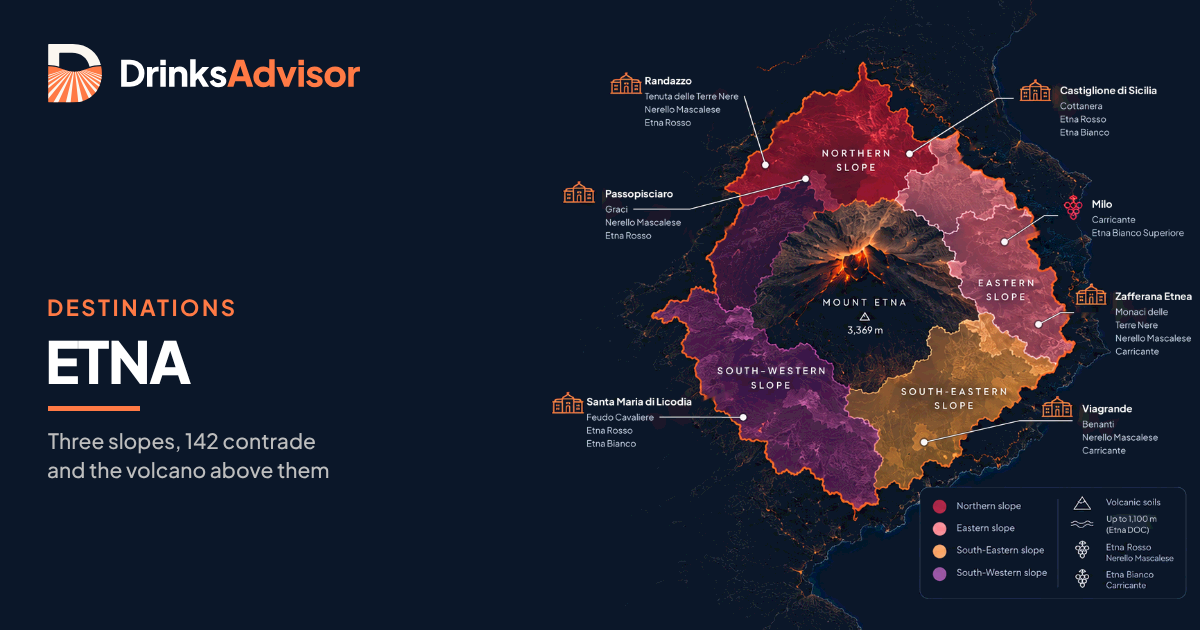
Etna was the first wine appellation in Sicily: the Etna DOC dates from 1968. Its vineyards form an incomplete ring around the volcano, mostly between about 450 and 1,100 meters (roughly 1,500 to 3,600 feet), on terraces of black lava sand held up by dry-stone walls. The western flank, toward Bronte, is pistachio country rather than vineyard. What’s left is three slopes worth knowing, plus a small southwestern fringe.
The slopes are not marketing labels. They differ in rainfall, exposure and the age of the lava under the vines, and you can taste it. They also differ as places to stay: an hour of mountain road can separate two estates that look close on the map, so it pays to pick a side before you book.
The north slope — Castiglione di Sicilia, Passopisciaro, Randazzo
This is where most of the names you’ve read about make their wine. The vineyards run along the valley of the Alcantara river, through Linguaglossa, Castiglione di Sicilia and the hamlets of Solicchiata and Passopisciaro, up to the medieval town of Randazzo. Castiglione di Sicilia alone holds 41 of the appellation’s official contrade, Randazzo another 25.
The north is drier and more sheltered than the east, and it is Nerello Mascalese country: reds that are pale in the glass, with high acidity, firm tannins and a smoky, mineral edge that people compare to Burgundy and Barolo in the same breath. For a first visit focused on red wine, this is the side to sleep on.
The east slope — Milo, Zafferana and the white wine
The eastern flank looks straight down at the Ionian Sea and catches the moisture coming off it. It is the wettest side of the mountain, and the home of Carricante, the white grape that gives Etna Bianco its salty, citrus tension. The village of Milo has its own rule: Etna Bianco Superiore can only be made from grapes grown within its boundaries, with at least 80% Carricante.
Milo is also home to Barone di Villagrande, one of the oldest family estates on the mountain, which receives visitors for tours and tastings and has rooms of its own. Zafferana Etnea and Santa Venerina, further down the slope, round out the east side.
The south slope — Viagrande and Trecastagni
The southern vineyards sit above Catania, among the villages of Viagrande and Trecastagni, and they are the easiest to reach from the airport. Viagrande is the home of Benanti, the family estate that did more than anyone in the 1990s to show that Etna could make wines for the world’s best tables. Both reds and whites grow here, often on the slopes of extinct side cones.
Further west, Santa Maria di Licodia and Biancavilla form the southwestern fringe of the appellation. It is a small and quiet area with very few places to stay, so treat it as a day trip rather than a base.
For the curious — what a contrada is
A contrada is a named vineyard district, the traditional local name for a stretch of hillside, and on Etna it often follows the edges of a single lava flow. Since 2011 the appellation rules let producers print the contrada on the label, much like a cru in Burgundy. The list started at 133 and grew to 142 with the official map published in 2022. When you see a contrada name on a bottle, you are reading the address of the vineyard.
When to visit Etna wine country
The best months to visit Etna wine country are May and June, and then September and October. Spring brings green vines, wildflowers on the lava fields and snow still on the summit. It is also when many producers pour their newest single-contrada wines at Le Contrade dell’Etna, a tasting held on the north slope that has become the mountain’s main wine event. Dates change every year, so check them before you plan around it.
The harvest on Etna is one of the latest in Italy. At altitude, Nerello Mascalese is often picked well into October, which means the mountain is still busy with tractors and crates when most of the country has finished. Mornings are cool and the light is clear, and it is the most rewarding time to visit if you don’t mind wineries that are busier than usual.
July and August are hot down on the coast, though the vineyards stay several degrees cooler. Mid-August is also Ferragosto, the national holiday, when many small estates close for a week or two. Winter is quiet and often wet, with snow at the higher elevations: fine for a food-and-wine trip based in Taormina, less so for a week of cellar visits.
How to get around
Catania’s Fontanarossa airport (CTA) is the gateway, with connections across Europe; from the US you’ll usually change in Rome, Milan or another European hub. From the airport the south slope is close by, and the wineries of the north slope are roughly an hour and a half away by car, depending on traffic around Catania.
A car is the practical choice. The estates sit along narrow mountain roads that link the villages around the volcano, and few of them can be reached any other way. The old Circumetnea railway does run around the mountain from Catania through Randazzo and Linguaglossa, and it’s a lovely ride, but it stops in town centers, not at cellar doors.
Two things to know before you drive. Italy requires an International Driving Permit alongside a US license, and the blood-alcohol limit is 0.5 g/l, lower than in most US states. If the plan is three tastings a day, book a driver for those days. Our guide to renting a car for a wine trip in Europe covers insurance, pickup and the drinking rules in more detail.
Compare rental rates on DiscoverCars →
Where to stay
The first decision is whether to sleep on the mountain or below it. On the mountain, you wake up in the vines and the wineries are minutes away. Below it, in Taormina, you get the sea, the restaurants and some of the grandest hotels in southern Italy, with the north slope about an hour’s drive inland.
For a trip through Etna wine country, the slope matters more than the town:
- North slope (Castiglione di Sicilia, Linguaglossa, Randazzo): the right base for red-wine lovers, with wine estates that have rooms, such as Tenuta di Fessina and Cavanera Etnea, and boutique hotels in the villages.
- East slope (Milo, Zafferana Etnea, Santa Venerina): quieter, greener and closer to the sea, and home to some of the most exclusive vineyard stays on the mountain, including Monaci delle Terre Nere near Zafferana.
- South slope (Viagrande, Trecastagni): the most convenient for the airport, with country houses and villas rather than wine resorts.
- Taormina: the luxury option, from cliffside palace hotels to small boutique addresses, for travelers who want the coast as much as the cellars.
On sample dates in May 2027, the rooms we checked ranged from about $100 a night for a farm stay among the vines to more than $1,200 at the top of the market. Prices are indicative and set by our booking partners. Our round-up of Etna wine resorts compares the estates where you can sleep among the volcano’s vines.
What to do
Cellar visits are the heart of any trip, and on Etna they nearly always need a reservation. Many estates are family operations without a tasting room open to walk-ins; you book a time, someone from the family or the team walks you through the vineyard and the cellar, and the tasting follows. Two or three visits a day is plenty, especially on mountain roads.
Look out for palmenti, the old stone wineries where grapes were once crushed by foot and the juice ran by gravity into fermenting tanks below. Hundreds of them survive across the mountain, some restored by estates as tasting rooms. Several producers also work bush vines, trained in the old alberello style on a single chestnut stake, and some vineyards still hold vines on their own roots: phylloxera, the louse that devastated Europe’s vineyards, struggles in loose volcanic sand.
Leave half a day for the volcano itself. The south side road climbs to Rifugio Sapienza, where a cable car carries visitors further up, and licensed guides lead walks toward the summit craters when activity allows. Mount Etna has been a UNESCO World Heritage Site since 2013. Access to the upper slopes changes with the eruptions, so check conditions on the day.
Bookable tastings and tours will appear in our Experiences section as we cover the mountain.
Natural and biodynamic wine on Etna
Etna has an outsized place in the natural wine world. Frank Cornelissen, a Belgian who settled near Passopisciaro in the early 2000s, became one of its best-known names, making wines with minimal intervention and no added sulfites in many cuvées. Around him, a generation of small growers took up old vineyards on the north slope and farmed them by hand.
Organic farming is common here, helped by dry summers and steady breezes that keep disease pressure lower than in much of Italy. Certification is another matter: some estates are certified organic or biodynamic, many others farm along the same lines without the paperwork. If it matters to you, ask the producer, or look for the certifier’s logo on the back label.
If the labels are confusing, our explainer on organic vs biodynamic vs natural wine sets out what each term guarantees, and what it doesn’t.
Practical tips for US travelers
- Book every visit ahead. Email or book online a week or two in advance, more around the harvest and the spring tastings.
- Plan for the clock. Many estates close for lunch, and Sunday visits are the exception rather than the rule. Dinner in Sicily rarely starts before 8 p.m.
- Pack a layer. At 800 meters it can be ten degrees cooler than on the beach in Taormina, and the wind on the upper slopes is serious.
- Bring your appetite. Tastings often come with local cheese, olives and bread, and lunch at a winery is one of the best meals you’ll have on the island.
- Think about the bottles home. Etna wines from small producers are hard to find in the US. Ask the estate whether it ships, or pack a wine suitcase.
Where to start in Etna wine country
For a first trip of four or five nights, sleep on the north slope and spend your days between Castiglione di Sicilia, Passopisciaro and Randazzo, with one day crossing to Milo for the whites and another on the volcano itself. If you’d rather split the week, finish with two nights by the sea in Taormina.
Etna rewards people who slow down. The distances are short and the roads are not, the wineries are small and personal, and the best glass of the trip is often the one poured in a palmento by the person who made it. Choose the slope first, then the bed.