The Douro Valley is where Port comes from, and the most dramatic wine landscape in Europe: a river cut deep into schist, with vineyards stacked on hand-built terraces from Porto’s hinterland to the Spanish border. It was demarcated in 1756, and today it makes as much dry red and white wine as Port. This guide covers the three subregions, when to go, how to get there by train, car or boat, and where to base yourself.
ⓘ We may earn a commission when you book through links on this page — at no extra cost to you. Affiliate Disclosure
- Best time to go
- May to June for green terraces and mild days; September to early October for the harvest
- Nearest airport
- Porto (OPO), about an hour and a quarter by car from Peso da Régua
- Getting around
- Rental car or private driver between the quintas; the Douro railway line for the river towns
- Typical budget
- $$ to $$$$, from a family quinta with a few rooms to a five-star spa above the river
- Signature grapes
- Touriga Nacional, Touriga Franca and Tinta Roriz for reds; Rabigato, Viosinho and Gouveio for whites
In this article
Understanding the Douro Valley’s three subregions
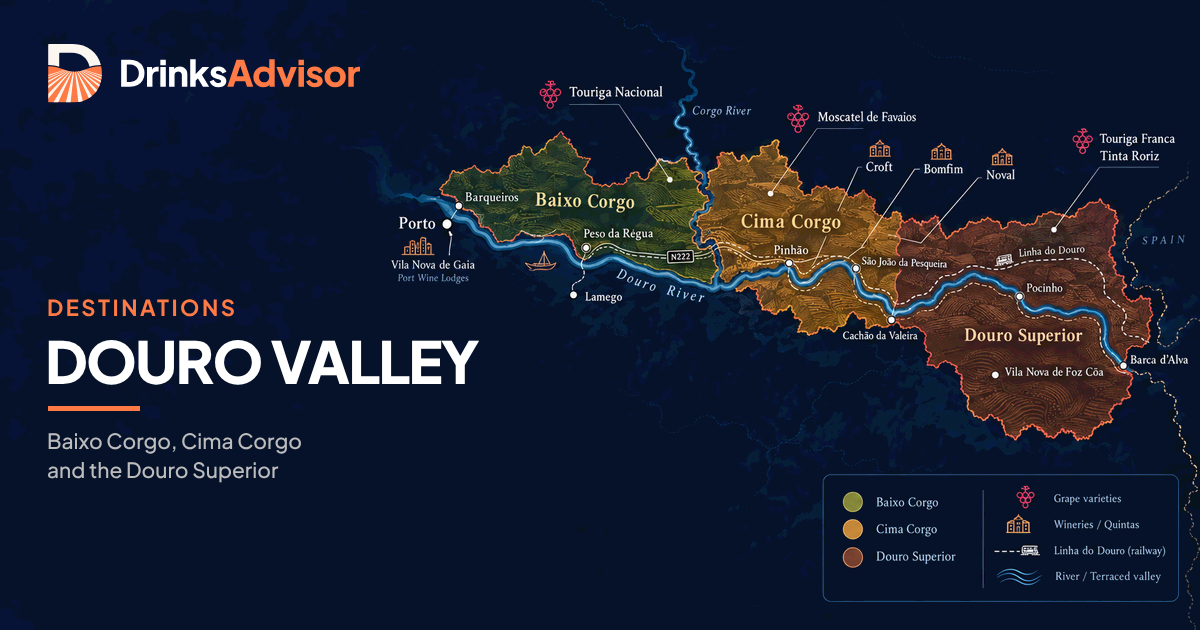
The Douro was the first wine region in the world to get legal boundaries, drawn by royal charter in 1756 to protect Port from fraud. In 2001 UNESCO inscribed the Alto Douro Wine Region as a World Heritage site, for the terraces as much as for the wine. Inside the demarcated area the valley splits into three subregions, running west to east, and each one feels like a different trip.
The rule of thumb: the further east you go, the hotter, drier and emptier it gets. The west is closest to Porto and easiest to reach; the middle has the famous names; the east has the space and the wildest scenery. Most visitors stay in the first two, and that is where the quintas with tasting rooms and hotels are concentrated.
Baixo Corgo — Régua, Lamego and the gateway from Porto
The Baixo Corgo is the western end of the valley, around Peso da Régua and, on the south bank, Lamego. It gets the most rain and the mildest summers, and has about 14,000 hectares of vines. Its wines have a reputation for being lighter, but the estates here have the shortest drive from Porto, and several of the best-known wine hotels sit on these slopes.
Régua is the practical hub: train station, river pier and the Museu do Douro, a good first stop to understand how the terraces were built. Lamego, twenty minutes south, adds a baroque sanctuary and a quieter base among the vines.
Cima Corgo — Pinhão and the classic quintas
East of the Corgo river, the Cima Corgo is the heart of the Douro and its largest subregion, with roughly 19,000 hectares. This is the postcard: steep schist terraces, white quinta houses with the shipper’s name painted on the wall, and the small town of Pinhão at the meeting of the Douro and Pinhão rivers. Many of the most famous Port estates are within a few miles of its station.
If you only have two or three days, base yourself here. Croft’s Quinta da Roêda and Symington’s Quinta do Bomfim receive visitors next to town, and the road up to the Casal de Loivos viewpoint gives the view of the river bend that ends up on half the region’s brochures.
Douro Superior — toward the Spanish border
The Douro Superior runs from the Cachão da Valeira gorge to the border with Spain. It is the hottest and driest of the three, the most recently planted and still expanding, with about 8,700 hectares. Villages are far apart and the river widens into a quieter, almost desert landscape of almond trees, olives and rock.
Some of Portugal’s most sought-after red wines come from estates out here, but few of them run regular tours. Come for the scenery, for the Côa Valley rock art near Vila Nova de Foz Côa, and for the last stretch of the railway to Pocinho, which is the most spectacular part of the line.
For the curious — Port and Douro DOC
The same vineyards make two kinds of wine. Port is fortified: grape spirit is added during fermentation, which stops it and keeps the wine sweet and strong. Douro DOC is the dry, unfortified red and white wine from the same valley, and today the region makes about as much of it as it does Port. For two centuries Port was shipped downriver to age in the lodges of Vila Nova de Gaia, across the river from Porto; since Portugal joined the European Community in 1986, estates in the valley can age and export their own wine. That is why so many quintas now pour both at the tasting table.
When to visit the Douro Valley
The best months to visit the Douro Valley are May and June, and then September to early October. In late spring the terraces are green, the days are warm rather than hot, and the river boats are running without the summer crowds. In autumn the harvest takes over: the vines turn yellow and red, and the estates are at their busiest and most interesting.
The harvest runs between September and October. Several quintas open harvest days to visitors, with grape picking in the morning, a long lunch and, at estates that still use them, foot treading in the granite lagares in the evening. These days are run by each estate on its own calendar, so book directly and early. Quinta do Infantado near Pinhão, for example, publishes open harvest days on its website.
July and August are very hot, especially in the Cima Corgo and the Douro Superior, where the valley traps the heat. Plan tastings for the morning and keep the afternoon for the pool or the river. Winter is cold, quiet and often misty; some restaurants and tasting rooms reduce their hours, but the light on the bare terraces can be beautiful.
How to get around
By train. The Douro line from Porto São Bento follows the river for most of its length, through Régua and Pinhão to the end of the line at Pocinho, about three and a half hours from Porto. There are five or six trains a day, tickets cannot sell out and seats are not reserved, so you can buy on the day. Check times on the CP website before you go: from November 3, 2026 to March 24, 2027 buses replace trains between Marco de Canaveses and Régua. Sit on the right heading east for the river.
By boat. Day cruises leave from Porto, Régua and Pinhão, from an hour on a traditional rabelo to a full day upriver with a train back. Multi-day river cruises between Porto and the Spanish border are a different product, and they stop at a handful of quintas on a fixed schedule.
By car. Régua is about an hour and a quarter from Porto on the A4 motorway, and a car is the only way to visit three or four quintas in a day on your own schedule. From Régua the N222 follows the south bank to Pinhão: 27 km and 93 bends, named the best driving road in the world in a 2015 study by Avis. Allow more time than the map suggests, and remember that every tasting adds up.
Our guide to renting a car for a wine trip in Europe covers insurance, tolls and drink-driving limits. If two of you want to taste freely, a private driver for the day is worth the cost.
Compare rental rates on DiscoverCars →
Where to stay
The Douro’s best stays are quintas: working wine estates with rooms, a pool facing the river and dinner with the house wines. Choose the area first, because crossing the valley takes longer than the distances suggest.
- Régua and Lamego: the easiest choice for a first trip, with the most hotels and the shortest drive from Porto. Good for a short break or for travelers arriving by train.
- Pinhão and the Cima Corgo: the classic base, surrounded by the famous estates, with a station, river boats and tasting rooms within walking distance or a short drive.
- Douro Superior: for a slower, quieter stay, with long drives between visits and very few hotels.
Two or three nights in one place is better than moving every day. At the top end, Six Senses Douro Valley sits above the river on the south bank near Lamego; around Régua, estates such as Quinta do Vallado have built small wine hotels next to their cellars. Rooms at the best quintas sell out early for the harvest weeks, so September dates are worth booking months ahead.
What to do
Most Douro visits are built around a tasting at a quinta, usually by appointment and often paired with lunch. Beyond the cellar door, the valley rewards slow days.
- Taste Port and Douro DOC side by side at the estates around Pinhão and Régua, where a typical visit pairs a cellar tour with a flight of both.
- Take a rabelo boat from Pinhão or Régua for an hour on the river, the best way to see how steep the terraces are.
- Climb to a viewpoint: São Leonardo de Galafura above Régua and Casal de Loivos above Pinhão are the two most famous.
- Ride the train to Pocinho for the wildest stretch of the river, and stop at the Côa Valley rock art park on the way.
- Join a harvest day in September or early October, with picking and foot treading at the estates that offer it.
If you are short on time, a day trip from Porto with a driver, a quinta visit and a short cruise is the classic introduction. Save a morning in Porto for the Port lodges of Vila Nova de Gaia, where the shippers still age much of their wine.
Natural and biodynamic wine in the Douro
Certified organic farming is less common here than in Tuscany or Bordeaux. The terraces are steep and narrow, much of the work is done by hand, and in many places the vines are old field blends of dozens of varieties planted together, which makes conversion slow. Most estates farm under integrated production, which limits treatments without being an organic certification.
Certification often covers only part of an estate: at Quinta do Infantado, near Pinhão, 12 of its 46 hectares are certified organic. If the label matters to you, ask which wines come from the certified plots, and read our guide to organic vs biodynamic vs natural wine for what each claim actually means.
Practical tips for US travelers
- Book visits ahead. The large Port houses have regular tours, but most family quintas receive guests by appointment. An email a few days before is the norm, and English is widely spoken.
- Know the drink-driving limit. Portugal’s limit is 0.5 g/l, and 0.2 g/l for newly qualified and professional drivers. Roadside breath tests are common, especially on weekends.
- Expect electronic tolls. Some Portuguese motorways have no booths and charge by license plate. Ask the rental company for a toll device; the charges are added to your bill.
- Plan for the heat. In July and August, tastings are best in the morning; bring a hat for the terraces and the viewpoints.
- Shipping wine home. Many quintas sell bottles you will not find in the US. Read our guide to shipping wine home to the US before you fill a suitcase.
Where to start in the Douro Valley
For a first trip, give the Douro Valley three nights: one in Porto, to taste in the lodges of Gaia and take the morning train upriver, and two at a quinta near Pinhão or Régua. That is enough for two estate visits, an hour on a rabelo and the drive along the N222, without spending the whole holiday in the car.
With more time, add a night in the Douro Superior and ride the train to Pocinho. The rules of the region, its two kinds of wine and its subregions are set out by the Instituto dos Vinhos do Douro e do Porto, the regulator of both Port and Douro DOC. Read it as a map: the west for easy access, the middle for the great names, the east for space.