Rioja wine country runs for 100 kilometers along the Ebro, across 144 municipalities and three autonomous communities, and it is far less uniform than the label suggests. Cool limestone slopes sit under the Sierra de Cantabria at one end; warm, almost Mediterranean flats sit near Alfaro at the other. This guide covers how the three zones differ, what the words on a Rioja bottle actually promise, when to come, and how to move between the towns once you are here.
ⓘ We may earn a commission when you book through links on this page — at no extra cost to you. Affiliate Disclosure
- Best time to go
- Late May and June, then mid-September to late October
- Nearest airport
- Logroño–Agoncillo (RJL), 14 km from the city; Bilbao (BIO) for international connections
- Getting around
- A car for the villages; Haro and Logroño both work on foot
- Typical budget
- $$ to $$$$, from a Logroño guesthouse to a Gehry-designed hotel in Elciego
- Signature grapes
- Tempranillo, Garnacha, Graciano and Mazuelo for reds; Viura for whites
- What defines it
- Barrel and bottle age, declared on every label as Crianza, Reserva or Gran Reserva
In this article
Understanding Rioja’s three wine areas
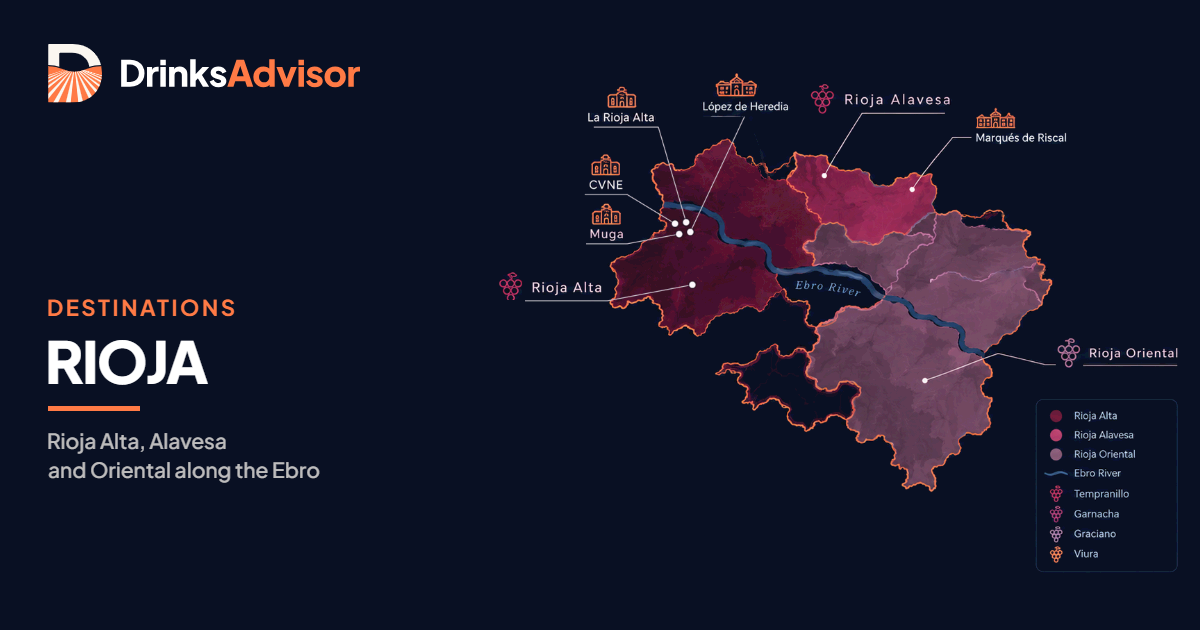
The Consejo Regulador counts roughly 66,000 hectares of vineyard and 571 wineries spread over 144 municipalities: 118 of them in La Rioja, 18 in the Basque Country, 8 in Navarre, plus a single winery in Castilla y León. The region stretches about 100 kilometers from west to east and 40 at its widest, and climbs to around 900 meters.
That span is the reason Rioja wine country can taste like three regions under one name. West to east, the valley gets warmer, drier and lower, and the three official zones follow that gradient. A trip that stays in one of them sees a fraction of what Rioja does.
The grapes follow the same logic. Fourteen varieties are authorized across the appellation, but four reds carry the region: Tempranillo for structure and red fruit, Garnacha for weight and warmth, Graciano for aromatics and acidity, Mazuelo for color and grip. Viura does most of the work in the whites, including the oxidative, barrel-aged style that Rioja makes better than anywhere else and that almost no visitor arrives expecting.
Rioja Alta: the western end, and the one most visitors book
Vineyards here sit between 400 and 600 meters on calcareous-clay, ferrous-clay and alluvial soils, in country that is mostly flat with terraces, low hills and river plains. Logroño, at the eastern edge of the zone, swings from around −5°C (23°F) in winter to over 35°C (95°F) in summer.
This is where the classic names cluster. Haro, Briones and San Vicente de la Sonsierra are all within a short drive of each other, and Haro in particular concentrates more visitable century-old cellars in one street than anywhere else in the region.
Rioja Alavesa: the smallest zone, and the steepest
Eighteen municipalities over roughly 300 square kilometers, bounded to the north by the Sierra de Cantabria and the Sierra de Toloño, with vineyards between 400 and 700 meters. Laguardia alone accounts for 3,338 hectares and 58 wineries; neighboring Elciego has 17. Administratively this is the Basque Country, and the road signs, the language and the bar food all reflect it.
The mountain wall matters more than the political border. It blocks the worst of the Atlantic weather, and the plots that climb toward it are the coolest, latest-ripening sites in Rioja.
Rioja Oriental: the warm eastern end
Known as Rioja Baja until the region renamed it, the eastern zone has a strongly Mediterranean climate and the warmest temperatures of the three. It takes in eight municipalities that belong to Navarre, and Alfaro alone has 4,359 hectares of vines worked by seven wineries: a lot of vineyard, comparatively few cellar doors.
For a first trip, this is the zone to treat as a day out rather than a base. Garnacha does well in the heat here, and the wines that carry the zone name on the label are worth asking for when you are tasting further west.
What the words on a Rioja label promise
Rioja is unusual in that its most familiar terms are about time, not place. A Crianza red has had two years of aging, at least one of them in oak barrel. A Reserva has had three years, with a minimum of one in barrel and six months in bottle. A Gran Reserva has had five, with two in barrel and two in bottle. Whites and rosés follow their own, shorter schedule.
Since 2017 there is a second set of terms, and this one is about place. Vino de Zona names one of the three zones. Vino de Municipio names one of the 144 villages. Viñedo Singular names a specific plot, and the bar for it is high: vines at least 35 years old, hand harvesting, a ceiling of 5,000 kg per hectare for red varieties and 6,922 for white, a processing yield capped at 65 percent, and two tastings, the second of which has to rate the wine excellent.
In practice, a bodega that has a Viñedo Singular will usually build its visit around that plot, and those are the tours where you walk the vineyard rather than the barrel hall.
When to visit Rioja wine country
Two windows do most of the work. Late May and June give you long days, green vineyards and comfortable walking weather before the summer heat sets in. Mid-September to late October gives you harvest, which is the reason many people come, along with cooler mornings and full cellars.
Two dates are worth planning around or avoiding, depending on your taste. On June 29, San Pedro’s day, Haro holds the Batalla del Vino: participants climb to the Riscos de Bilibio and drench each other in red wine before the crowd reassembles in the Plaza de la Paz. In September, Logroño’s San Mateo festival doubles as the Fiesta de la Vendimia Riojana, with the treading of the first grapes and the offering of the first must to the Virgen de Valvanera.
Harvest dates move with the year and with altitude: the warm eastern plots come in first, the high Alavesa sites last, and a cool spring can push the whole thing into October. No bodega will commit to a picking date more than a couple of weeks out, so if watching fruit arrive is the point of the trip, build in flexibility rather than booking a single day.
July and August are hot and quiet in the villages. Winter is the locals’ season: cellars stay open by appointment, restaurants keep shorter hours, and the light on the Sierra is at its best.
How to get around
Logroño–Agoncillo airport sits 14 kilometers from the city, about ten minutes by car, with Air Nostrum flights to Madrid and Barcelona, a Hertz desk and a 24-hour taxi service. Most travelers from the United States will do better flying into Bilbao and driving south, which also opens up a night in the Basque country on either end of the trip.
Once here, the pattern is simple. Haro and Logroño are compact enough to work on foot, and Haro’s station district puts six cellars within a few hundred meters of each other. Everything else, including most of Rioja Alavesa, assumes a car.
One planning note. Spain’s drink-driving limit is well below the 0.08 percent that American drivers are used to, and it is lower again for drivers in their first years of licensing. Check the current figure with the DGT (Dirección General de Tráfico) before you build a day around tastings, and if in doubt, keep a driver who is not tasting, or base yourself where you can walk.
Compare rental rates on DiscoverCars →
Where to stay
Four bases cover almost every version of this trip. Logroño is the city option, with the widest choice of restaurants and the only real nightlife. Haro is the one to pick if you want to taste without driving. Laguardia puts you inside a walled hill town in the middle of Rioja Alavesa. Briones and San Vicente de la Sonsierra are for travelers who want vineyards outside the window and dinner in the same square every night.
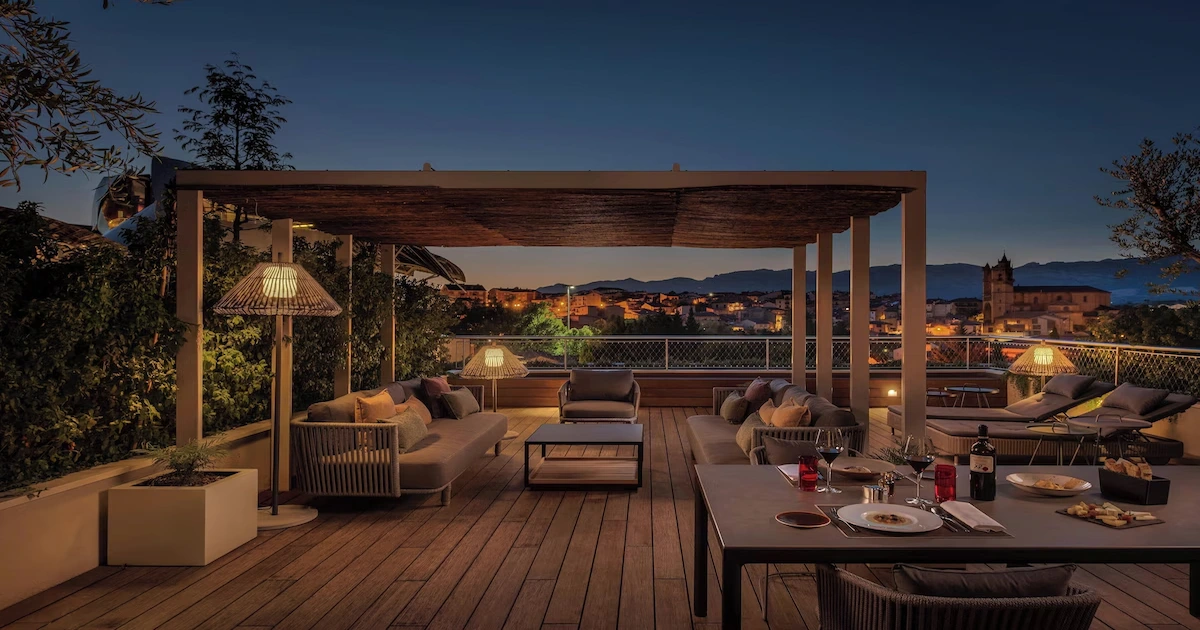
The landmark address is in Elciego. The Hotel Marqués de Riscal was designed by Frank Gehry and inaugurated on October 10, 2006, with 61 rooms, ten of them suites, split between two buildings joined by a raised walkway, a Caudalie Vinothérapie spa and three restaurants. It is the single most photographed building in the region and it prices accordingly.
For specific properties you can book, with what each one costs and who it suits, see our round-up of bodegas with rooms in Rioja Alta. If you are weighing Rioja against other regions, the closest comparison is Château Stays in Bordeaux, and for a warmer, more rural version of the same idea, the vineyard hotels of Tuscany.
Check Bodegas With Rooms in Rioja →
What to do
Start with Haro’s Barrio de la Estación, the cluster of cellars that grew up around the railway station and now calls itself the largest concentration of century-old wineries in the world: CVNE, Gómez Cruzado, La Rioja Alta S.A., Bodega Bilbaínas–Viña Pomal, Muga and Roda. The district’s own guided tour takes in three of them with three premium wines and three tapas, runs about three and a half hours, and is conducted in a single language per departure, either English or Spanish. Prices are quoted on request rather than published.
In Briones, ten minutes away, Vivanco combines a working winery with a museum of wine culture. Its flagship four-hour visit, Descubre los Secretos de Vivanco, runs at €280 per person for groups of two to ten in Spanish or English and asks for 15 days’ notice. Opening days are limited outside the high season, so check before you drive over.
Beyond the cellars: the medieval core of Laguardia, the Sonsierra’s rock-cut wine presses, and the marked walking routes between villages. A tasting-led day out here looks much like a Chianti day trip from Florence in structure, with two or three visits, a long lunch, and a driver.
Rioja wine country also keeps libraries, not just cellars. Several of the older houses in Haro hold bottles going back decades and pour from them on their premium visits, something a younger wine region simply can’t offer.
Prices are indicative and set by the venues. Figures here were read on September 18, 2026.
Organic and biodynamic wine in Rioja
Organic farming in Rioja is more than a marketing line. The regional government reports that organic production in La Rioja reached 9,656.82 hectares in 2025, about 4 percent of the region’s useful agricultural land, across all crops and not vines alone. Certification is handled by the regional control body, CPAER, under the European organic rules.
Biodynamic and low-intervention producers exist here too, in small numbers and mostly in Rioja Alavesa and the Sonsierra. The useful question to ask at the cellar door is which certification a wine actually carries, because “organic”, “biodynamic” and “natural” are not interchangeable and only the first two are audited. We apply those labels the same way, and the criteria are published in our editorial methodology.
Practical tips for US travelers
Book ahead, further than feels necessary. Most bodegas take visitors by appointment only, and the set-piece visits fill first: Vivanco’s flagship tour asks for 15 days’ notice, and the Barrio de la Estación tours run on fixed departures in one language at a time.
Reset your clock. Lunch is the serious meal of the day and runs late by American standards; dinner rarely starts before nine. Village kitchens close in between, so a mid-afternoon arrival with no plan usually means no food.
Spitting is normal. Tasting rooms provide the bucket and nobody reads it as an insult. On a day with three visits it is the difference between remembering the wines and remembering none of them.
Two zones, two languages. Rioja Alavesa is Basque territory, and place names often appear in both Basque and Spanish. It changes nothing practical, but it explains why the same village can look like two on a map.
Where to start
For a first trip, three nights is the realistic minimum: one based in Haro for the station district, one in or around Laguardia for Rioja Alavesa, and one in Logroño at either end for the restaurants. Book the two set-piece visits first, because they dictate the shape of the days around them, and leave the eastern zone for a return trip unless Garnacha is what brought you.
If you are still choosing between European wine regions rather than planning this one, Bordeaux offers the grander architecture and the stricter etiquette, and Tuscany the longer distances and the better scenery between stops. Rioja’s case is simpler: in Haro you can taste wines from several decades, on foot, in a single afternoon.
Check Bodegas With Rooms in Rioja →