The Piedmont wine region is where Italy makes Barolo and Barbaresco, and it is a quieter, more rural trip than most first-timers expect. There are no grand visitor centers on every corner: the Langhe hills are a patchwork of family cellars, hilltop villages and restaurants that take their white truffles very seriously. This guide explains the five areas worth knowing, when to go, how to get around and where to base yourself.
ⓘ We may earn a commission when you book through links on this page — at no extra cost to you. Affiliate Disclosure
- Best time to go
- September to November for harvest and the white truffle season; May and June for green hills and easy bookings
- Nearest airport
- Turin (TRN), roughly 75 to 90 minutes by car from Alba; Milan Malpensa (MXP) has more flights from the US but is about two hours away
- Getting around
- A rental car or a private driver; trains reach Alba and Asti but not the wine villages
- Typical budget
- $$ to $$$$, from a farm stay in the vines to a five-star hotel with a Michelin-starred restaurant
- Signature grapes
- Nebbiolo, Barbera and Dolcetto for reds; Arneis and Moscato for whites
In this article
Understanding the Piedmont wine region’s five areas
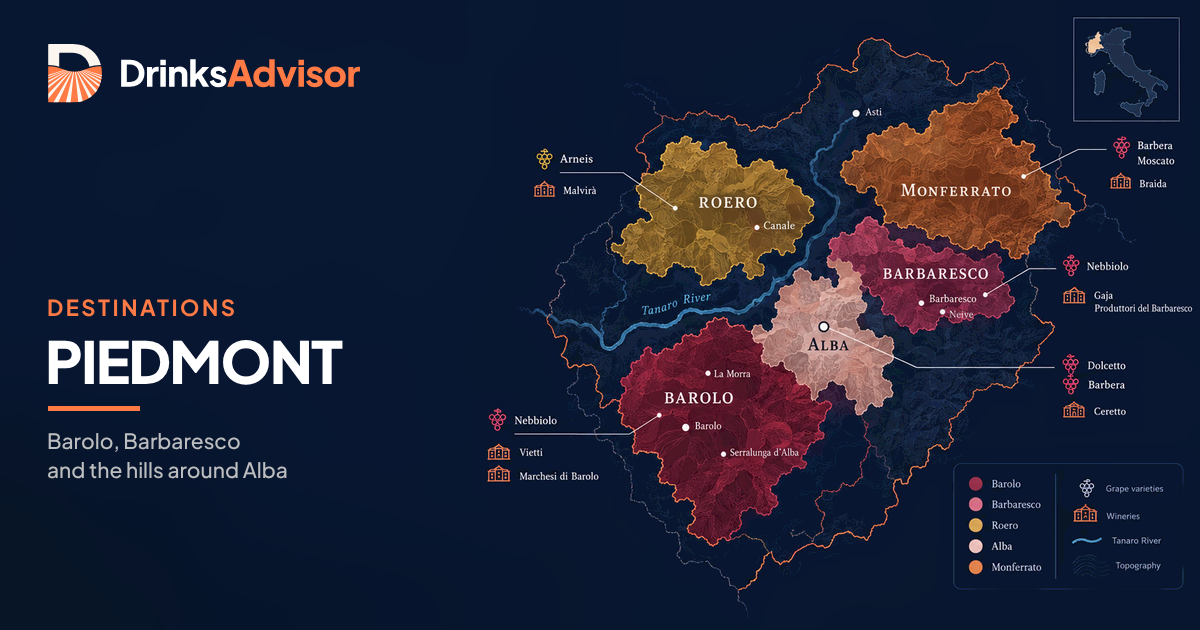
Piedmont is a large region in Italy’s northwest, at the foot of the Alps, but almost every wine trip ends up in the same corner of it: the Langhe, the hill country of southern Piedmont around Alba, in the province of Cuneo, and the Monferrato hills around Asti. In 2014 these vineyards became a UNESCO World Heritage site, the Vineyard Landscape of Piedmont: Langhe-Roero and Monferrato.
The grape that matters most is Nebbiolo, a pale but powerful red that ripens late and needs years in the cellar. It makes both Barolo and Barbaresco, and the difference between the two is largely one of place. Around them, Barbera and Dolcetto make the everyday reds that locals drink with dinner.
Barolo — the Langhe’s eleven villages
Barolo takes its name from a village, but the appellation covers 11 communes in the Langhe hills southwest of Alba. Five of them make most of the famous wine and most of the visits: La Morra, Barolo, Castiglione Falletto, Monforte d’Alba and Serralunga d’Alba. Each sits on its own hilltop, and the roads between them run along ridges with vineyards falling away on both sides.
The rules are strict: Barolo must age at least 38 months before release, 18 of them in wood. Labels often name a single vineyard, and the producers’ association, the Consorzio di Tutela Barolo Barbaresco Alba Langhe e Dogliani, has mapped those names officially. In the village of Barolo, the castle houses WiMu, a wine museum that makes a good first stop.
Barbaresco — Nebbiolo northeast of Alba
Barbaresco is smaller and closer to Alba, on the other side of town from Barolo. The wine comes mainly from three villages, Barbaresco, Neive and Treiso, and from a corner of Alba itself. It needs only 26 months of aging, nine in wood, and is often described as the more approachable of the two, though the best bottles last just as long.
For a visitor, Barbaresco is the easier half-day. The villages are close together, the tower in Barbaresco looks out over the Tanaro river, and Neive is one of the prettiest hill towns in the Langhe. If you have one day, you can taste in both areas; if you have three, give Barbaresco a full afternoon.
Roero — sand, Arneis and fewer visitors
Across the Tanaro, north of Alba, the Roero hills are steeper and sandier, cut by gullies and woods. The local white grape, Arneis, makes fresh, aromatic wines that are a welcome break after a day of Nebbiolo, and the Roero also makes its own Nebbiolo reds. Prices are lower and the cellars see far fewer tour groups than the Barolo villages a few miles away.
Alba — the town at the center
Alba is not a wine area in its own right, but it is where the Langhe comes to shop, eat and trade truffles. Its medieval center is compact and walkable, with wine shops, cafés and towers. From October to early December it hosts the International White Truffle Fair, with a market on Saturdays and Sundays.
Asti and the Monferrato — Barbera, Moscato and the cellars of Canelli
East of the Langhe, the Monferrato hills around Asti are Barbera country. Nizza Monferrato gives its name to the most serious version, and Canelli is the home of Asti Spumante and Moscato d’Asti, the gently sweet sparkling wines the area is known for. Under Canelli, long brick and tufa cellars run deep into the hill; they are one of the six parts of the UNESCO site, which the site’s official association describes component by component.
Farther north, the Monferrato also has the infernot, small chambers dug into the soft stone under houses to keep wine. It is a slower, less polished trip than the Langhe, and a good choice for a second visit.
For the curious — Langhe, Roero and the other names on the label
Langhe is both a place and an appellation. As a place, it is the hill country around Alba that includes Barolo and Barbaresco. As a label, Langhe Nebbiolo is a younger, cheaper wine from the same grape, made with fewer aging rules, and often the best value on a restaurant list. Barbera d’Alba and Dolcetto d’Alba come from the same hills; Barbera d’Asti comes from the Monferrato. DOCG on the neck of a bottle is Italy’s top tier of appellation, with the strictest rules.
When to visit the Piedmont wine region
Autumn is the high season, and for good reason. Nebbiolo is one of the last grapes in Italy to be picked, usually in October, so the harvest runs from late September through most of the month. The vines turn yellow and red, the fog settles in the valleys in the morning, and the white truffle season opens at the same time. The cost is busy weekends and hotels that fill months ahead.
If you want to taste during harvest, book small producers well in advance and expect shorter visits: the family that pours the wine is also in the vineyard and the cellar. Our guide to wine harvest season explains what changes in a wine region during the picking weeks.
Spring is the underrated alternative. From late April to June the hills are green, the cellars have time for visitors, and hotel rates are lower than in October. Summer is hot in the valleys but pleasant on the ridges. Winter is quiet and often foggy; many small producers still receive visitors by appointment, but some restaurants and hotels close for part of January and February.
How to get around
Piedmont is a driving trip. Trains reach Alba and Asti, but the villages of the Langhe and the Roero have little public transport, and the cellars sit on back roads between them. Most visitors fly into Turin or Milan, collect a car at the airport and are in the vineyards the same afternoon.
The distances are short: Barolo to Barbaresco is about half an hour, and La Morra to Serralunga d’Alba less than that. The roads, though, are narrow and winding, with tractors in season and fog on autumn mornings, so allow more time than the map suggests. Italy’s legal limit is 0.5 grams of alcohol per liter of blood, lower than in most US states, and zero for drivers who have held a license for less than three years.
Our guide to renting a car for a wine trip in Europe covers insurance, tolls and the paperwork US drivers need. If both of you want to taste, a private driver for the Barolo day is money well spent.
Compare rental rates on DiscoverCars →
Where to stay
Choose your base by how much you want to drive at night. The wine villages are close together, but after a long dinner a short trip back matters.
- Alba: the most practical base for a first trip. Restaurants, shops and the truffle market on foot, and both Barolo and Barbaresco within half an hour.
- A Barolo village: La Morra and Monforte d’Alba have the widest choice of small hotels and guest rooms, with views across the vineyards. You will need a car.
- Barbaresco or Neive: quieter, closer to Alba, and well placed for a trip that leans toward Barbaresco and the Roero.
- A farm stay among the vines: many wine estates in the Langhe rent rooms, often with breakfast made from their own produce. The best choice for a slow trip and a good way to meet a producer.
For most people, three nights in one base is better than one night in each village. In truffle season, book as early as you can: the best-placed hotels in the Langhe fill up first.
Check Barolo Hotels in the Langhe →
What to do
Most good days in the Langhe follow the same rhythm: one cellar in the morning, a long lunch, one or two visits in the afternoon.
- Family cellars: the heart of the trip. Most producers, large and small, take visitors by appointment only, so write or book online before you go. Tastings usually include a Barbera or a Langhe Nebbiolo before the Barolo or Barbaresco.
- The truffle season: the fair in Alba, and truffle hunts with a local hunter and his dog in the woods, usually in the morning.
- Castles and museums: WiMu in the castle of Barolo, and the castle of Grinzane Cavour, home of the regional enoteca and one of the six parts of the UNESCO site.
- The food: tajarin, thin egg pasta often served with butter and shaved truffle, vitello tonnato and hazelnut cakes. Lunch is the main meal, and the trattorias in the villages are some of the best value in Italy.
The Langhe is also a place to hike between villages. Paths link La Morra, Barolo and the other hilltops through the vineyards, and an hour on foot between two tastings is the best way to understand why the slopes matter so much to the wine.
Natural and biodynamic wine in Piedmont
Piedmont has a long tradition of small, family-run farms, and a growing number of them farm organically. Biodynamics is rarer. Rivetto, in Serralunga d’Alba, is described as the first estate in Barolo and Barbaresco to be certified biodynamic by Demeter, from the 2019 vintage, after organic certification in 2016.
On labels and estate websites you will meet the EU organic leaf, and sometimes Demeter for biodynamic farming. Natural wine has no legal definition in Italy, so ask the producer what they mean by it. Our guide to organic, biodynamic and natural wine explains what each one actually requires.
Practical tips for US travelers
- Book every visit. Walk-ins are rare in the Langhe. A short email a few weeks ahead is normal, and in autumn earlier is better.
- Plan three tastings a day at most. Visits are long and personal, and lunch here is not something to rush.
- Reserve lunch and dinner. The good trattorias are small, and in truffle season they are full every weekend.
- Carry some cash. Cards are widely accepted, but a few farm shops and village bars still prefer cash.
- Think about the bottles you buy. Many small Barolo producers are hard to find in the US. Our guide to shipping wine home to the US explains the options and costs.
Where to start in the Piedmont wine region
For a first trip of three or four days, base yourself in Alba or a Barolo village. Spend one day in the Barolo villages, with La Morra for the views and Serralunga d’Alba for the castle; give Barbaresco and Neive an afternoon; and keep a morning for the Roero or for a truffle hunt in season.
With more time, add two nights in the Monferrato for Barbera and the cellars of Canelli. If you are pairing Piedmont with another Italian region, our guide to Tuscany wine country shows how different a trip there feels: bigger estates, more visitor infrastructure and Sangiovese at the center. The Langhe rewards the opposite approach, small doors, short drives and long lunches.
Check Barolo Hotels in the Langhe →