Tuscany wine country is not one region. It’s a Renaissance city ringed by half a dozen of them, each with its own grape, its own rulebook, and its own idea of what a good afternoon looks like. Chianti Classico begins forty minutes south of Florence. Bolgheri is a different climate on a different coast, two hours away. This guide covers how the areas differ, when to go, how to move between them, and what to expect once you’re there.
ⓘ We may earn a commission when you book through links on this page — at no extra cost to you. Affiliate Disclosure
- Best time to go
- Mid-April to June, and September to mid-October
- Nearest airports
- Florence (FLR) and Pisa (PSA); Rome Fiumicino (FCO) about 3 hours by car
- Getting around
- Rental car. Public transport reaches the towns, not the estates
- Typical budget
- $$ to $$$$, from a family agriturismo to a castle with a Michelin restaurant
- Signature grapes
- Sangiovese inland; Cabernet Sauvignon, Merlot and Cabernet Franc on the coast; Vernaccia and Vermentino for whites
In this article
Understanding Tuscany’s wine areas
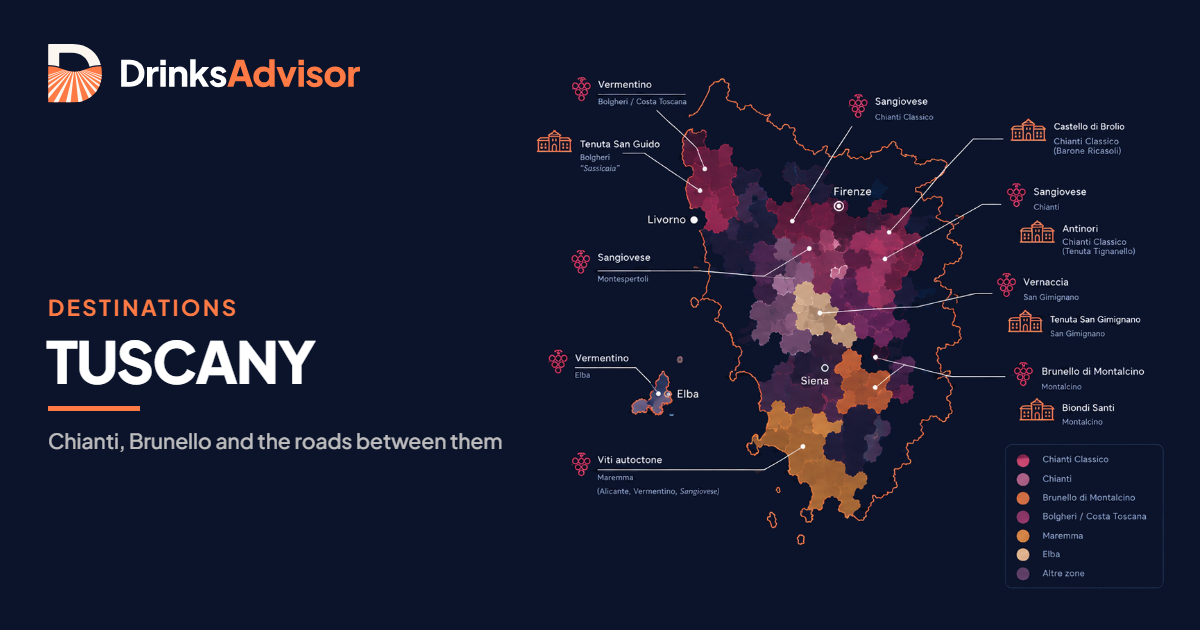
Most first-time visitors picture a single stretch of cypress-lined hills and plan accordingly. In practice you’re choosing between areas that are an hour or two apart, grow different grapes, and attract different crowds. Here’s the map worth having in your head before you book anything.
Chianti Classico — between Florence and Siena
The historic heart, and the easiest to reach. Chianti Classico occupies the hills between Florence and Siena, and its bottles carry the Gallo Nero, the black rooster seal, on the neck.
Since July 2023 the appellation has been divided into eleven named subzones, the Unità Geografiche Aggiuntive: Castellina, Castelnuovo Berardenga, Gaiole, Greve, Lamole, Montefioralle, Panzano, Radda, San Casciano, San Donato in Poggio and Vagliagli. They may appear on Gran Selezione labels, the top tier of the denomination which, from the 2027 vintage, must be at least 90% Sangiovese.
For a traveler this matters less as trivia than as itinerary. Greve, Panzano and Radda are walkable villages with estates in every direction; Gaiole and Castelnuovo Berardenga are more spread out and reward a car and a slower pace.
For the curious — Chianti vs. Chianti Classico
They are two separate denominations, not two grades of the same one. Chianti Classico covers the original zone between Florence and Siena and has its own consortium and its own rules; plain Chianti covers a much larger area of Tuscany around it. If the neck of the bottle has a black rooster on it, you’re in the Classico zone.
Montalcino — Brunello and the long wait
An hour and a half south of Florence, Montalcino sits on a hill above the Val d’Orcia and makes one of Italy’s most demanding wines. Brunello di Montalcino is Sangiovese and nothing else. It spends a minimum of two years in oak, and it cannot legally be sold until January 1 of the sixth year after the harvest. The Riserva waits a year longer, with at least six months in bottle.
That rule shapes the visit. A tasting room here is pouring wines made five or six years ago, often alongside Rosso di Montalcino, the earlier-release sibling from the same estates, and sometimes a barrel sample of something you couldn’t buy for years. Montalcino is where the wine talk gets most technical, and where the appointment culture is strictest.
For the curious — why the wait
The regulations also set a maximum yield of 80 quintals of grapes per hectare, a minimum alcohol of 12.5%, and require the wine to be sold in a Bordeaux-shaped bottle. Few denominations in Italy legislate this tightly. The effect is a wine built to age, and a town whose economy runs on cellars full of stock that can’t be sold yet.
Montepulciano and the Val d’Orcia
East of Montalcino, Montepulciano makes Vino Nobile di Montepulciano (Sangiovese again, here called Prugnolo Gentile) from a hilltop town that most visitors photograph before they taste. The denomination recently added a top tier called Pieve, tied to the historic parish districts of the zone and permitted from the 2021 vintage onward. It’s the newest piece of zoning in Tuscany and worth asking about in the tasting room.
Between the two towns lies the Val d’Orcia, on UNESCO’s World Heritage List since 2004. It is the landscape on the postcards, and the reason many people book a stay south of Siena rather than in Chianti.
Bolgheri — the coast, and the Bordeaux grapes
Ninety minutes west, on the Tyrrhenian coast, the rules change entirely. Bolgheri built its reputation on Cabernet Sauvignon, Merlot and Cabernet Franc rather than Sangiovese: the DOC was created in 1983 and revised in 1994 to allow the red wines that made it famous. Bolgheri Superiore requires two years of aging, at least one of them in oak.
One estate has its own appellation: since 2013, Bolgheri Sassicaia is a standalone denomination, requiring a minimum of 80% Cabernet Sauvignon. Nowhere else in Italy is a single estate’s wine treated this way.
The coast is warmer, flatter and greener than the interior, and it can be combined with a beach. It is also the least “Tuscan-looking” part of Tuscan wine country, which surprises people who booked it expecting cypresses.
For the curious — what “Super Tuscan” actually means
Nothing official. The term was coined for wines that broke the local rulebook in the 1970s (usually by blending in Bordeaux varieties) and were therefore sold as humble table wine despite the prices they commanded. Most of those wines now sit inside denominations written to accommodate them. The phrase survives mainly on wine lists.
San Gimignano — the white one
The town with the towers makes Tuscany’s best-known white, Vernaccia di San Gimignano, which in 1966 became the first Italian wine to receive DOC status. San Gimignano is heavily visited by day-trippers between roughly 10 a.m. and 5 p.m.; the estates in the surrounding hills are not.
Maremma — the quiet south
The southern coastal strip is Tuscany’s newest serious wine area and its least crowded. Fewer landmark names, more space, lower prices, and a landscape closer to open country than to manicured hills. Good for a second trip, or a first one if crowds are the thing you’re trying to avoid.
When to visit Tuscany wine country
May and June are the best all-round window: vineyards in full leaf, long light, estates fully staffed, and the summer crowds not yet in place.
July and August are hot and busy. Much of Italy takes its own vacation around Ferragosto, August 15, and some family-run estates close for part of the month. If August is your only option, book tastings well ahead and plan them for the morning.
Harvest (the vendemmia) is the reason many people come. White grapes typically come in from late August; Sangiovese is usually picked from mid-September into early October, though the dates move by a week or two with the vintage. Estates are working, not entertaining, so the visits that happen are either scheduled harvest experiences or short detours between loads. Book earlier than feels necessary, and expect a lively, dusty, slightly chaotic version of the place. Our guide to the wine harvest season compares the timing here with Bordeaux, Napa and Rioja.
Late October and November bring olive harvest, new oil, and truffle season inland: a quieter and underrated stretch, with the caveat that some estates begin reducing hours.
December to March is the off-season. Rates fall, the light is beautiful, and a significant share of vineyard hotels simply close. Anything you plan in this window needs confirming directly.
How to get around
Fly into Florence or Pisa. Both put you within an hour of Chianti Classico. Rome Fiumicino is a longer but often cheaper option, about three hours by car to Montalcino.
You will want a car. Trains and buses connect the towns (Florence, Siena, Montepulciano) but the estates are on unpaved side roads several miles out. The classic compromise is a few nights in Florence without a car, then a car for the wine country leg.
Two local realities to plan for. Historic centers are governed by ZTL zones (limited traffic areas, camera-enforced). Driving into one without a permit generates a fine that typically reaches you months later, through your rental company, with a fee attached. Park outside the walls. Second, many estates sit at the end of a strada bianca, a white gravel road: passable in a normal car, slow, and unpleasant in heavy rain.
Drinking and driving. Italy’s legal limit is 0.5 grams per liter of blood (0.05%) and it is zero for drivers under 21 and for anyone who has held a license for less than three years. Penalties scale with the reading and include fines, license points and, at the top of the range, confiscation. Tasting rooms are used to this: ask for the spit bucket, which is standard practice and not a judgment on the wine, or rotate the driving between you.
Compare rental rates on DiscoverCars →
Where to stay
Four broad shapes of vineyard stay, and they are genuinely different holidays:
- Castles and historic estates: a restored borgo or castle with a working cellar, a restaurant, and often a pool. The most expensive and the most photographed.
- Agriturismi: farm stays, from simple to polished. Legally these are working farms, so the wine and the oil on the table are usually made there.
- Boutique wine resorts: hotel service on an estate, with a spa and a booked-out restaurant.
- Private villas: the choice for groups and families; a car and a supermarket run come with it.
Where to base yourself. Chianti Classico is the most central: Siena, Florence, San Gimignano and Montalcino are all reachable as day trips. If the Val d’Orcia is your priority, stay south instead: the drive from Chianti is longer than the map suggests. Our guides to where to stay in Chianti and to Montalcino estates with rooms cover seven estates in each area.
For eight specific estates you can book, with what each one costs and who each suits, see our round-up of the best vineyard hotels in Tuscany.
Check the Best Vineyard Hotels →
What to do
Tastings are by appointment, almost everywhere and almost always. Very few Tuscan estates run a walk-in tasting room in the Napa sense. Two to three weeks ahead is a comfortable lead time in season; harvest needs more.
Cellar tours are where the region explains itself: the difference between a large oak botte and a French barrique stops being abstract when you’re standing between them.
Harvest and blending workshops run in September and October: a morning of picking, then a lunch, then the part where you learn how little of the process is romantic.
Vineyard dining. Estate restaurants take reservations weeks out in high season, and many close on Sunday evening and Monday. Italian dinner service starts around 8 p.m.; arriving at 6:30 gets you an empty room and a confused waiter.
Natural and biodynamic wine in Tuscany
Tuscany is one of the strongest places in Europe to travel for organically and biodynamically farmed wine, and unusually that overlaps with the high end rather than sitting apart from it. Several serious Chianti Classico and Montalcino estates farm this way and have rooms.
The vocabulary is worth getting straight, because it is used loosely:
- Certified organic is a legal certification, carried on the label as the EU leaf or, in the US, the USDA Organic seal.
- Biodynamic is certified by private bodies, principally Demeter and Biodyvin.
- “Natural” has no legal definition anywhere. The closest thing to a standard is the French voluntary label Vin Méthode Nature.
We apply these labels only where there’s a certification or the producer’s own published statement, and we say which. The full criteria are in Our Editorial Methodology.
Practical tips for US travelers
Tasting fees are normal and modest by Napa standards, and are often waived or credited against a purchase. Ask when you book, not when you arrive.
Bring a card, and some cash. Cards are accepted nearly everywhere, but a small family estate at the end of a gravel road is exactly where the terminal fails.
Lunch is roughly 1 to 2:30 p.m., dinner from 8. Between those windows, rural kitchens are closed. Plan tastings around them rather than assuming you can eat at 5.
Tipping is not expected the way it is at home. Rounding up, or a few euros for a long and generous tasting, is more than enough.
Taking wine home is the part people get wrong. US Customs and Border Protection sets a personal duty-free allowance, additional bottles can be brought in subject to duty, and your state of residence sets its own rules on top, which are stricter in some states than federal law. Check CBP’s guidance before you commit to a case, and ask the estate whether they ship to your state; many of the larger ones do.
A little Italian goes further here than in Florence. Un assaggio = a taste. Il conto = the bill. Nobody expects fluency, and the effort is noticed.
Where to start in Tuscany wine country
Tuscany rewards choosing an area rather than sampling all of them. A week split between two zones — Chianti Classico and the Val d’Orcia, say, or Chianti and the coast — leaves you with mornings that don’t begin with two hours of driving. Pick the wine you actually want to drink, base yourself inside that zone, and treat everything else as a day trip.
The next decision is where you sleep, and in this region it’s more consequential than usual: the estate you book is also, most of the time, the cellar you’ll taste in. Our round-up of the best vineyard hotels in Tuscany covers eight of them, with what each one costs and when to book.
Check the Best Vineyard Hotels →