This Chianti itinerary fits two days and two nights into the hills between Florence and Siena. You drive in from the north on the old Chiantigiana road, taste in an abbey cellar and a castle, eat lunch where the wine is made, and sleep both nights in one place in the middle of the map. It is a short route on purpose: Chianti rewards slowness, and the best hours here are rarely the ones spent in the car.
ⓘ We may earn a commission when you book through links on this page — at no extra cost to you. Affiliate Disclosure
In this article
How this Chianti itinerary is planned
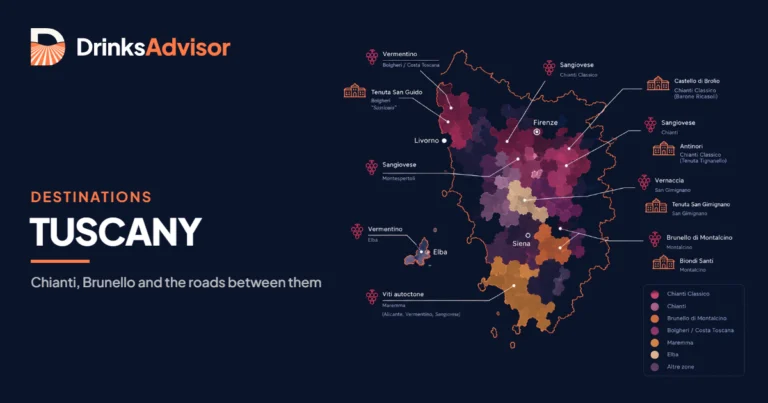
Chianti Classico is the hill country between Florence and Siena, and the black rooster on the neck of its bottles is the mark of the Chianti Classico consortium. On a map it looks small. On the ground the roads twist, the villages sit on ridges, and a 20-minute drive easily becomes 40. Two days is enough to see its two halves properly if you stop trying to see everything.
The route runs north to south. Day one goes from Florence to Greve and Panzano, the western side of the appellation, with a cellar visit at the abbey of Passignano. Day two crosses to Radda and Gaiole in the east and ends at Castello di Brolio, with Siena close enough for the evening or the drive home. Both nights are spent near Castellina, which sits on the ridge between the two halves, so you unpack once.
Plan for two cellar visits a day at most, and book them before you leave home: the large estates run guided tours at set times. Someone has to drive after the tastings, which is the one real problem with touring Chianti on your own. If nobody in the group wants that job, a driver for a day solves it, and our guide to Chianti wine tours from Florence compares the ones you can book. If you are renting, read our notes on renting a car for a wine trip first. For the wider region, start with our Tuscany wine country guide.
Day 1: Florence to Greve, Passignano and Panzano
Morning, Greve in Chianti. Leave Florence early and take the Chiantigiana south; Greve is about 18 miles away. Its main square, Piazza Matteotti, is an odd triangle with a statue of the navigator Giovanni da Verrazzano in the middle and arcades on two sides. Falorni, the old butcher on the square, also has tables, which makes it the easiest first taste of Chianti salumi. If you have an extra hour, walk up to Montefioralle, a tiny walled village about a mile west of town.
Midday, Badia a Passignano. West of Greve, a road of cypresses climbs to a hilltop abbey surrounded by vines. The Antinori family runs guided visits to the medieval cellars under the abbey, where their Chianti Classico ages, followed by a tasting. Lunch is next door at the Osteria di Passignano, and the wine shop inside it sells the estate bottles by the glass. This is the long lunch of the trip; keep the afternoon light.
Afternoon, Panzano. Panzano is about five miles south of Greve, and the reason to stop is the Conca d’Oro, the “golden bowl” of south-facing Sangiovese vineyards below the village. Fontodi, one of the best-known estates in the bowl, sits right on the road. In the evening Panzano belongs to Dario Cecchini, Chianti’s most famous butcher, whose shop and restaurants (Solociccia and Officina della Bistecca among them) are the dinner most visitors book first. Then drive on to your base near Castellina.
Day 2: Radda, Gaiole and Castello di Brolio
Morning, around Castellina and Radda. If you are sleeping at Fonterutoli, the first visit is a walk away: the Mazzei family has owned the hamlet since 1435, and the estate cellar offers tastings from a simple flight to the single-vineyard wines. East of Castellina the road climbs to Radda, a compact hill town worth half an hour, and to Volpaia above it, a walled hamlet whose winery uses the village buildings themselves.
Late morning, Badia a Coltibuono. Further east, near Gaiole, the abbey of Coltibuono has been making wine since 1051 and farms organically today. The estate runs tours of the old cellars and keeps a restaurant on the estate, a good place for a slower lunch than yesterday’s.
Afternoon, Castello di Brolio. The last stop is the one that explains the wine. The Ricasoli family has held Brolio since 1141, and in the nineteenth century Bettino Ricasoli, later prime minister of Italy, ran the experiments here that led to modern Chianti. The sixteenth-century gardens open from March to November, a guided visit takes you into the family collection in the keep, and the terrace looks straight down on the vineyards. The enoteca by the castle is open all year and needs no reservation. From Brolio it is a short drive south to Siena for dinner, or onward if this is the end of the trip.
Where to sleep near Castellina
One base for both nights is the whole idea, and Castellina is the right place for it: Greve and Panzano are on one side, Radda and Gaiole on the other.
Nights 1 and 2. Castello di Fonterutoli Wine Resort puts the rooms, the osteria, the wine bar and the cellar along one lane of the hamlet, so the second evening needs no car at all. It is rated 9.4 out of 10 across 233 Expedia reviews, with rooms from $237 a night. If you want a pool, a spa or a castle instead, our guide to where to stay in Chianti compares seven estates from Greve to Castelnuovo Berardenga.
Book it
Compare hotels at the start of the route
Spring and harvest weekends fill early in the Chianti villages. A search around Greve shows what is left on the Florence side.
When to go, and how to stretch it
Spring and early fall are the easy seasons: mild days, open gardens at Brolio, and cellar tours running at full schedule. September and October bring the harvest, when the roads carry tractors as well as tourists and the estates are at their busiest; our guide to the wine harvest season explains what that means for a visit, and the best time to visit Tuscany wineries goes month by month. In Greve, the fourth Sunday of most months brings a market to Piazza Matteotti.
With a third day, add Montalcino to the south and spend it on Brunello tastings in Montalcino, or give each half of Chianti a full day instead of a morning. With only one, choose a side: Greve, Passignano and Panzano if you are coming from Florence, Brolio and Coltibuono if you are staying in Siena.
Prices are “from” rates, indicative and set by our booking partners: they change with dates and availability, so check the current rate on Expedia.