Renting a car for a wine trip in Europe makes sense when your hotel and winery appointments are spread across the countryside. It gives you freedom between villages, but it takes some preparation: an acceptable license, the right insurance, a transmission you can drive, and a plan for getting home after tastings. This guide focuses on Tuscany, Bordeaux, and Rioja, with the decisions to make before you collect the keys.
ⓘ We may earn a commission when you book through links on this page — at no extra cost to you. Affiliate Disclosure
- Do you need a car?
- Useful for rural stays and wineries far from town; optional for organized tasting days.
- License and IDP
- Bring your physical license; check country-specific translation or International Driving Permit requirements.
- Driver age
- Check the rental company’s minimum age, license-holding period, and any young-driver surcharge.
- Transmission
- Reserve an automatic explicitly if you cannot comfortably drive a manual.
- Insurance
- Read the deductible, deposit, exclusions, and your card’s country-specific terms.
- Tasting days
- Arrange a driver who will not drink, a guided tour, or a walkable base.
In this article
- Renting a car for a wine trip: do you need one?
- Licenses, age, and the International Driving Permit
- Insurance and what U.S. credit cards leave out
- Manual, automatic, and when to book
- Driving in Tuscany, Bordeaux, and Rioja
- Drink-driving limits in Italy, France, and Spain
- Common questions
- Drive, hire a driver, or mix both
Renting a car for a wine trip: do you need one?
A rental car is useful when your trip includes a countryside hotel, independent winery appointments, or several villages that public transportation does not connect conveniently. It can also make luggage transfers between wine regions easier. For a city-based stay with scheduled tastings, a car may spend most of its time parked.
Think about the shape of the day before booking. If you plan to leave Florence, visit a Chianti estate, stop for lunch, and return to the city, an organized outing is often simpler. Our Chianti wine tours from Florence include options that handle transportation. If you are staying outside a village for several nights, having your own car can make dinner, sightseeing, and airport transfers much easier.
Separate sightseeing days from tasting days on the itinerary. A rental car can serve the first purpose while a hired driver takes care of the second. Confirm transportation when you reserve each winery visit, particularly if the estate is reached by a narrow rural road or has no practical taxi service.
Licenses, age, and the International Driving Permit
Travelers from the United States should carry their original, valid driver’s license. An International Driving Permit (IDP) translates the details of that license; it does not replace it. The issuing country matters, so travelers holding a license from Canada, the United Kingdom, Australia, or another country should check the rules for that specific license rather than assume the U.S. requirements apply.
Italy requires drivers using a non-EU license to carry an IDP or a sworn translation. France accepts a valid non-European license for a short visit when it is in French or accompanied by an official French translation or an IDP. Spain advises travelers with non-EU/EEA licenses to obtain an IDP; its rules also recognize certain other license formats and official translations. For a U.S. itinerary crossing these countries, obtaining an IDP before departure is the least complicated approach.
Get a genuine U.S.-issued permit through an authorized issuer such as AAA’s International Driving Permit service. Carry the original license alongside it, plus your passport. A screenshot, a privately sold “international driver’s license,” or an IDP alone is not a substitute.
Rental eligibility is a separate question from permission to drive on public roads. The supplier may specify a minimum age, a period for which you must have held your license, a young-driver fee, or limits on vehicle categories. Read the terms for the actual supplier and pickup station, especially if you are a younger driver. Bring a payment card in the main driver’s name and check its deposit requirements before traveling.
Insurance and what U.S. credit cards leave out
When renting a car for a wine trip, the cheapest displayed rate rarely tells you the whole financial story. Start by distinguishing third-party liability, which concerns damage or injury caused to others, from collision damage waiver (CDW) and theft protection, which concern the rental vehicle. CDW is a contractual waiver subject to conditions, and it usually leaves a deductible payable by you. European rental terms call it the “excess.”
Compare the deductible and security deposit as carefully as the daily rate. Read what happens if the car suffers tire, windshield, underbody, roof, or interior damage; whether roadside assistance is included; and what the supplier requires after an incident. A broker’s reimbursement product may ask you to pay the supplier first and submit a separate claim afterward. Keep the supplier’s rental conditions and any additional coverage terms together.
Do not assume that a premium U.S. credit card covers every European rental. Some U.S.-issued American Express cards’ standard Car Rental Loss and Damage Insurance excludes rentals in Italy, while other issuers and products have different territorial rules. Card coverage may also exclude liability and depend on paying with the eligible card and satisfying the insurer’s rules about the rental company’s CDW. Ask your issuer for the current guide to benefits, explicitly naming each country and your rental dates. Get confirmation in writing if coverage is central to your decision.
At pickup, inspect the vehicle with the agent, photograph all sides and the wheels, and make sure every existing mark appears on the inspection record. Save the fuel policy, mileage allowance, roadside number, and after-hours return instructions. A quick video of the condition at return is useful, particularly where the counter is closed.
Manual, automatic, and when to book
Manual-transmission cars remain a common rental option in Europe. If you normally drive an automatic, select the automatic filter and confirm the transmission in the supplier’s terms before you pay. A general vehicle-class picture does not guarantee the model shown. Allow for a different car within the booked class, and check how the supplier handles a transmission change.
A compact car is easier to place on the narrow approaches to Tuscan villages, in older Bordeaux parking garages, and along Rioja’s hill-town streets. Leave enough trunk space for luggage, and avoid planning to leave purchased wine in a parked car, especially in summer. If several adults are traveling together, check the luggage allowance rather than relying only on the passenger count.
Reserve as soon as your flights and accommodation are reasonably settled if you require an automatic, child seat, or unusual pickup time. Before confirming, compare airport and city-center collection, desk opening hours, cancellation terms, fuel policy, cross-border permission, additional-driver fees, and any one-way return charge. In harvest season, allow time between a winery appointment and an airport return instead of scheduling them back to back.
Bordeaux is the easiest of the three regions to start from by car: the airport sits on the western edge of the city, a short drive from the Médoc road. Filter for automatics, then open the supplier’s own conditions before paying. The same checklist works for a pickup in Florence or Bilbao.
Compare Bordeaux Rentals on DiscoverCars →
Driving in Tuscany, Bordeaux, and Rioja
Tuscany: rural flexibility and ZTL restrictions
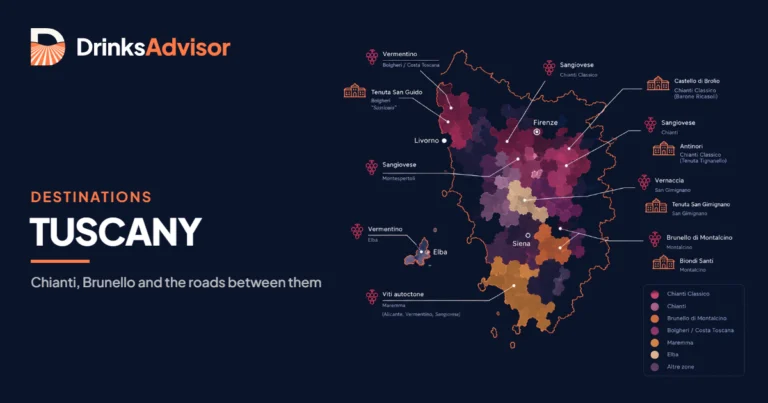
Florence is a useful arrival point; a rental car becomes more valuable once you leave the city for rural Chianti, Montalcino, or a vineyard property. Plan the route around your actual reservations and allow time for slower country roads. Start with our Tuscany wine country guide, then compare vineyard hotels in Tuscany if you want to sleep outside town.
Watch for ZTL signs: these limited-traffic zones operate in many Italian historic centers, and a rental car does not automatically have permission to enter. Ask your hotel exactly how permitted guest access and registration work before following navigation into the old town. Choose a parking location outside the restricted area when in doubt.
Bordeaux: choose a bank before choosing a route
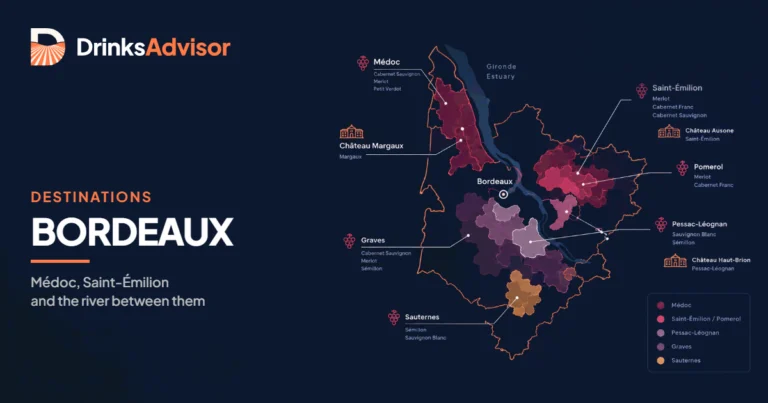
Bordeaux is a practical city base, but driving across the Gironde and Dordogne repeatedly can consume time better spent at estates. Group appointments geographically: Médoc on one day, Saint-Émilion or Pomerol on another, with Graves and Sauternes planned together when their opening hours fit. Our Bordeaux wine travel guide explains the areas; château stays in Bordeaux can reduce your daily transfers.
French low-emission zones (ZFE) and Crit’Air vehicle stickers can affect urban driving. Requirements vary by location and can change, so ask the rental supplier whether your vehicle is properly equipped for your intended city route. Parking once and continuing on foot is often easier in central Bordeaux.
Rioja: a walkable tasting base and a wider driving circuit
Haro’s Barrio de la Estación puts several wineries near each other, making it an appealing base for a day without a car. A vehicle helps with the longer circuit through Briones, Laguardia, Elciego, and the villages of Rioja Alavesa. Logroño is useful for restaurants and an urban overnight stop. For the broader geography, see our Rioja wine country guide; if you would rather sleep at a winery, start with our bodegas with rooms in Rioja.
If arriving through a larger airport and driving into the region, check the low-emission-zone (ZBE) rules of any Spanish city you plan to enter, along with the rental company’s instructions. Do not assume an unfamiliar city-center shortcut is available to every vehicle.
Drink-driving limits in Italy, France, and Spain
The figures below are blood alcohol concentration (BAC), expressed in grams of alcohol per liter of blood. They describe legal thresholds, not a safe quantity of wine to drink. The limit that applies to you may depend on your age, license history, or driver category.
| Country | General driver limit | Lower-limit categories |
|---|---|---|
| Italy | 0.5 g/L (0.05%) | 0.0 g/L for drivers under 21, drivers in their first three years of licensing, and professional drivers. |
| France | Below 0.5 g/L (0.05%) | Below 0.2 g/L (0.02%) for probationary-license drivers; specific other categories also have reduced limits. |
| Spain | 0.5 g/L (0.05%) | 0.3 g/L (0.03%) for novice drivers in their first two years and for professional drivers. |
Spain’s limits may come down: in September 2026 the national parliament agreed to debate a bill that would cut them. Until a new law is published and in force, the figures above apply.
Sources: Automobile Club d’Italia, France’s Service Public, and Spain’s Dirección General de Tráfico. Official guidance checked October 2, 2026; check current rules before travel.
Wine pours are not standardized across tasting rooms, and your BAC cannot be reliably calculated from the number of glasses you have tasted. There is no recommended “allowance” of tasting samples for someone who will drive. If the itinerary includes drinking wine, arrange a sober driver, book transportation, or stay where you can walk to dinner and the cellar door. Spitting during a tasting can reduce consumption, but it does not replace a transportation plan.
For a day in Chianti, review our guided wine tours from Florence. In Bordeaux, our private cellar tours offer another itinerary to compare; check each listing’s transportation details before reserving.
Check Chianti Wine Tours From Florence →
Common questions
Can Americans rent a car in Italy with a U.S. driver’s license?
Yes, for a qualifying short visit, but you should carry your valid U.S. license together with an International Driving Permit or a sworn translation, as required for a non-EU license in Italy. The rental company can impose additional conditions. Bring your physical documents and check the supplier’s terms before departure.
Should I book an automatic transmission in advance?
Yes, if you do not drive a manual comfortably. Filter your search for automatic vehicles and verify the transmission in the offer’s terms before paying. Confirm again at pickup. Car-class images are illustrative, so check which vehicle characteristics the supplier guarantees and what its substitution policy says.
Is my U.S. credit card’s rental insurance enough?
It depends on the precise card benefit, country, vehicle, and rental agreement. Some U.S. credit-card benefits exclude Italy, and collision coverage does not automatically cover third-party liability. Ask the card’s benefits administrator for the applicable terms and compare them with the supplier’s CDW, theft protection, deductible, and deposit.
Can I collect a car in one European country and return it in another?
Sometimes. The rental supplier must permit the countries on your itinerary, and an international one-way return may carry an additional fee or be unavailable at a particular station. Disclose every intended border crossing before you book and check coverage, roadside assistance, and the return location in writing.
What is the easiest way to visit wineries without driving after tastings?
Book a tour with transportation, hire a professional driver, designate someone who will not consume alcohol, or stay in a walkable tasting town. Haro and central Bordeaux can work well for parts of a trip on foot. Ask every operator whether transport is included and where pickup and drop-off actually take place.
Drive, hire a driver, or mix both
Renting a car for a wine trip works best when the route is built from your confirmed winery visits, accommodation, and arrival airport. For countryside stays, reserve a vehicle with a transmission you can use, check the documents, and compare the full rental conditions. Keep city-center driving restrictions and parking in mind when deciding where to collect it.
Then plan your tasting days separately. A driver or a guided tour lets everyone participate without worrying about the return journey. You can also spend a few nights in a walkable base, or at an estate where the cellar is downstairs, and use the rental only for transfers and sightseeing. Our round-ups of vineyard hotels in Tuscany and château stays in Bordeaux are a good place to find that base.