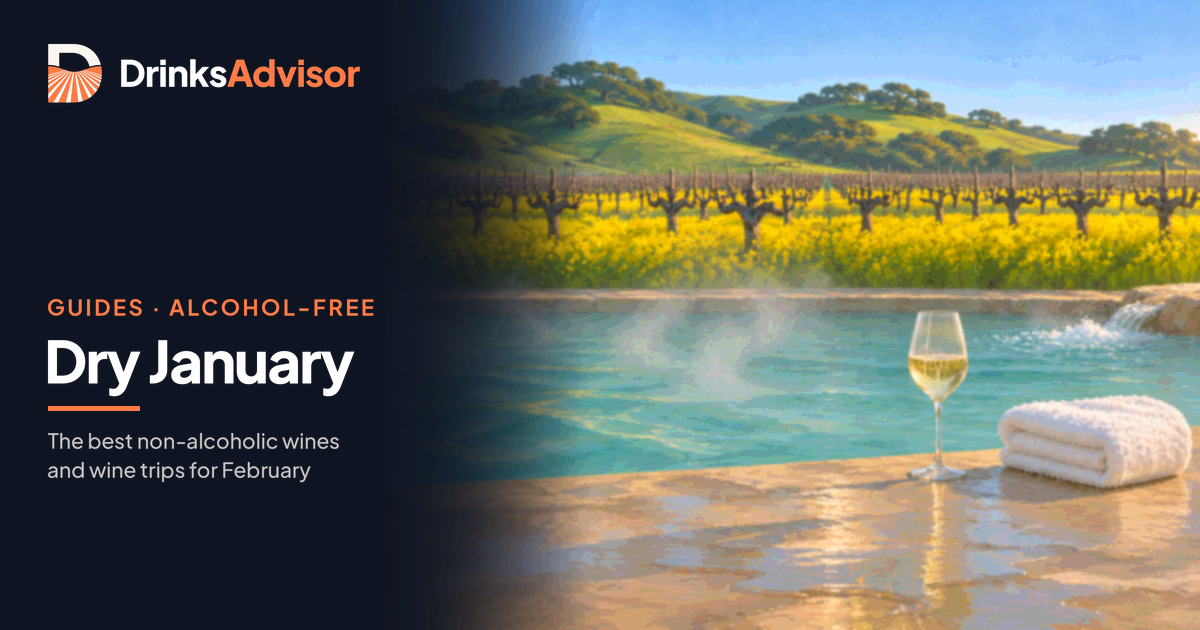
Dry January asks for 31 days without a drink, and for a wine lover it goes better with a plan for both halves of the month: something worth pouring while the glass stays empty of alcohol, and somewhere worth going when it fills again. Here is what a non-alcoholic wine label actually promises in the US, how the alcohol comes out, the bottles that hold up, and two wine trips that work in February.
ⓘ We may earn a commission when you book through links on this page, at no extra cost to you. Affiliate Disclosure
- The month
- Friday, January 1 to Sunday, January 31, 2027
- The US rule
- A “dealcoholized” wine should hold less than 0.5% alcohol by volume; “alcohol-free” means none detectable
- What works best
- Sparkling wine and aromatic whites, such as Sauvignon Blanc and Riesling
- How it’s made
- Real wine, with the alcohol removed by vacuum distillation, spinning cone or reverse osmosis
- The glass comes back
- Monday, February 1, 2027
- Where to go in February
- Napa Valley in mustard season, or Florence and the Chianti Classico hills
In this article
What Dry January is, and where it came from
Dry January is a British idea that crossed the Atlantic. According to Alcohol Change UK, the charity behind the campaign, it began with one person: Emily Robinson gave up alcohol in January 2011 to train for a half marathon, did it again in January 2012 after joining the charity, and the campaign launched officially in 2013 with 4,000 people. In 2026 more than 160,000 people took part using the charity’s own tools, and many more simply join in on their own.
The rules are short: no alcohol from January 1 to January 31. What people pour instead is the part that has changed most. Ten years ago the choice for a wine drinker was sparkling grape juice or water. Today several serious wine estates make dealcoholized versions of their own wines, and a handful of specialist producers make nothing else.
For a wine traveler the month has a second use. January is when the year’s trips get booked, and a month off is a good moment to choose the one that makes the first glass back worth waiting for. We come back to that in the second half of this guide.
What non-alcoholic wine means on a US label
The words on the bottle are not interchangeable, and in the US they are not even regulated by the same agency as ordinary wine. Wine between 7% and 24% alcohol falls under federal alcohol rules. A dealcoholized wine has less than 7%, so its label falls under the Food and Drug Administration, which explains its position in a compliance policy guide on dealcoholized wine.
- Dealcoholized or alcohol-removed: the FDA considers these terms misleading if the wine holds more than 0.5% alcohol by volume, and expects the label to say it contains less than 0.5%.
- Alcohol-free: only for a product with no detectable alcohol. That is the meaning of “0.0%” on a label.
- Non-alcoholic: allowed as an extra description, but the FDA says it is not a synonym of alcohol-free. A non-alcoholic wine can still carry a trace, up to that 0.5% line.
If you avoid alcohol for medical or religious reasons, look for 0.0% and “alcohol-free” rather than “non-alcoholic”. European labels use their own pair of terms: “dealcoholised” for wine at 0.5% or below, and “partially dealcoholised” for wine taken down from its normal strength but still above that line.
Low-alcohol wine is a different thing again: wine that never had much alcohol to begin with. A Moscato d’Asti usually sits around 5%, and a Mosel Riesling Kabinett with some sweetness often lands between 7.5% and 9%. Neither counts for a strict Dry January, but both are worth remembering for the weeks after.
How the alcohol comes out of wine
A good non-alcoholic wine starts as a finished wine: grapes, fermentation, often months of aging. The alcohol is taken out afterwards, and the method decides how much of the wine survives the trip. There are three main ones.
Vacuum distillation. Alcohol boils at a lower temperature than water, and under reduced pressure it boils lower still. In a vacuum the wine can be distilled at roughly 30 to 60°C (86 to 140°F) instead of cooking it at normal pressure, which protects more of the fruit.
Spinning cone column. The wine runs as a thin film over a stack of spinning cones under vacuum. The volatile aromas are drawn off first and set aside, then the alcohol in a second pass, and the aromas are blended back into the finished wine. New Zealand’s Giesen uses it for its 0% Sauvignon Blanc.
Reverse osmosis. Under pressure the wine is pushed against a semi-permeable membrane that lets water and alcohol through and holds back color, flavor and structure. The alcohol is then separated from the water, and the water goes back in.
Every method costs something. Alcohol carries aroma, adds body and softens acidity, so a wine without it reads thinner and sharper. That is why the category’s best bottles are wines whose pleasure was never mostly about weight: bubbles, high acidity and loud aromatics.
Four non-alcoholic wines worth pouring in January
We picked producers that start from real wine and say how they make it. We don’t list prices: they move a lot from state to state and from one retailer to the next.
French Bloom: the bottle for a toast
Founded in 2019 by Maggie Frerejean-Taittinger and Constance Jablonski, French Bloom makes alcohol-free sparkling wine, 0.0%, from organic Chardonnay and Pinot Noir wines from Limoux, in the Languedoc. The alcohol comes out by vacuum distillation at low temperature. If you are skipping the New Year’s Eve Champagne, this is the closest thing to it in a flute.
Giesen 0% Sauvignon Blanc: the everyday white
Giesen dealcoholizes a full-strength Marlborough Sauvignon Blanc, with fruit from Marlborough and Waipara, using the spinning cone described above, and bottles it below 0.5%. Sauvignon Blanc is one of the grapes that suffers least: the gooseberry and citrus aromas are loud enough to come through, and the acidity does the job alcohol usually does at the table.
Leitz Eins Zwei Zero Riesling: the one for dinner
Weingut Leitz, in Rüdesheim on the Rheingau, is a serious Riesling estate, and its Eins Zwei Zero line takes Riesling down to 0.0% by gentle vacuum distillation at around 30°C. Riesling’s acidity is its spine with or without alcohol, which makes this one of the more food-friendly bottles in the category: think spicy dishes, pork, anything with a little sweetness.
Oddbird: the specialist
Oddbird, founded in 2013 by Moa Gürbüzer, works only in alcohol-free wine. Its approach is the one that matters most for flavor: the wines are matured for up to 12 months before the alcohol is removed, so they go into the process with more to lose. The range includes sparkling wines and an alcohol-free natural wine made with grapes from Alsace.
Red is the hard color. Tannin without alcohol tastes drier and more bitter, and body is exactly what dealcoholization takes away, so most non-alcoholic reds read thin next to these whites and sparklers. If you want one, chill it a little and drink it with food.
February wine trips: where to go when the glass comes back
February is low season in most wine regions of the Northern Hemisphere: vines are bare, harvest crowds are months away, and the cellars that stay open have time to talk. Two trips make the most of it, one in California and one in Tuscany.
Napa Valley in mustard season
From January to March the vineyard rows of Napa Valley fill with wild mustard in bloom. Growers plant it between the vines as a cover crop that protects the soil, and Visit Napa Valley calls the season one of the best-kept secrets in wine country. The bloom depends on the weather, so a February visit is a good bet rather than a promise.
After a month without wine, a quiet valley is the right place to start again: fewer people in the tasting rooms, more time with whoever is pouring. Our Napa Valley wine country guide covers the areas and how to get around, and our pick of the best wine tastings in Napa Valley lists visits you can book ahead. If the plan is to ease back in slowly, the Calistoga wine resorts pair the north end of the valley with hot springs and spas; for a wider choice, see our Napa Valley wine resorts.
Check Napa Valley hotels on Expedia →
Florence and the Chianti Classico Collection
Every February the Chianti Classico consortium brings its producers to the Stazione Leopolda, a former railway station in Florence, to present the new vintages. In 2026 the Chianti Classico Collection ran on February 16 and 17, with the second day open to the public: more than 200 producers under one roof, for a €30 ticket. The 2027 dates had not been announced when we wrote this, so check the consortium’s site before booking.
It is an efficient way to taste a whole region in a day and pick the estates to visit afterwards. Base yourself in Florence, where Expedia lists the city’s hotels, then head south into the hills: our guide to where to stay in Chianti covers wine estates with rooms, and the Chianti wine tours from Florence work for anyone who would rather not drive after the first tasting back.
Common questions
Is non-alcoholic wine really alcohol-free?
Not always. In the US a dealcoholized or non-alcoholic wine can contain up to 0.5% alcohol by volume. Only a wine labeled “alcohol-free”, usually shown as 0.0%, has no detectable alcohol.
Can I drink non-alcoholic wine during Dry January?
Most people doing Dry January do, since the aim is a month without alcohol, not without wine glasses. If you want zero alcohol, choose bottles labeled alcohol-free or 0.0%, because “non-alcoholic” allows a trace.
Which non-alcoholic wines taste most like wine?
Sparkling wines and aromatic whites. Bubbles and acidity replace some of what alcohol gives, and grapes like Sauvignon Blanc and Riesling keep their aromas. Reds are the hardest, because they lose body and their tannins taste harsher.
When is a good time to visit wine country after Dry January?
February works well: it is the quiet season, with time to talk at the cellars. Napa Valley has its mustard bloom from January to March, and Florence hosts the Chianti Classico Collection, the region’s annual showcase of new vintages.
Dry January is easier with something good in the glass, and the category has grown up enough to offer it: pick sparkling wine and aromatic whites from producers who start with real wine and tell you how they take the alcohol out, and read the label for the difference between non-alcoholic and alcohol-free. Then use the quiet month to plan the trip that ends it. Napa’s mustard-yellow rows and a day among the Chianti Classico producers in Florence are two good reasons to wait for February 1, and the first glass back tastes better at the source.
Producer details come from the wineries’ own published information. Hotel rates are set by our booking partners and change with dates and availability, so check the current rate on Expedia.