New Year’s Eve Champagne has one job that no other bottle of the year shares: it has to be open, cold and in a glass at exactly midnight, for everyone in the room at once. That makes the choice more practical than it looks. Here is how to read a Champagne label, what to buy at every budget, how many bottles you need per guest, and the Champagne houses you can visit once the holidays are over.
ⓘ We may earn a commission when you book through links on this page, at no extra cost to you. Affiliate Disclosure
- The date
- New Year’s Eve falls on Thursday, December 31, 2026, which in the US is also National Champagne Day
- The safe choice
- A non-vintage Brut from a house or a grower you trust
- Sweetness
- Brut is drier than Extra Dry; Demi-Sec is the one for dessert
- How much
- One 750 ml bottle pours six flutes; plan on half a bottle per guest for a full evening
- Serve at
- 46 to 50°F: three to four hours in the fridge, or 20 to 30 minutes in ice and water
- Go to the source
- Reims, about 45 minutes from Paris by high-speed train, and Épernay, half an hour beyond
In this article
How to choose New Year’s Eve Champagne
Every bottle labeled Champagne comes from one place: the vineyards of the Champagne region in northeastern France, made with a second fermentation in the bottle. That rule is what you pay for. Within it, three words on the label tell you most of what you need to know before midnight: whether the wine is vintage or not, how much sugar it carries, and who made it.
Non-vintage or vintage. Most Champagne is non-vintage, a blend of several harvests that keeps a house style steady from year to year. The rules require at least 15 months of aging before release, and the better houses give it far longer. A vintage Champagne comes from a single year, spends at least three years in the cellar and costs more. For a crowd at midnight, non-vintage is the right call; a vintage bottle is for the smaller table afterward.
The sweetness word. After the second fermentation, a small dose of wine and sugar, the dosage, is added before the final cork. The amount decides the word on the front label, and the scale catches people out every year, because Extra Dry is sweeter than Brut.
| Label | Sugar per liter | How it tastes |
|---|---|---|
| Brut Nature | 0 to 3 g | Bone dry, sharp, for oysters |
| Extra Brut | 0 to 6 g | Very dry, chalky |
| Brut | Under 12 g | Dry; the standard, and the safe midnight choice |
| Extra Dry | 12 to 17 g | Off-dry, softer, a little fruitier |
| Sec | 17 to 32 g | Noticeably sweet |
| Demi-Sec | 32 to 50 g | Sweet, for dessert |
| Doux | Over 50 g | Very sweet, rarely seen |
House or grower. The small print near the bottom of the label carries a two-letter code. NM (négociant-manipulant) means a house that buys grapes from many growers: Moët & Chandon, Veuve Clicquot, Taittinger. RM (récoltant-manipulant) means a grower who makes wine only from the family’s own vines. Grower Champagne tends to say more about one village and one patch of chalk; house Champagne is about consistency. Both make excellent New Year’s Eve Champagne, and the Comité Champagne, the region’s trade body, publishes a clear guide to the codes and styles.
New Year’s Eve Champagne at every budget
Prices below are typical US retail ranges for a 750 ml bottle; they move with the state, the store and the season, and they climb in the last two weeks of December. The cheapest way to save is to buy before the rush.
Under about $50: grower Brut. This is where Champagne offers the best value, and where most shoppers never look. Grower bottles from villages in the Côte des Blancs or the Montagne de Reims often cost less than the famous labels and taste more distinctive. Look for RM on the label and a specific village name, and ask the store for its grower shelf.
About $50 to $80: the big-house Brut. The names everyone recognizes sit here: Veuve Clicquot Yellow Label, Moët & Chandon Impérial, Taittinger Brut Réserve, Pol Roger, Billecart-Salmon. They are reliable, widely stocked and exactly what most guests expect to hear when the cork comes out. If you want a little more, move to the same house’s rosé or Blanc de Blancs, made only from Chardonnay, which is lighter and more precise.
About $80 to $200: vintage. A vintage bottle from a good house has more depth, more toast and a longer finish. It is wasted on a crowd shouting a countdown, so save it for the hour after, when the room has emptied to the people who will notice.
Over $200: the prestige cuvée. Dom Pérignon, Krug Grande Cuvée, Louis Roederer Cristal, Pol Roger Sir Winston Churchill, Taittinger Comtes de Champagne. These are each house’s flagship, aged for years before release. One bottle shared between two or four people is the way to drink them; pouring one into twelve flutes at midnight is the most expensive way to waste good wine.
If the budget is tight and the guest list long, there is no shame in a Crémant from Alsace, Burgundy or the Loire for the big pour, made the same way as Champagne at a fraction of the price, and one good bottle of Champagne for the toast itself.
How much Champagne to buy per guest
A standard 750 ml bottle holds about 25 ounces. At the usual 4-ounce pour, that is six flutes. The rest is arithmetic, and it depends on whether Champagne is the toast or the drink of the night.
- Toast only: one bottle for every six guests, plus one spare.
- A party of three or four hours: half a bottle per guest, so a 12-person party needs six bottles.
- Dinner with Champagne throughout: two-thirds of a bottle per person.
- Big formats: a magnum (1.5 liters, two bottles) pours twelve flutes and ages more slowly; a jeroboam (3 liters, four bottles) pours about twenty-four.
A magnum is the most festive way to do the midnight toast for ten or twelve people: one cork, one pour, and wine that many producers say tastes fresher from the larger bottle. It is also heavy, so let the steadiest pair of hands do the pouring.
Chilling, opening and pouring before midnight
Chill. Serve Champagne at 46 to 50°F. Three to four hours in the fridge gets it there; if you forgot, a bucket filled with ice and water (not ice alone) does it in 20 to 30 minutes. Avoid the freezer: it is easy to forget a bottle there until the cork pushes out.
Open. The pressure inside a bottle is around six atmospheres, roughly three times a car tire, so a cork can do real damage. Remove the foil, keep a thumb on the cork while you loosen the wire cage, and keep the bottle pointed away from people at about 45 degrees. Hold the cork still and turn the bottle, not the cork. The goal is a soft sigh, not a pop: a loud pop loses bubbles and sometimes wine.
Pour. Pour in two goes: a little to let the foam settle, then top up to about two-thirds. Open the first bottles ten minutes before midnight and pour as the countdown starts, so nobody is waiting with an empty glass at twelve. A tulip-shaped glass or an ordinary white-wine glass shows the aromas better than a narrow flute; the shallow coupe looks wonderful and loses its bubbles fastest.
What to serve with it
Dry Champagne loves salt, fat and crunch, which is lucky, because that describes most party food. Potato chips, fried chicken, popcorn with butter, gougères and aged Comté all work. Oysters and caviar are the classic pairing for Brut Nature and Extra Brut. Smoked salmon on blini suits a rosé.
Dessert is where Brut fails: next to anything sweet it tastes thin and sour. If the toast comes with cake, open a Demi-Sec for that course. For the full line-up of holiday bottles, from the roast to the cheese board, see our guide to Christmas wine.
Toast the source: Champagne houses you can visit
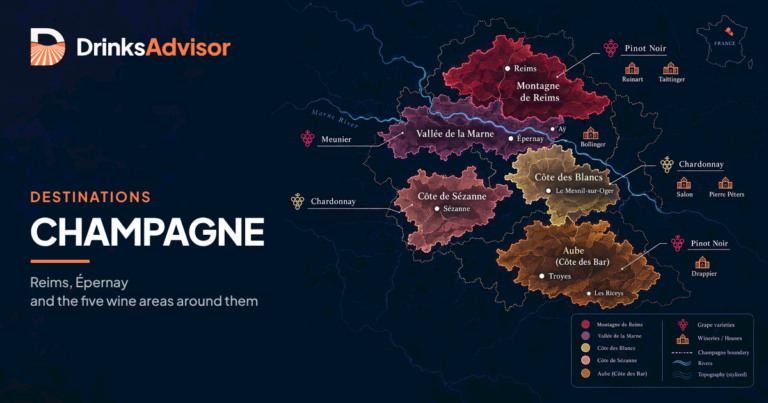
Every bottle you open on December 31 started in the chalk cellars under Reims and Épernay, which UNESCO lists as a World Heritage site, the Champagne Hillsides, Houses and Cellars. If the midnight bottle makes you curious, the region is an easy trip: our Champagne region travel guide covers the wine areas and when to go.
The big houses run cellar tours most of the year; we compare them in Champagne houses to visit in Reims and Épernay and, for Reims alone, in our guide to Reims Champagne tours. If you came to like grower Champagne, a small-group afternoon tour of family growers from Reims is one of the best-reviewed ways to meet the people behind the RM on the label.
Without a car, the simplest option is a guided day trip from Paris; we compare the options in Champagne tours from Paris. To stay a night or two among the vineyards, start with our pick of hotels in Épernay and Reims. In December, Épernay also lights up the Avenue de Champagne for the Habits de Lumière festival. Check opening days before you book, because many houses keep shorter hours in winter.
Common questions
What is the best Champagne for New Year’s Eve?
For a crowd, a non-vintage Brut: dry enough for party food and easy for everyone to like. A grower Brut gives the best value; a big-house Brut is the most familiar. Keep vintage and prestige bottles for a smaller table.
How many bottles of Champagne do I need for a New Year’s Eve party?
One 750 ml bottle pours six flutes. For the midnight toast alone, buy one bottle per six guests plus a spare; for a party where Champagne is the main drink, plan on half a bottle per guest.
Is Extra Dry Champagne drier than Brut?
No. Extra Dry carries 12 to 17 grams of sugar per liter and Brut less than 12, so Extra Dry tastes slightly sweeter. For a drier wine, look for Extra Brut or Brut Nature.
How cold should Champagne be at midnight?
Between 46 and 50°F. That takes three to four hours in the fridge, or 20 to 30 minutes in a bucket of ice and water.
The best New Year’s Eve Champagne is the one that is cold, open and poured when the countdown starts, so plan the bottles before you plan the label: count your guests, buy a spare, and chill everything in time. Then spend where it shows. A grower Brut for the crowd, one better bottle for the people who stay, and a Demi-Sec if there is cake. And if a glass at midnight leaves you wanting to see where it comes from, the cellars of Reims and Épernay are a short train ride from Paris and open most of the year.
Bottle prices are typical US retail ranges. Tour prices are indicative and set by our booking partners.