Puglia wine country runs the length of Italy’s heel, from the castle hills of the north to the red earth of Salento, with the sea never more than an hour away. It is where Primitivo and Negroamaro come from, where Italy bottled its first rosé, and where a night in a masseria among the olives and vines costs less than a hotel in Florence. This guide covers the four wine areas worth planning around, when to go, how to get around and where to sleep.
ⓘ We may earn a commission when you book through links on this page — at no extra cost to you. Affiliate Disclosure
- Best time to go
- May to June, and September to October for the harvest and the quieter beaches
- Nearest airports
- Bari (BRI) for Castel del Monte, Gioia del Colle and the Itria Valley; Brindisi (BDS) for Salento and Manduria
- Getting around
- Rental car or private driver. Trains link the cities, not the estates
- Typical budget
- $$ to $$$$, from a family-run masseria to a five-star resort on the coast
- Signature grapes
- Primitivo, Negroamaro and Nero di Troia for reds; Verdeca, Fiano and Bombino Bianco for whites
In this article
Understanding Puglia’s wine areas
Puglia is one of Italy’s biggest wine regions: around 91,700 hectares of vines, third in the country by area and second by volume, according to the 2022 ISTAT figures quoted by Decanter. For a long time most of that went into bulk wine and blends sold north. The change of the last few decades is what makes the region worth a trip now: estates that bottle their own wine, open their cellars and, often, rent rooms in the farmhouse next door.
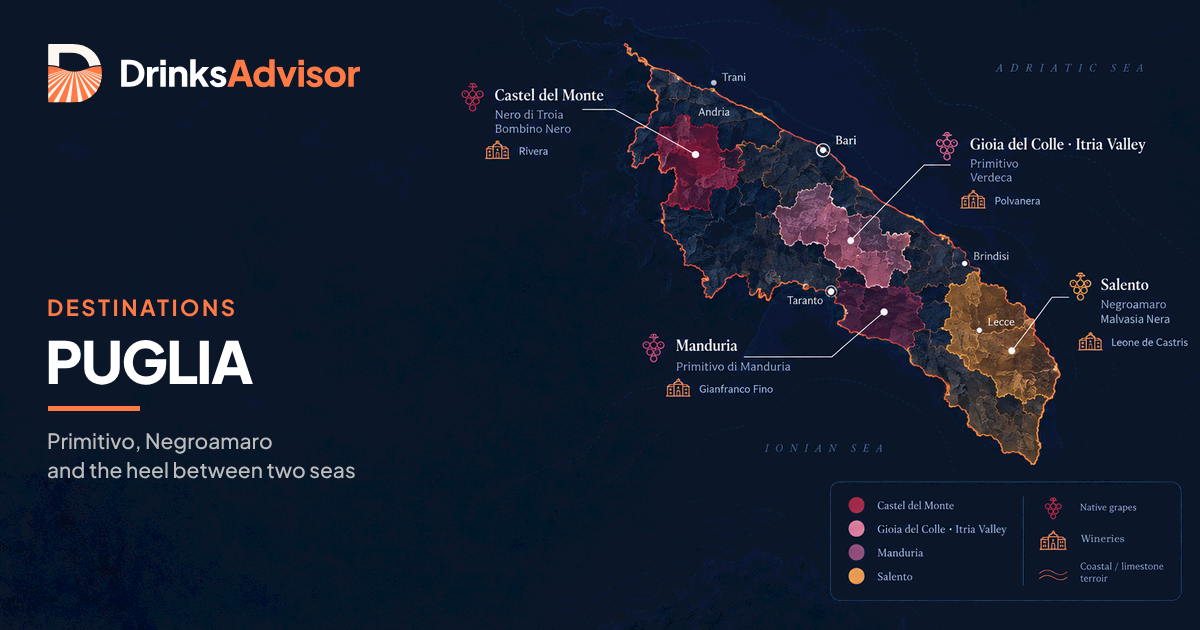
The region is long, about 400 km from the Gargano to the tip of the heel, so it pays to think of it as four areas rather than one. Each has its own grape, its own soil and its own kind of landscape, and each is a sensible base for two or three days.
Castel del Monte and the north — Nero di Troia
The Murge plateau west of Bari is limestone country, high and dry, and its wines are the leanest in Puglia. The appellation takes its name from Castel del Monte, the octagonal castle Frederick II built in the 1240s, a UNESCO World Heritage Site since 1996. Nero di Troia is the local red, structured and peppery; Bombino Nero makes bright rosato, and Aglianico does well here too. Three of Puglia’s four DOCGs belong to this area: Castel del Monte Rosso Riserva, Nero di Troia Riserva and Bombino Nero.
Further north, the flat Tavoliere around Foggia grows most of Puglia’s volume. It is not touring country, with one exception worth a detour: the metodo classico sparkling wines aged in tunnels under San Severo, made from the high-acid Bombino Bianco.
Gioia del Colle and the Itria Valley — mountain Primitivo and whites
In the middle of the plateau, Gioia del Colle grows Primitivo at 250 to 500 meters on crushed limestone. The altitude and the cool nights give it more acidity and lighter fruit than the Primitivo of the south, and a handful of young producers have made it the name to watch among Puglian reds.
A little east, the Itria Valley is the Puglia of the postcards: trulli with conical stone roofs, white towns on the ridges such as Locorotondo, Cisternino and Martina Franca, and Alberobello’s trulli district, also on the UNESCO list. Vineyards here sit above 400 meters, which suits white grapes. Locorotondo Bianco is the traditional blend; single-varietal Verdeca is the one that has caught on, and it is made for the raw seafood on every coastal menu.
Manduria — the home of Primitivo
Inland from the Gulf of Taranto, Manduria is Primitivo’s heartland: red, iron-rich clay over sand, dry summers and old bush vines. Primitivo is a close relative of California’s Zinfandel, and here it makes big, ripe reds that can top 16% alcohol. The Primitivo di Manduria DOC covers the dry wines; the sweet version, Primitivo di Manduria Dolce Naturale, is Puglia’s fourth DOCG.
The best producers now aim for balance rather than weight. Gianfranco Fino, whose Es became one of Italy’s most talked-about reds within a few years of the winery’s founding in 2004, has opened a wine resort next to his new cellar in Manduria. In town, the Museo della Civiltà del Vino Primitivo is devoted to the grape and its history.
Salento — Negroamaro and rosato
South of Brindisi the land flattens into the Salento peninsula, with Lecce and its baroque churches at the center and the sea on both sides. The grape is Negroamaro, often blended with Malvasia Nera: less muscular than Primitivo, more tannic, at its most refined in the Salice Salentino DOC.
Salento is also Italy’s rosato country. In 1943 Leone de Castris, a family that has made wine in Salice Salentino since 1665, launched Five Roses, the first rosé bottled and sold in Italy. The estate still pours it, runs a wine museum open to the public and has a hotel, Villa Donna Lisa, in the village. Cantele and the Antinori family’s Tormaresca are the other big names in the area.
For the curious — what a masseria is
A masseria is a fortified farmhouse, built to run a large estate of olives, wheat and vines and to protect the people who worked it. The older ones have thick stone walls, a watchtower and an inner courtyard. Hundreds have been restored as hotels, from simple farm stays to some of the most expensive resorts in southern Italy. When a Puglian estate offers rooms, they are almost always in its masseria.
When to visit Puglia wine country
The best months to visit Puglia wine country are May and June, then September and October. Spring brings warm days, wildflowers on the Murge and sea water just warm enough to swim by June. September and early October are harvest time: Primitivo, as its name suggests, ripens early, often from late August, and Negroamaro and Nero di Troia follow through September and into October.
July and August are hot, and they are beach months. According to Regione Puglia, more than 10 million visitors arrive in the summer, most of them heading for the coast. Masserie fill up and raise their rates, and many wineries slow down for the August holidays around Ferragosto on August 15. If summer is the only option, book visits ahead and plan tastings for the morning.
Winter is mild but quiet. Some coastal resorts and masserie close for the season, while the cities and most cellars stay open, with visits by appointment.
How to get around
Puglia has two international airports, Bari in the center-north and Brindisi in the south. From the US, United flies seasonally from Newark to Bari, four times a week in summer 2026, the only nonstop between the US and Puglia; otherwise connect through Rome, Milan or a European hub. Direct trains also run from Rome to Bari in about four hours, and to Lecce in about five and a half.
Once you are here, you need wheels. Trains and buses connect the towns, not the estates, and the wineries are spread across a region you can drive end to end in a few hours. A car also makes the masserie, often down a country lane, easy to reach. Fly into Bari and out of Brindisi, or the other way round, to avoid driving the length of the region twice. Our guide to renting a car for a wine trip covers insurance, the international driving permit and Italy’s limited-traffic zones.
If nobody in the group wants to skip the tastings, book a driver for the wine days and keep the car for the rest.
Compare rental rates on DiscoverCars →
Where to stay
The best base is a masseria with its own vines, or one a short drive from the cellars you want to visit. Puglia has them in every area, and the choice of area decides the shape of the trip.
- Itria Valley and the Murge: the central option. Trulli and masserie between Locorotondo and Ostuni, within an hour of Gioia del Colle, Castel del Monte and the coast.
- Manduria and the Ionian coast: for a trip built around Primitivo, with sandy beaches twenty minutes away.
- Salento: masserie around Lecce and Salice Salentino, for Negroamaro, rosato and the baroque towns.
For specific properties, with what each pours and what a night costs, see our round-up of wine masserie in Puglia.
Check Wine Masserie in Puglia →
What to do
Most Puglian estates welcome visitors by appointment, and the visit usually ends at a table: a tasting with local bread, olive oil, cheese and cured meats, sometimes a full lunch in the masseria. Book a day or two ahead, and more in summer.
- Taste Primitivo two ways: a ripe Manduria in the south and a fresher Gioia del Colle in the hills, a few days apart, show how much altitude changes the grape.
- Visit Castel del Monte: the castle and a Nero di Troia tasting nearby make an easy half day from Bari or Trani.
- Drink rosato where it started: Salice Salentino, Five Roses at the source, then dinner in Lecce.
- Pair Verdeca with crudo: the Itria Valley white and raw seafood in Monopoli or Polignano a Mare.
Bookable tastings and guided wine days are collected in our experiences section.
Natural and biodynamic wine in Puglia
A dry, windy climate makes organic farming easier here than in much of northern Italy, and a growing number of Puglian estates work that way. Two names from Decanter’s regional profile of Puglia are a good place to start: Morella, in Manduria, farms 13 hectares on biodynamic principles, including some of the oldest Primitivo bush vines in the area; Caiaffa, in the Tavoliere, is organic and makes low-intervention wines from Nero di Troia and other local grapes.
The labels can be confusing, and a bottle sold as natural is not always certified anything. Our guide to organic, biodynamic and natural wine explains what each term guarantees and how to ask a producer about it.
Practical tips for US travelers
- Book visits ahead. Few cellars have a walk-in tasting room. An email or a call a few days before is the norm, and many estates answer in English.
- Bring an international driving permit. Italy requires one alongside a US license, and rental desks may ask for it.
- Watch the ZTL signs. The old centers of Lecce, Ostuni and other towns are limited-traffic zones, enforced by camera. Park outside and walk in.
- Mind the drink-driving limit. It is 0.5 grams per liter in Italy, lower than in most US states, and zero for drivers who have held a license for less than three years. Spit, share, or hire a driver.
- Plan around lunch. Many wineries and shops close from about 1 pm to 4 pm. Book a morning visit, lunch nearby, then the beach or a town in the afternoon.
- Ship rather than carry. Primitivo is heavy and wine does not travel well in a hot car. Ask the estate if it ships to the US before you buy more than a few bottles.
Where to start in Puglia wine country
For a first trip of a week, split Puglia wine country in two. Spend three or four nights in the Itria Valley, with day trips to Gioia del Colle and Castel del Monte, then move south to a masseria near Manduria or Lecce for Primitivo, Negroamaro and the beaches of Salento. Fly into Bari and home from Brindisi, and you never drive the same road twice.
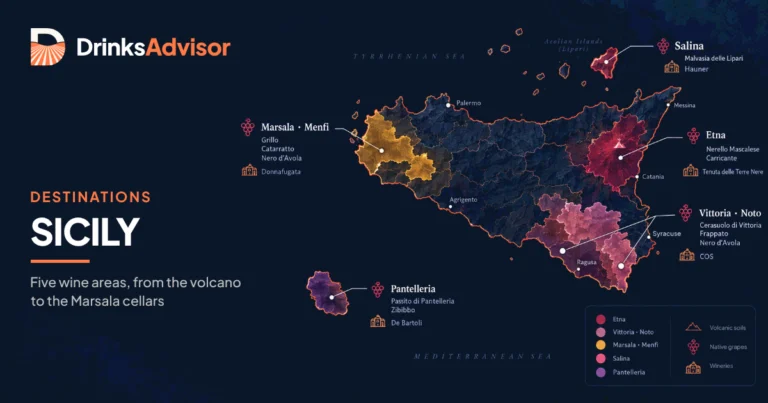
With more time, add a night in Trani on the Adriatic, or continue to the far south of the heel. If Puglia has you wanting more of southern Italy, our guide to Sicily wine country is the natural next trip. Either way, the place you sleep shapes the stay more than any single tasting: start there.
Check Wine Masserie in Puglia →