The Hong Kong Wine and Dine Festival closed its 2026 edition on November 1 after four nights on the Central Harbourfront, with more than 340 booths, a first extension into Tamar Park and, by the Tourism Board’s count, more than 171,000 visits. For wine travelers the headline was the Grand Wine Pavilion, where Bordeaux first growths and Burgundy grand cru shared the same tent. Here is what the 2026 festival offered, what it cost, and what to know if you are planning for 2027.
ⓘ We may earn a commission when you book through links on this page — at no extra cost to you. Affiliate Disclosure
- Dates
- Held October 29 to November 1, 2026
- Where
- Central Harbourfront Event Space and Tamar Park, Hong Kong Island
- Organizer
- Hong Kong Tourism Board, with the Bordeaux Wine Council as co-organizer
- Tickets in 2026
- HK$40 entry at the gate; Tasting Pass HK$258 and Grand Wine Pass HK$558 online, entry included
- Attendance
- More than 171,000 visits, up over 5% on 2025
- Next edition
- 2027 dates not yet announced
In this article
- What the Hong Kong Wine and Dine Festival is
- Tickets and tokens at the 2026 festival
- What poured at the Hong Kong Wine and Dine Festival 2026
- The 2026 festival in numbers
- Why the wine is cheap here
- Where to stay for the Hong Kong Wine and Dine Festival
- Getting to the Central Harbourfront
- What else to taste that month
- Past editions
- The 2027 edition: what we know
What the Hong Kong Wine and Dine Festival is
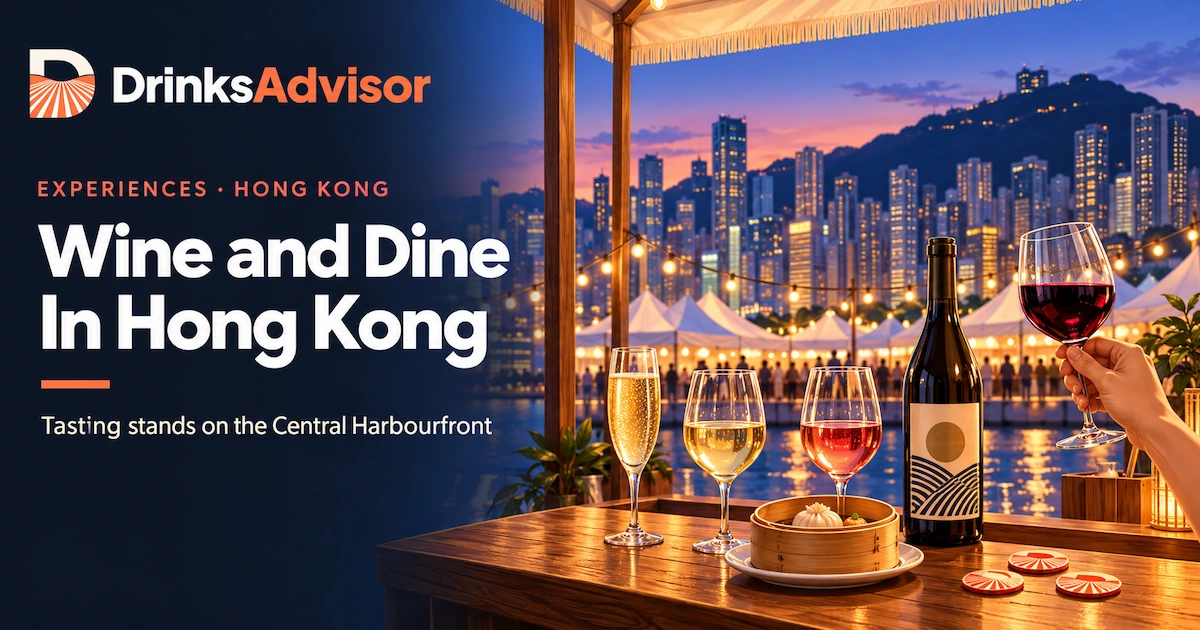
The festival is run by the Hong Kong Tourism Board, which stages it every year at the end of October on the reclaimed ground between the Central ferry piers and the office towers. The 2026 edition ran from Thursday, October 29 to Sunday, November 1 at the Central Harbourfront Event Space and, for the first time, the adjoining Tamar Park.
The format is simple enough to explain in a sentence: you buy entry, you buy tasting tokens, and you spend them booth by booth along the water. What makes it unusual is the breadth. A single evening can take you from a Bordeaux classified growth to a Georgian amber wine to something from Ningxia, poured by the importer who brought it in rather than by a brand ambassador.
One thing to know before you plan around it: the event is not only about wine. There are dedicated spirits booths and a long list of restaurant stalls, and the evening program leans on live music. This guide sticks to the wine, which is the half of the festival worth flying for.
Tickets and tokens at the 2026 festival
The Tourism Board published the 2026 prices in October, and they confirmed the shape of the thing. Entry cost HK$40 (about $5) at the gate, with half price for seniors, full-time students and young children. Tasting tokens cost HK$25 each (about $3), and most visitors bought them in a pass: the Tasting Pass, at HK$258 online (about $33), bundled entry, eight tokens and a standard glass, while the Grand Wine Pass, at HK$558 (about $72), added sixteen tokens, a heavier glass and access to the Grand Wine Pavilion. Bought online, the passes included entry; at the gate, entry was charged on top.
Two details are worth carrying into next year’s planning. Passes went on public sale through Trip.com on October 12, after a priority window for American Express cardmembers, and were sold first come, first served. And on Friday and Saturday the festival stayed open until 1am for the first time, which turns a single evening into something you can pace.
Hong Kong’s legal drinking age is 18, and you will be asked for photo identification at the gate.
What poured at the Hong Kong Wine and Dine Festival 2026
The Tourism Board’s October announcement put the 2026 edition at more than 340 booths from around 31 countries and regions, over 10% more than the year before, with first pavilions for Australia, Canada and South Korea. Three parts of that were where the wine actually was.
Good to know
The pavilion was the Bordeaux agreement made visible. The Conseil Interprofessionnel du Vin de Bordeaux came on board as co-organizer this year, and the French list leaned on it: returning châteaux led by a Lafite Rothschild 2016, a Mouton Rothschild from the celebrated 1982 vintage, and from Burgundy a Clos de Bèze from Domaine Armand Rousseau, one of the most prized bottles in any collector’s cellar. Those were the pours that justified the Grand Wine Pass. If they are the wines that bring you, the next step is the regions themselves: our guide to private cellar tours in Bordeaux covers the châteaux that open their doors, and Burgundy’s November starts with the Hospices de Beaune wine auction.
Italy and Spain sent collector bottles of their own: a Biondi-Santi Brunello di Montalcino Riserva 2013 and a Vega Sicilia Único 2015 from Ribera del Duero, with a six-liter Viña Vik from Chile for the large-format crowd. A pour of Biondi-Santi on a Hong Kong pier is a fine introduction to Montalcino; the estates themselves are in our list of Brunello tastings in Montalcino.
The new format was the Wine Walk, three guided routes you signed up for at a booth on site. One followed Cabernet Sauvignon from Bordeaux and Chile to Shangri-La in Yunnan; one stayed with Old World classics from Châteauneuf-du-Pape, Brunello di Montalcino and Germany’s best Pinot Noir regions; the third paired a Bordeaux orange wine, a Thai Viognier and a high-altitude wine from Yunnan with Hong Kong snacks. For anyone who finds a 340-booth harbourfront intimidating, it was the most useful addition of the year, and a format worth looking for again in 2027.
The masterclasses remained the best value on the site if you want structure instead of grazing: a seated session with someone who can explain what you just drank. The Tasting Room, by contrast, is a restaurant event rather than a wine one: its ten-hand dinner on October 30, cooked by Edward Lee, Chen Zhiping, Lau Yiu-fai, Thierry Marx and Justin Yang Yanbin, cost HK$2,380 a head.
The 2026 festival in numbers
The Tourism Board’s closing figures, reported by The Standard on November 2, put the four days at more than 171,000 visits, over 5% up on 2025, with festival sales up about 8%. These are the organizer’s own numbers, and they count visits rather than unique visitors: someone who came on Thursday and again on Saturday counts twice. The board did not publish a sales total.
For a visitor, the useful reading is about crowds. Exhibitors credited good weather, Halloween weekend and the later closing time for packed Friday and Saturday nights. If you are there for the wine rather than the party, Thursday evening, the shortest session, and Sunday afternoon are the times to work the booths.
Why the wine is cheap here
Hong Kong charges no duty on wine at all, a rate of zero percent, where spirits above 30% alcohol are still taxed heavily. The duty was abolished in 2008, and the city turned into Asia’s wine trading hub within a few years of the decision.
For a visitor this has two consequences. Pours at the festival cost a fraction of what the same bottle would cost you by the glass in a London or New York tasting, because no one is recovering an excise bill. And the importers who staff the booths are sitting on genuinely deep cellars, so the question “what else do you have open?” is worth asking. It is also why the festival can be an honest shortcut: four nights here will put more of the wine world in front of you than a fortnight of regional tasting rooms.
Where to stay for the Hong Kong Wine and Dine Festival
The 2026 festival is over and the 2027 dates are not yet announced, but the advice does not change with the year. Stay in Central or just above it. The festival runs late, the harbourfront empties onto the same two MTR stations at closing time, and with 1am closings now part of the format, the single best thing you can do for your own night is to be able to walk home.
1. Mandarin Oriental The Landmark, Hong Kong
The most comfortable version of this trip. The hotel sits inside the Landmark complex in the middle of Central, which puts the harbourfront at the end of a flat walk through covered walkways. Worth it if you intend to treat the festival as the center of a short, expensive, very pleasant long weekend rather than as one stop on a longer Asia trip.
Good to know
Check availability on Expedia →
2. The Murray, Hong Kong, a Niccolo Hotel
A converted government office block on Cotton Tree Drive, on the uphill edge of Central, and the pick of the three on value, at roughly half the Mandarin Oriental’s rate for the same nights. The walk down to the harbourfront is ten minutes and all of it is downhill, which matters more on the way back than on the way there.
Good to know
Check availability on Expedia →
3. Motto by Hilton Hong Kong Soho
The sensible option, and a good one if the festival is a single evening inside a bigger trip. Rooms are small, as they are at this price anywhere on Hong Kong Island, but the location in Soho is the one you want for the night after the festival, when you will be looking for somewhere to eat rather than another glass.
Good to know
Check availability on Expedia →
Book it
Hotels within walking distance of the Central Harbourfront
Filtered to Central and Western District, the hotels closest to the festival site.
Getting to the Central Harbourfront
You will not want a car, and you will not need one. The venue is within walking distance of both Central and Hong Kong MTR stations, the 2026 extension into Tamar Park added an entrance on the Admiralty side, and the Star Ferry pier is on the same stretch of waterfront if you are coming across from Tsim Sha Tsui, which is the better arrival for the view.
Closing time is the pinch point: everyone leaves at once, into the same two stations, so either leave half an hour early or stay for a last pour and let it clear. On the 1am nights the last trains are the thing to check before you buy one more token.
What else to taste that month
The festival hands over to Hong Kong Gourmet Month, which in 2026 runs to November 30 with more than 400 restaurants and bars taking part, wine-pairing menus among them, and discounts of up to 30% on selected Michelin Guide dishes. Festival passes came with a privilege card for more than 250 offers over the same weeks, so keep it if you are staying on. Vinitaly’s roadshow also stops in Hong Kong on November 13 and 14, though that one is for the trade.
It is also worth being honest about what Hong Kong is not. There are no vineyards to visit and no cellar door, so the festival is a tasting event rather than a wine region, and it works best as the reason for a city trip or as a stop en route to somewhere with vines. If what you want is the vines, the same money buys a week in Tuscany in the right month. If you want a big wine show closer to home, our recap of Vinitaly USA in New York covers the American trade equivalent, and the best wine tastings in Napa Valley are the bookable version of what the masterclasses here only sample.
Past editions
2024. The Tourism Board ran the festival over five days for the first time, from October 23 to 27, with over 300 wine and culinary booths at the same Central Harbourfront site.
2025. About 163,000 participants, by the Tourism Board’s count, the baseline against which the 2026 growth was measured.
2026. Four days, October 29 to November 1, with more than 340 booths and more than 171,000 visits. It was the first edition with the Bordeaux Wine Council as co-organizer, the first to spread into Tamar Park, and the first with guided Wine Walks and 1am closings.
The 2027 edition: what we know
Nothing official yet. The festival has landed in the last week of October or the first days of November in every recent edition, so late October 2027 is the sensible assumption for anyone booking flights far ahead, but it is an assumption and not a date. In 2026 the dates were public in early September and passes went on sale in mid-October, which is the realistic window to watch. We will update this page when the Tourism Board confirms.
If you are deciding whether to go at all, the question is not really the program. It is whether you want four nights of the whole wine world poured at duty-free prices with a skyline behind it, or the same budget spent in one region with the people who grew the fruit. Both are good trips. This one is simply the only place that offers the first of them.
Prices are “from” rates, indicative and set by our booking partners: they change with dates and availability, so check the current rate on Expedia.