Santorini wineries make some of the most distinctive white wine in Europe, from vines that grow in baskets on volcanic ash. Most visitors come for the caldera views and leave with a bottle of Assyrtiko they did not expect to love. This guide explains how the island’s vineyards work, which villages hold the cellars worth a visit, when to go, how to get around and where to base yourself.
ⓘ We may earn a commission when you book through links on this page — at no extra cost to you. Affiliate Disclosure
- Best time to go
- May, June, September and October, when the wineries are open and the island is calmer; harvest starts in mid-August, in the busiest weeks of the year
- Nearest airport
- Santorini (JTR), on the island itself, with connections through Athens and other European hubs; ferries also run from Piraeus, the port of Athens
- Getting around
- A rental car, a private driver or a guided tour; distances are short, but caldera roads are slow in summer
- Typical budget
- $$$ to $$$$, from a village guesthouse to a cave suite on the caldera rim
- Signature grapes
- Assyrtiko, with Athiri and Aidani for whites, and Mavrotragano and Mandilaria for reds
In this article
Understanding Santorini wine country: one island, four areas
Santorini is the rim of a volcano that collapsed into the sea. The towns everyone photographs cling to the inner cliffs, while the vineyards spread across the gentler outer slopes that run down to the beaches on the east and south. There are roughly 1,200 hectares (about 3,000 acres) of vines on the island, and that figure has been shrinking as hotels and villas take land that used to grow grapes.
What grows there is unlike anywhere else in Europe. The soil is volcanic ash and pumice with almost no clay, and the phylloxera louse that destroyed most of the world’s vineyards in the nineteenth century never survived in it. Santorini’s vines have never needed grafting onto American rootstock: when a vine gets old, growers cut it back and let it regrow from the same roots, so many root systems are centuries old. Rain is scarce, the summer air is humid, and the wind is strong enough that vines are trained low to the ground.
That is why you will see the kouloura everywhere: a vine woven into a round basket that sits on the ground, with the grapes growing inside it, sheltered from wind and sun. It looks like a bird’s nest, and it is the single most memorable sight on a wine day here. Because the island is small, it is easier to think of it as four areas than as a list of appellations.
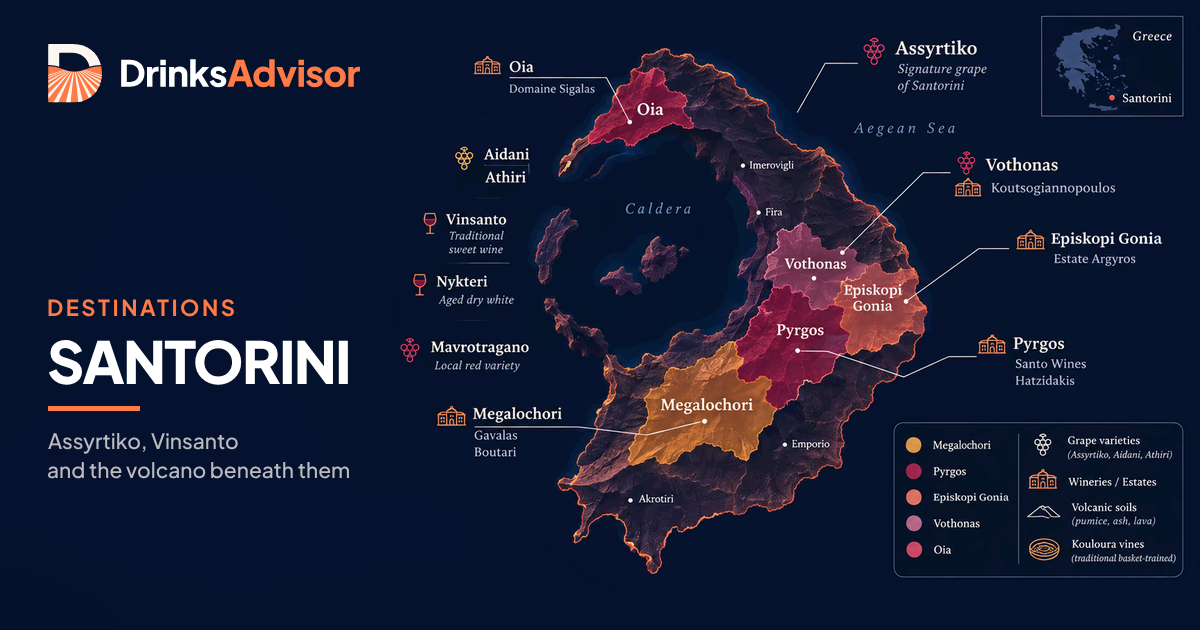
Pyrgos — the hill village at the center of the island
Pyrgos is one of the highest villages on the island, a tangle of lanes climbing to the ruins of a castle, and the closest thing Santorini has to a wine town. Its anchor is Santo Wines, the winery of the Union of Santorini Cooperatives, founded in 1947, which brings together the grapes of hundreds of small growers. Its wine tourism center is open all year, with a tasting terrace on the caldera side, a restaurant and a shop. It is the busiest tasting room on the island at sunset, and the easiest first stop for anyone short on time.
The caldera edge — cellars with a view
South of Fira, the road along the cliffs passes several wineries that pour with the caldera below. Venetsanos Winery describes itself as the first industrial winery on the island, and its visit combines a walk through the old building with a tasting and a light lunch. These are the places where the view is part of the price, so book the hour you want rather than turning up.
Episkopi Gonia and the east coast — old vines and the sea
The eastern slopes are where the vineyards are widest and the island feels most agricultural. Estate Argyros in Episkopi Gonia was established in 1903 and is the largest private owner of vineyards on Santorini, with more than 120 hectares. The estate says its vines average more than 70 years of age and that its oldest parcels are over two centuries old, which makes a tasting here a lesson in what the island’s own-rooted vines can do.
Down on the shore, Gaia Wines has worked since 1994 from an old tomato factory right by the water. The building is a reminder that tomatoes were once an island crop too, and it is the most relaxed setting for a tasting between two beach days.
Messaria and the interior — history underground
The flat middle of the island, around Messaria and the neighboring villages, is where you see the vineyards up close and where the wine’s history is easiest to follow. The Koutsogiannopoulos Wine Museum sits in a natural cave eight meters below ground and 300 meters long, on the grounds of the family’s winery. The family spent twenty-one years building it, and the walk through tools, presses and old photographs ends with a tasting. It is the best rainy-day or midday-heat stop on the island.
For the curious — Santorini, Nykteri and Vinsanto on the label
A bottle labeled Santorini is a dry white from the protected designation of origin, with at least 75% Assyrtiko and the rest Athiri or Aidani. Nykteri, from the Greek word for night, uses the same minimum of Assyrtiko, was traditionally picked in the cool of the night, and spends at least three months in oak, so it is richer and rounder. Vinsanto is the island’s sweet wine: at least 51% Assyrtiko, grapes dried in the sun for 12 to 14 days, then aged at least 24 months in barrel.
When to visit the Santorini wine country
Santorini is a summer island, and July and August bring heat, cruise passengers and the highest hotel rates of the year. The harvest also falls in that window, starting around mid-August, earlier than in most of Europe because of the heat. If you want to see grapes coming in, aim for the second half of August and book everything months ahead.
For tastings without the crush, May, June, September and October are the sweet spot. The sea is warm enough to swim from June, the wineries keep full hours, and the light on the vineyards in the late afternoon is easier to enjoy when you are not queuing for a table. Some smaller wineries keep seasonal hours, so check before you go; Santo Wines in Pyrgos stays open all year.
Winter is quiet, often windy, and many hotels and restaurants close. It can suit a traveler who wants the island almost to themselves, but plan around what is actually open. For how harvest timing works in other wine regions, our guide to the wine harvest season compares the main European and Californian dates.
How to get around
Santorini has its own airport (JTR), a few minutes from Fira, with flights from Athens year-round and from many European cities in season. From the US, the usual route is a connection through Athens or another European hub. Ferries and high-speed boats also run from Piraeus, the port of Athens, and from other Cycladic islands, arriving at the port below the cliffs.
On the island, distances are short: most wineries are within twenty to thirty minutes of each other by car. The catch is the road along the caldera, which gets slow and congested in summer, and the parking in Fira and Oia, which is scarce. A rental car gives you the most freedom for an independent wine day, especially if you are staying in a village rather than on the cliffs.
Greece’s drink-driving limit is lower than in most US states, so the driver should taste little or nothing; our guide to renting a car for a wine trip in Europe explains the limits and the paperwork. For a day of serious tasting, a private driver or a small-group tour is the better choice, and you can keep the car for the beaches.
Compare rental rates on DiscoverCars →
Where to stay
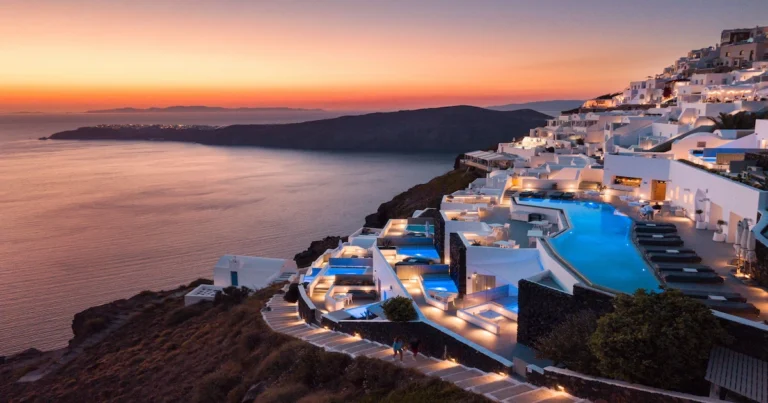
Where you sleep decides what kind of Santorini trip you have. The caldera towns give you the famous view; the inland villages put you closer to the vines and further from the crowds. For a wine-focused trip, the villages are often the better base, with the caldera an easy drive away for dinner. Our guide to where to stay in Santorini compares six hotels on both sides of that choice.
- Fira and Imerovigli: on the caldera rim, central for the airport, the port and the wineries in every direction. Expect steps, small rooms carved into the rock and the highest prices on the island.
- Oia: the most photographed village, at the northern tip. Beautiful and very busy at sunset, and the farthest from most wineries.
- Pyrgos and Megalochori: the quiet wine villages of the interior and the south, with boutique hotels in old houses and the cellars a short drive or walk away. Our first choice for a wine trip.
- Kamari and Perissa: the beach towns on the east and south coasts, near the vineyards of the eastern slopes. Easier on the budget, with no caldera view.
Check Santorini Hotels for Wine Lovers →
What to do
Two or three wineries in a day is plenty: tastings here are often paired with food, and the heat slows everyone down. A balanced first visit mixes a big, well-organized tasting room with a smaller family estate.
- A sunset tasting on the caldera: Santo Wines in Pyrgos is the classic, and the reason to book ahead in summer.
- An old-vine estate: Estate Argyros, for the clearest sense of how ancient the island’s vineyards are.
- A tasting by the sea: Gaia Wines, in its former tomato factory on the shore.
- Dinner in the vineyard: Domaine Sigalas, which began in 1991, is known for tastings paired with Cycladic food and for small sunset dinners among the vines.
- A cave museum: the Koutsogiannopoulos Wine Museum, for the history of winemaking on the island and a tasting at the end.
- A walk among the baskets: any vineyard road on the eastern slopes, in the early morning, to see the kouloura vines before the heat.
Order the island’s food alongside the wine: fava (a yellow split-pea purée), tomato fritters and grilled fish all suit a glass of Assyrtiko, whose acidity and salty edge are made for the sea.
Practical tips for US travelers
- Book tastings ahead from June to September. Sunset slots at the best-known wineries fill up days in advance, and many visits are by reservation only.
- Plan the day around the heat. Do vineyards in the morning, a cellar or the museum at midday, and keep the caldera tasting for the evening.
- Bring good shoes. Caldera hotels and towns are built on steps, and vineyard paths are loose ash and pumice.
- Think about bottles before you buy. Many wineries ship abroad; our guide to shipping wine home to the US explains what it costs and when it is worth it.
- Read the label for the style. Ask for Nykteri if you like fuller whites, and save room for a small glass of Vinsanto at the end.
Where to start with Santorini wineries
If you have a single day, start with the vines rather than the views: a morning walk among the baskets on the eastern slopes, a tasting at Estate Argyros, lunch in Pyrgos and a sunset glass at Santo Wines. With two days, add the wine museum and a slower afternoon at Gaia by the sea, and you will have seen every side of the island’s wine.
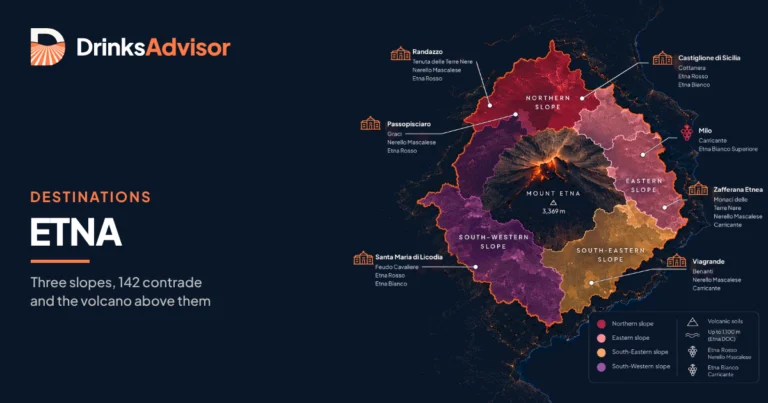
Santorini wineries reward the traveler who stays a night or two in the villages rather than visiting on a day trip from a cruise ship. And if the volcanic soils win you over, the same pull explains another island’s wines: our guide to Mount Etna wine country covers Sicily’s volcano, while our explainer on organic, biodynamic and natural wine helps you read the labels you will find on both.
Check Santorini Hotels for Wine Lovers →