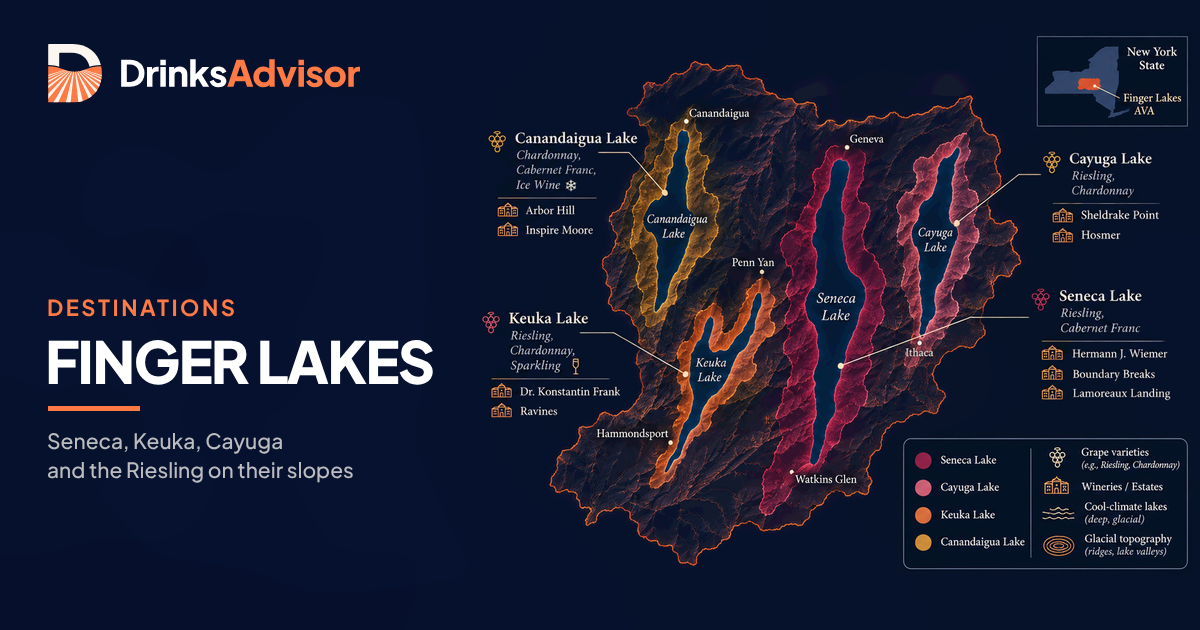
Finger Lakes wine country is upstate New York’s answer to the Rhine: long, deep glacial lakes, steep vineyard slopes and Riesling on almost every tasting bar. It is also one of the easiest serious wine regions in America to visit, with cellar doors that still feel like farms. This guide explains how Seneca, Cayuga, Keuka and Canandaigua lakes differ, when to go, how to get around and where to base yourself.
ⓘ We may earn a commission when you book through links on this page — at no extra cost to you. Affiliate Disclosure
- Best time to go
- September and October for harvest and fall color; June to August for the lakes themselves
- Nearest airport
- Rochester (ROC) or Syracuse (SYR); Ithaca (ITH) and Elmira-Corning (ELM) are closer but smaller
- Getting around
- A car, or a driver for the tasting days; there is no useful public transport between wineries
- Typical budget
- Standard tastings from about $18 per person; seated and library tastings run $75 to $95
- Signature grapes
- Riesling first, then Cabernet Franc, Chardonnay, Gewürztraminer and Pinot Noir, plus hybrids such as Vidal and Seyval Blanc
In this article
Understanding Finger Lakes wine country: four lakes, one cool climate
The Finger Lakes were cut by successive waves of glaciers, and some of the trenches they left reach as deep as 618 feet below sea level. That depth is the whole point. Deep water stores heat, so the lakes act like radiators: in winter they feed the snow that blankets the vines, in spring they hold back budbreak until the frost has passed, and in fall they keep the slopes warm long enough to ripen grapes. The historian Richard Figiel notes that vineyards near the shore can sit 10 to 15°F warmer than land half a mile away.
The Finger Lakes became an American Viticultural Area in 1982, with two sub-appellations added later: Cayuga Lake in 1988 and Seneca Lake in 2003. According to the Finger Lakes Wine Alliance, the region has about 10,790 producing acres, and it supplies roughly 80 percent of all the wine made in New York State. Wine Enthusiast named it its 2025 American Wine Region of the Year.
The history is older than most visitors expect. The first vines went into the ground in Hammondsport, at the southern tip of Keuka Lake, in 1829, and by 1900 more than 50 wineries lined the lakes. The modern era began with Dr. Konstantin Frank, a Ukrainian viticulturist who arrived in New York in 1951, planted European grape varieties on the slopes above Keuka in 1958 and founded his winery in 1962. His story is the reason the region pours dry Riesling today rather than only sweet wines from native grapes. Most of the vineyards sit around four lakes, each with its own pace.
Seneca Lake — the deepest water and the biggest cluster of cellars
Seneca is the center of gravity. The lake is so deep that it has frozen over only a few times in the past century, and the Seneca Lake Wine Trail counts dozens of member wineries along its two shores, pouring Riesling, Cabernet Franc, Chardonnay, Pinot Noir and sparkling wine. The west side, between Geneva and Dundee, holds several of the region’s most respected Riesling estates, including Hermann J. Wiemer. The east side is gentler and more casual, with more food stops between tastings. Geneva sits at the north end, Watkins Glen at the south.
Cayuga Lake — Ithaca and the family estates
Cayuga was the first of the two sub-appellations, recognized in 1988. Its wineries are mostly family-owned and operated, and tastings here are often poured by the people who farm the vines. Ithaca, a college town at the southern tip, gives you restaurants and gorges within a short drive of the cellars on both shores. It works well as a second base once you know Seneca.
Keuka Lake — Hammondsport and the birthplace of the region
Keuka is the Y-shaped lake, and the one with the deepest roots: Hammondsport, at its southern end, is where Finger Lakes wine began. Dr. Konstantin Frank still welcomes visitors above the west shore, and the Keuka Lake Wine Trail groups a smaller set of producers, among them Heron Hill, Keuka Spring, Weis Vineyards and Domaine LeSeurre. Keuka is quieter than Seneca and suits a slower day: fewer stops, longer tastings, a lunch with a view of the water.
Canandaigua Lake — the western edge
Canandaigua is the westernmost of the four main wine lakes and the closest to Rochester, which makes it the natural first stop if you fly into ROC. The town of Canandaigua sits at its northern tip. It has fewer wineries than Seneca or Cayuga, so treat it as a half day on the way in or out rather than the core of the trip.
For the curious — reading a Finger Lakes Riesling label
The average producer here makes two or three styles of Riesling every year, so the grape name alone will not tell you what is in the glass. Look for the words dry, semi-dry or late harvest on the front label, and for a sweetness scale on the back, which many wineries print. Dry Rieslings are crisp and citrusy; semi-dry ones keep a touch of sweetness that balances the acidity. The region also grows hybrids such as Vidal and Seyval Blanc, and native grapes like Concord and Catawba, which you will find mostly in the sweeter and lighter wines.
When to visit Finger Lakes wine country
September and October are the best months to visit Finger Lakes wine country. Harvest usually runs through both, the hillsides turn color by early October, and the tasting rooms are busy without the crowds of high summer. Weekends in this window fill fast, so book seated tastings and dinners ahead. Our guide to the wine harvest season explains what you can and cannot see in the vineyards at this time of year.
June to August is lake season: swimming, boats, waterfalls at full flow and long evenings on winery patios. It is also the busiest time, and Saturday afternoons on the Seneca shore can feel like a party bus route. Go on weekdays if you can.
Winter is snowy and quiet. Many tasting rooms stay open, often with shorter hours, and the lake effect that protects the vines also brings heavy snow to the roads. Spring is pleasant from May, when the vines wake up and the summer rush has not started. If you only have one trip in you, choose the fall.
How to get around
You need a car. The wineries are strung out along the lake roads, the lakes are long and narrow, and crossing from one shore to the other means driving around an end. There is no public transport worth planning around, and taxis and ride-hailing are thin outside Ithaca and Geneva.
Rochester is the most practical airport for Canandaigua, Keuka and the west side of Seneca; Syracuse suits Cayuga and the north end of Seneca. Ithaca and Elmira-Corning are closer to the southern lakes but have fewer flights. All four have rental desks, and picking up the car at the airport saves a second transfer.
Plan the tasting days around a designated driver or a hired one. New York’s limit is 0.08 percent, as in other states, but the state also has a lesser offense, driving while ability impaired, that starts at 0.05. Three or four wineries a day is plenty. Our guide to renting a car for a wine trip covers insurance and the practical details.
Compare rental rates on DiscoverCars →
Where to stay
Pick a base by lake, not by hotel. Each town below puts a different set of cellars within a short drive, and changing base once on a longer trip saves hours in the car.
- Geneva: at the north end of Seneca Lake, with the widest choice of restaurants and the easiest access to both Seneca shores and the north of Cayuga.
- Watkins Glen: at the south end of Seneca, next to the state park gorge, and within reach of the southern Seneca wineries and Keuka.
- Ithaca: at the south end of Cayuga, the liveliest town in the region, with gorges and dining that fill the evenings.
- Hammondsport and Penn Yan: at the two ends of Keuka, small and quiet, for a slower trip built around the oldest part of the region.
- Canandaigua: at the north tip of Canandaigua Lake, the closest base to Rochester airport.
Lakeside inns and bed-and-breakfasts are the classic Finger Lakes stay, and the best rooms on fall weekends go months ahead. Our guide to Finger Lakes hotels picks six across the four lakes, from a 1914 lakeside villa in Geneva to an inn among the Glenora vineyards on Seneca. If the trip falls on a harvest weekend, book the room before the tastings.
What to do
The wineries are the reason to come, but the region gives you plenty for the hours in between. A good trip mixes two or three tastings a day with a walk or a museum.
- Gorges and waterfalls: the gorge trail at Watkins Glen State Park is the famous one, and Ithaca has several more within a few miles of downtown.
- Seated tastings: several estates offer longer, guided tastings with food or older vintages, which is the best way to understand how Riesling ages here.
- Vineyard walks: some wineries run guided walks through the vines in season, Dr. Konstantin Frank among them.
- The Corning Museum of Glass: near the Elmira-Corning airport, a good rainy-day stop at the southern edge of the region.
Sustainability is a common thread: according to the Finger Lakes Wine Alliance, most growers limit synthetic fungicides and pesticides, and many tasting rooms run on renewable energy. If you want to know what the labels on organic and biodynamic bottles actually mean, read our guide to organic, biodynamic and natural wine.
Practical tips for US travelers
- Budget: tastings cost far less than in California. At Dr. Konstantin Frank a standard tasting starts at $18 per person and a seated tasting with small bites at $75; the library tasting at Hermann J. Wiemer is $95.
- Reservations: walk-ins still work on many weekdays, but book ahead for weekends, groups and anything seated.
- Shipping: many wineries ship by the case, but what they can send depends on your home state. Our guide to shipping wine home explains the rules.
- Bottles in the car: in summer, a cooler bag keeps the wine you buy from cooking in the trunk between stops.
- Layers: the lakes make their own weather, and a warm afternoon on the shore can turn cool fast on a hilltop terrace.
Where to start in Finger Lakes wine country
For a first trip to Finger Lakes wine country, give it three or four days and two lakes. Base yourself in Geneva or Watkins Glen, spend two days on Seneca (one shore each day), and keep a third for Keuka, with Hammondsport and Dr. Konstantin Frank at its heart. With a fourth day, add the Cayuga shore and dinner in Ithaca.
What makes the region worth the flight is the contrast with the West Coast. Where Napa Valley and Sonoma sell sun, scale and big reds, the Finger Lakes sell cold water, steep slopes and white wines with real tension, poured by small producers at a gentler price. Taste the dry and semi-dry Rieslings side by side at your first stop, and you will understand the rest of the trip.