Planning a trip to the Champagne region, France? It is closer to Paris than most travelers expect: Reims is 45 minutes away by fast train. What surprises first-timers is how varied it is, from the grand houses and their chalk cellars to family growers in villages of a few hundred people. This guide explains the five areas, when to go, how to get around and where to base yourself.
ⓘ We may earn a commission when you book through links on this page — at no extra cost to you. Affiliate Disclosure
- Best time to go
- May to June for long, mild days in the vines; late summer to September for the harvest
- Nearest airport
- Paris Charles de Gaulle (CDG); Reims is about 45 minutes from Paris Gare de l’Est by TGV
- Getting around
- Regional trains between Reims and Épernay; a rental car or a driver for the villages and the Côte des Bar
- Typical budget
- $$ to $$$$, from a grower’s guest rooms to a five-star spa above the vineyards
- Signature grapes
- Pinot Noir, Meunier and Chardonnay
In this article
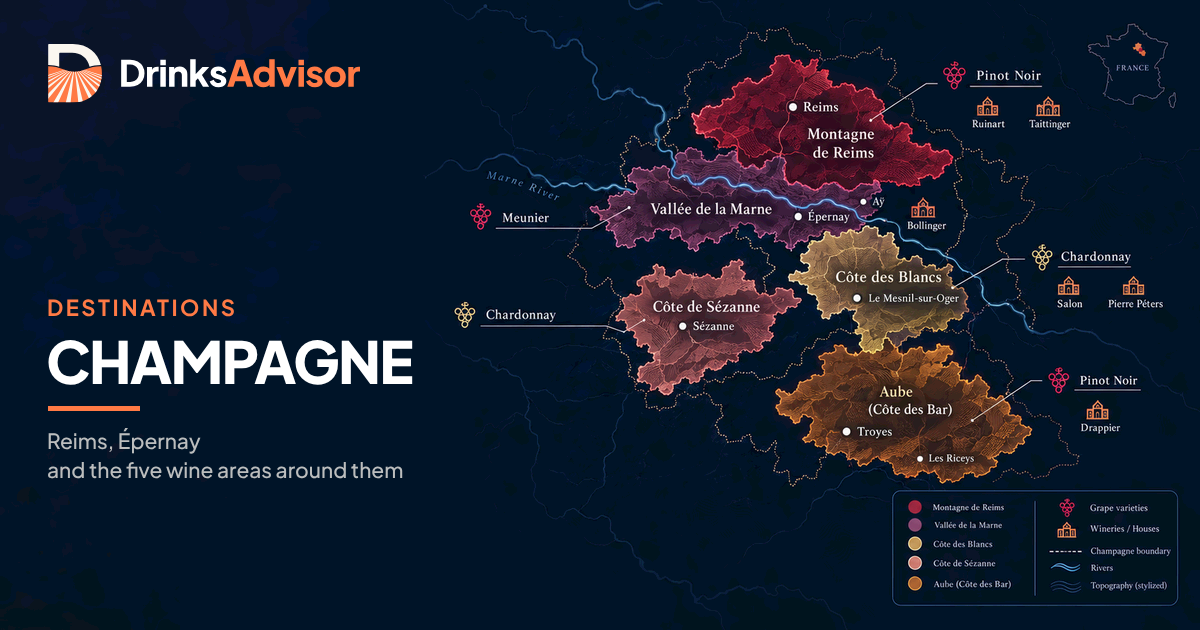
Understanding the Champagne region’s five wine areas
Champagne is a protected name with a precise map. According to the Comité Champagne, the trade body of growers and houses, the appellation covers about 34,000 hectares of vines in 319 villages, farmed by some 16,000 growers. Around 370 houses and 130 cooperatives make and ship most of the wine, and the United States is its second-largest market.
Every village has a rating. Seventeen are classified grand cru and 42 premier cru, and you will see those words on labels. For a traveler, though, the useful division is geographic: four areas around Reims and Épernay, plus the Côte des Bar far to the south.
Montagne de Reims — Reims and the Pinot Noir villages
The Montagne de Reims is a low, wooded plateau between Reims and the Marne, ringed by vineyards. Its slopes are Pinot Noir country, and some of the best-known grand cru villages are here: Verzenay and Verzy on the north side, Ambonnay and Bouzy on the south.
Reims is the obvious base. It has the cathedral where French kings were crowned, good restaurants, and several of the great houses, many of them on or near the Saint-Nicaise hill, where the cellars were cut into old chalk quarries. The vineyard villages are 20 to 30 minutes away by car.
Vallée de la Marne — Épernay, Aÿ and Hautvillers
The Marne valley runs west from Épernay toward Paris, with vineyards on both banks. Meunier, the most forgiving of the three grapes, dominates as you move west; around Aÿ, a grand cru, Pinot Noir takes over again.
Épernay is smaller than Reims and more focused on wine. Its Avenue de Champagne is lined with houses, and the town counts about 110 kilometers of cellars beneath it. Hautvillers, on the hill just north, is where the monk Dom Pérignon worked at the abbey; together with Aÿ and Mareuil-sur-Aÿ, its slopes are part of the UNESCO site described below.
Côte des Blancs — the Chardonnay slope
South of Épernay, an east-facing slope of chalk is planted almost entirely with Chardonnay, the white grape that gives the area its name. Cramant, Avize, Oger and Le Mesnil-sur-Oger are all grand cru villages, and blanc de blancs, Champagne made only from white grapes, is the local specialty.
This is the best place to meet growers who make their own wine. The villages are a short drive apart, so two or three visits fit easily into a morning. Further south, the smaller Côte de Sézanne continues the same Chardonnay theme with fewer visitors.
Côte des Bar — the Aube, far to the south
The Côte des Bar sits in the Aube department, about two hours’ drive south of Épernay and closer to Chablis than to Reims. Its clay and limestone hills are mostly planted with Pinot Noir, and the producers are mainly growers rather than houses. Les Riceys, also known for a rare still rosé, is the best-known village.
It deserves a night of its own rather than a day trip from Reims. Combine it with Troyes, the old capital of the Champagne fairs, for a slower second half of the trip.
For the curious — What the label tells you
Champagne gets its bubbles from a second fermentation in the bottle, and then rests on its lees, the spent yeast, before release. The rules set a minimum of 15 months for non-vintage wines and three years for a vintage. Two small letters on the label say who made it: RM (récoltant-manipulant) is a grower who makes wine from their own grapes, NM (négociant-manipulant) is a house that also buys grapes. Brut and extra brut tell you how dry it is; blanc de blancs means Chardonnay only, blanc de noirs means red grapes only.
When to visit the Champagne region, France
May and June are the easiest months. The vines are green, the days are long, the houses run their full program of visits and hotels are not yet at summer rates. July and August are busy with European travelers but still pleasant, as the climate here is cool even in summer.
Harvest has traditionally been a September event, but it is moving earlier: in 2026 the official picking dates, published village by village, were the earliest ever recorded, in August. Harvest is a great time to see the region working, with pickers in the rows and presses running in every village. It is also the hardest time to get a visit at a small grower, who will be in the vineyard all day.
Winter is quiet and often gray, but the big houses stay open, and the cellars are the same temperature all year. If your trip is about tasting rather than scenery, November to March brings lower hotel rates and easier bookings. Our guide to wine harvest season explains what changes in a wine region during the picking weeks.
How to get around
Champagne is one of the few wine regions you can reach without a car. TGV trains from Paris Gare de l’Est reach Reims in about 45 minutes, and direct trains to Épernay take about an hour and 20 minutes. Regional trains link Reims and Épernay in about 30 minutes, though service is thinner on Sundays.
That is enough for the big houses in both towns, which are within walking distance or a short taxi ride of the stations. The villages are another matter. Growers in the Côte des Blancs or the Montagne de Reims are spread out, buses are rare, and the Côte des Bar is only practical by car. The local tourist office’s guide to a day trip to Épernay and Reims from Paris sets out the train options.
If you drive, remember that the limit in France is 0.5 grams of alcohol per liter of blood, lower than in the United States, and that a tasting at a house usually means two or three full glasses. Our guide to renting a car for a wine trip in Europe covers insurance, tolls and drink-driving rules. If both of you want to taste, a driver for the village day is money well spent.
Compare rental rates on DiscoverCars →
Where to stay
Choose your base by what you want to do most. The distances are short, but every move costs time you could spend in a cellar.
- Reims: the best choice for a first trip without a car. Fast trains from Paris, the cathedral, the most restaurants and several great houses within walking distance.
- Épernay: smaller and entirely about wine, with the Avenue de Champagne on the doorstep and the Côte des Blancs and the Marne valley a short drive away.
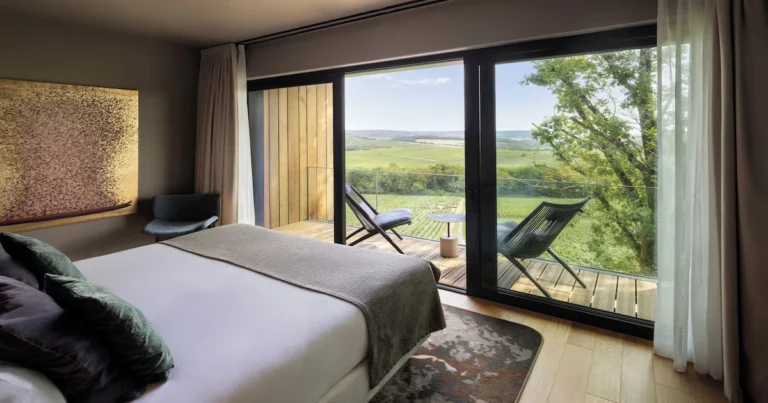
- A vineyard village: for quiet nights and grower visits, a guest room at a family estate or a hotel among the vines, such as the Loisium on the hillside above Aÿ, at the edge of the Montagne de Reims regional park. You will need a car.
- Troyes or the Côte des Bar: for the southern half of a longer trip, with a different landscape and almost no tour groups.
For most people, two nights in Reims or Épernay plus one in the vines is the right shape. Our round-up of hotels in Épernay and Reims picks eight, on the Avenue de Champagne, by the cathedral and among the vineyards, with rates and the trade-offs of each base.
Check Hotels in Épernay and Reims →
What to do
Most trips mix three kinds of visit, and the best ones balance them.
- The great houses: guided tours of the cellars, often in chalk galleries tens of meters underground, followed by a tasting. They are polished, informative and almost always bookable online; book ahead for weekends and for the premium tastings.
- The growers: smaller, more personal visits, often with the person who made the wine. Most take visitors by appointment only, so write or call before you go.
- The landscape and the heritage: the abbey church at Hautvillers, the vineyard lighthouse at Verzenay, which houses a museum of the vine, and the Reims cathedral.
For the first two, our guide to the Champagne houses to visit in Reims and Épernay picks eight visits you can book from home, from a Veuve Clicquot cellar tour to a one-hour tasting at a family grower, and lists the famous names that sell visits only on their own websites.
Since 2015 the Champagne hillsides, houses and cellars have been a UNESCO World Heritage site. It covers three places: the historic slopes of Hautvillers, Aÿ and Mareuil-sur-Aÿ, the Avenue de Champagne in Épernay, and the Saint-Nicaise hill in Reims, where the cellars spread through old chalk quarries. Seeing all three gives you the whole story, from vine to bottle to shipping.
Natural and biodynamic wine in Champagne
Organic farming is harder here than in the south: the climate is cool and damp, and mildew is a constant threat. That makes the growers who do it worth seeking out. Champagne Fleury, in Courteron in the Côte des Bar, converted its whole vineyard to biodynamics in 1989, the first Champagne producer to do so, and is still a reference for the movement.
On labels and estate websites you will meet several logos. AB is the French organic mark, Demeter and Biodyvin certify biodynamic farming, and Viticulture Durable en Champagne is the region’s own sustainability standard, which is broader and less strict than organic. Our guide to organic, biodynamic and natural wine explains what each one actually requires.
Practical tips for US travelers
- Book the houses ahead. Many of the big names sell visits online with fixed times, and the popular slots fill days or weeks in advance in May, June and September.
- Plan three visits a day at most. A house tour with tasting takes one to two hours, and you will want time for lunch.
- Bring a layer. The cellars stay cool all year, even when it is warm outside.
- Check Sunday and Monday opening. Small growers and some restaurants close, and trains are fewer on Sundays.
- Think about the bottles you buy. Grower Champagnes are often hard to find in the US. Our guide to shipping wine home to the US explains the options and costs.
Where to start in the Champagne region
For a first trip of three or four days, start in Reims: a house or two on the Saint-Nicaise hill, the cathedral, dinner in town. Move to Épernay for the Avenue de Champagne, then spend a day with a driver or a car in the Côte des Blancs and the Montagne de Reims, visiting growers by appointment.
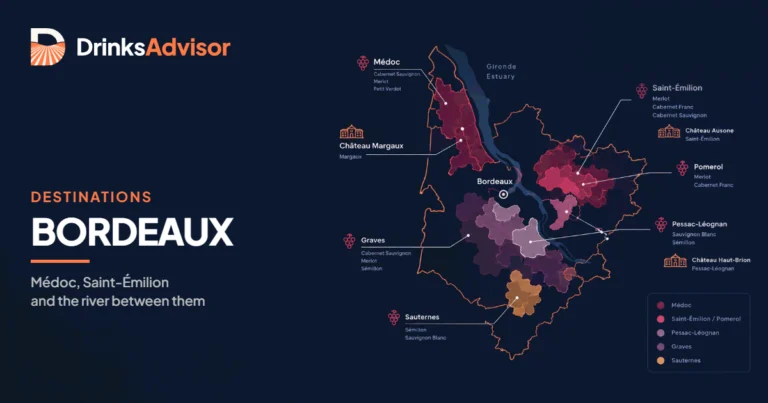
With more time, add two nights in the Côte des Bar and Troyes. If you are combining Champagne with another French region, our guide to Bordeaux for wine travelers shows how different a trip there feels: bigger estates, longer drives and red wine at the center. Champagne rewards the opposite approach, short distances, many small doors and a lot of time underground.
Check Hotels in Épernay and Reims →