Sicily wine country is bigger and more varied than most first-time visitors expect: an island roughly the size of Vermont, with a volcano at one end, salt pans and old Marsala cellars at the other, and baroque hill towns in between. Etna gets the headlines, but Vittoria, Noto and the far west make wines just as distinctive. This guide covers the five wine areas worth planning around, when to go, how to get around and where to sleep among the vines.
ⓘ We may earn a commission when you book through links on this page — at no extra cost to you. Affiliate Disclosure
- Best time to go
- May to June, and September to October for the harvest
- Nearest airports
- Catania (CTA) for Etna, Vittoria and Noto; Palermo (PMO) or Trapani (TPS) for Marsala and the west
- Getting around
- Rental car or private driver. Trains link the cities, not the estates
- Typical budget
- $$ to $$$$, from a farm stay in the Ragusa hills to a five-star base in Taormina
- Signature grapes
- Nero d’Avola, Frappato and Nerello Mascalese for reds; Grillo, Carricante and Zibibbo for whites
In this article
Understanding Sicily wine country
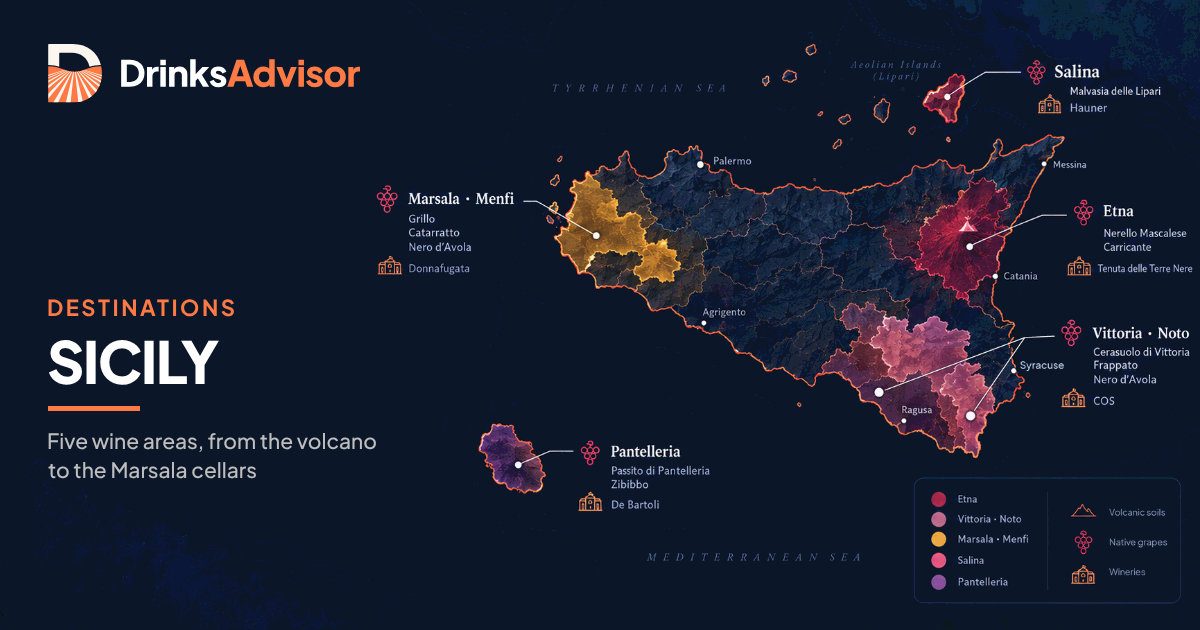
Sicily has more vineyards than almost any other Italian region, but for a traveler the island breaks down into five areas, each a day’s drive or more from the next. Trying to see all of them in a week means living in the car. The better plan is to pick one side of the island, or two areas that sit close together, and give each at least three nights.
The split that matters most is east versus west. The east, served by Catania airport, holds Etna, Vittoria and Noto. The west, served by Palermo and Trapani, holds Marsala, Menfi and the road to Pantelleria. The islands off the north and south coasts are a separate trip again.
Etna — the volcano in the northeast
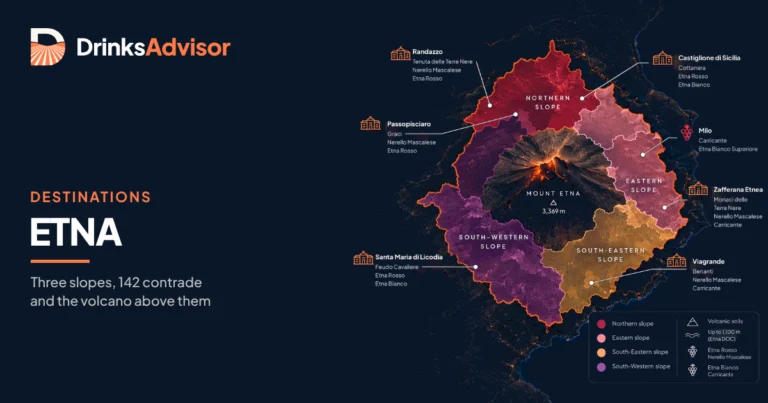
Etna is the reason many Americans first look at Sicilian wine. Vines climb the volcano’s slopes to well over 1,000 meters, the soils are black lava sand, and the reds from Nerello Mascalese drink more like Burgundy than like the sun-baked south. The whites, from Carricante, are some of the most mineral in Italy.
The volcano deserves its own trip, and it has its own guide: our Etna wine country guide covers the north, east and south slopes, the contrade and when to go. The Etna DOC consortium keeps the official list of producers.
Vittoria — Cerasuolo and Frappato
In the southeast, around the town of Vittoria in Ragusa province, the landscape turns to red sandy soil, dry-stone walls and carob trees. This is the home of Cerasuolo di Vittoria, a blend of Nero d’Avola (50 to 70 percent) and Frappato. It became a DOC in 1973 and, in 2005, the first DOCG awarded in Sicily.
Cerasuolo means “cherry-colored”, and the wine lives up to it: bright, fragrant and lighter than its color suggests, good slightly chilled. Frappato on its own is lighter still. Vittoria is also one of Sicily’s centers of natural winemaking, which makes it the most rewarding area for curious drinkers (more on that below).
Noto and the southeast — Nero d’Avola’s home
A little east of Vittoria, the Noto DOC covers the communes of Noto, Avola, Rosolini and Pachino in the province of Syracuse. Nero d’Avola, Sicily’s best-known red grape, takes its name from the town of Avola, and here it grows a few kilometers from the sea, in heat that gives ripe, generous wines.
The draw for travelers is the combination. Noto, Modica, Ragusa and Scicli are among the baroque towns of the Val di Noto, a UNESCO World Heritage site, and the wineries sit in the countryside between them. It is the easiest area of Sicily to mix wine, architecture and beach days without long drives.
Marsala and the west — Grillo and fortified wine
Western Sicily is flatter, windier and greener in spring, with salt pans along the coast between Trapani and Marsala. Marsala is where Sicilian wine first went international: the Liverpool merchant John Woodhouse landed here in 1773 and began shipping the local fortified wine to Britain, and Benjamin Ingham and the Florio family followed. Marsala became a DOC in 1969.
Forget the cooking Marsala sold in American supermarkets. A Marsala Vergine, aged at least five years without added sweetening, is dry, nutty and complex, and the old cellars in town are one of the best visits on the island. The same grapes, Grillo above all, also make crisp dry whites. Farther south, around Menfi and Sambuca di Sicilia, the vineyards run down toward the sea; Planeta, which started in Menfi, now farms estates in five Sicilian areas, Vittoria, Noto and Etna included.
The islands — Salina and Pantelleria
Two small islands make sweet wines with a long history. On Salina, in the Aeolian archipelago off the north coast, Malvasia delle Lipari is a golden dessert wine from dried grapes. Pantelleria, closer to Tunisia than to Sicily, grows Zibibbo (Muscat of Alexandria) for Passito di Pantelleria.
Pantelleria’s low bush vines, planted in hollows to escape the wind, are on UNESCO’s list of intangible cultural heritage, added in 2014. Neither island is a day trip: plan them as a stay of their own at the end of a mainland itinerary.
For the curious — what a baglio is
You will see the word baglio on wine labels and hotel signs all over western Sicily. A baglio is a fortified farmhouse built around a central courtyard, with high outer walls that once protected the harvest, the animals and the people who worked the land. Many were wine estates, and several have been turned into hotels: when a stay is called a baglio, expect thick stone walls, a courtyard and vines nearby.
When to visit Sicily wine country
The best months to visit Sicily wine country are May and June, and September and October. In late spring the countryside is still green, the sea is warm enough for a swim by June, and the wineries have time for visitors. In autumn the harvest is under way and the light turns gold.
The harvest runs in a long wave across the island. The low, hot vineyards of the southeast and the west pick first, from August. Etna, with its high vineyards, picks last, well into October. That makes early October a good compromise: the volcano is in full harvest and the rest of the island has cooled down.
July and August are the months to avoid for a wine-focused trip. Inland temperatures can pass 100°F, many Italians are on vacation, and small producers are busy in the vineyard. Winter is mild on the coast and quiet everywhere, which suits a city-and-food trip more than a winery one.
How to get around
Sicily is a driving island. The motorways link the main cities, but the estates sit on country roads, often several kilometers from the nearest village, and public transport does not reach them. Distances add up quickly: Catania to Marsala is more than three hours by car, which is why one side of the island per trip is the sensible rule.
Pick up the car at the airport closest to your first area: Catania for the east and southeast, Palermo or Trapani for the west. Ask for a compact model: the old centers of Noto, Ragusa and Marsala have narrow lanes and limited-traffic zones that fine drivers automatically. Our guide to renting a car for a wine trip covers insurance, drinking limits and the paperwork Americans need.
For tasting days, a private driver is worth the money: Italy’s blood alcohol limit is lower than in the US, and a day of three estates adds up. Most wine hotels can book a driver or a guide for you.
Compare rental rates on DiscoverCars →
Where to stay
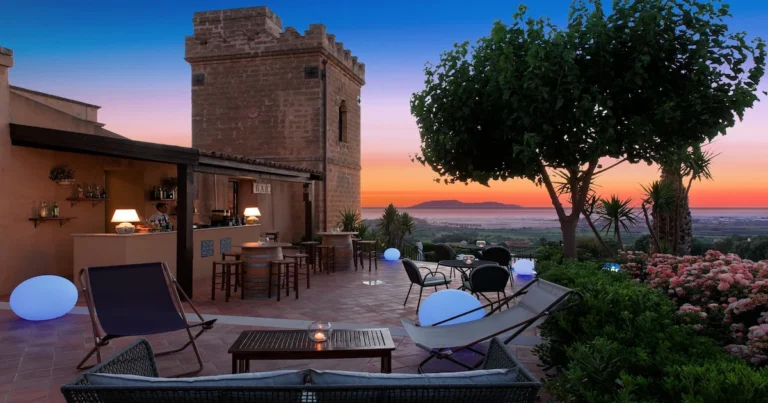
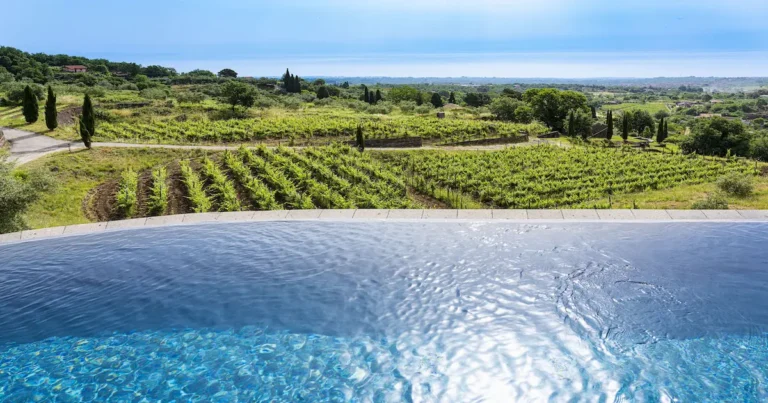
The best base is a wine estate with rooms, and Sicily has good ones in every area. A baglio in the west, a farm in the Ragusa hills or a villa among the lava terraces of Etna all put you in the vineyards rather than an hour’s drive from them.
- Etna: estates and boutique hotels on the north slope, or a seaside base in Taormina. See Etna wine resorts and where to stay in Taormina.
- Vittoria and the Ragusa hills: small wine estates with rooms and dinner on the farm, such as Baglio Occhipinti near Vittoria and Locanda Gulfi above Chiaramonte Gulfi.
- Noto: the town itself, for the baroque streets and the restaurants, with the wineries a short drive away.
- Marsala and Menfi: restored bagli on working estates, from Baglio Oneto outside Marsala to Planeta’s La Foresteria at Menfi.
- The islands: Capofaro, a Malvasia estate around a working lighthouse on Salina.
We compared seven of them, island-wide, in our round-up of the best wine resorts in Sicily, with what each one is like to stay in and who it suits.
Check Best Wine Resorts in Sicily →
What to do
Book winery visits ahead, by email or through the estate’s website, and plan two a day at most. Many Sicilian producers are family estates with no tasting room in the Napa sense: the visit is a walk through the vineyard and the cellar, then a tasting at the kitchen table, often with food. Allow two hours, and longer if lunch is offered.
In Marsala, the historic cellars are the main event: tours walk through long aging halls full of old casks, and the tastings run from dry Vergine to sweet styles. In the west, the salt pans between Marsala and Trapani and the island of Mozia, a Phoenician site in the lagoon, fit easily between two tastings.
In the southeast, pair the wineries with the baroque towns: a morning in a Vittoria cellar, an afternoon in Ragusa Ibla or Modica, dinner in Noto. On Etna, a guided walk on the upper slopes is the obvious companion to a tasting.
Bookable tastings and tours are listed in our Experiences section, which is growing region by region.
Natural and biodynamic wine in Sicily
The hot, dry, windy climate makes organic farming easier here than in most of Europe, and Sicily has taken advantage of it. Figures from the Sicilia DOC consortium, reported in 2022, put the island’s organic vineyards at about 30,000 hectares, roughly a third of all organic vineyard land in Italy.
Vittoria is the place to see the natural side up close. COS, founded in 1980 by three friends whose initials make its name, farms by biodynamic principles and ages part of its wine in terracotta amphorae. Arianna Occhipinti, from the same family, built a following among natural-wine drinkers with her Frappato. On Etna, a small group of producers works the same way on the volcano.
Labels can mean different things, so if the distinction matters to you, read our explainer on organic vs biodynamic vs natural wine before you go, and ask producers directly how they farm. Most are happy to explain.
Practical tips for US travelers
- Nonstop flights exist. In 2026 Delta flies New York JFK to Catania daily, with a winter break from early January to the end of February, and United flies Newark to Palermo three times a week from late May. Schedules change each season, so check before you plan around them.
- Book visits ahead. Walk-ins are rare, and on Sundays and in August many estates are closed.
- Lunch is the big meal. Restaurants in the countryside often close between lunch and dinner, and dinner rarely starts before 8 p.m.
- Carry some cash. Cards are widely accepted, but small producers and village bars may prefer cash for bottles and coffee.
- Shipping wine home is possible through some estates and specialist shippers; otherwise pack bottles in checked luggage, within your airline’s allowance.
- Tipping is not expected the way it is in the US. Rounding up or leaving a few euros for great service is enough.
Where to start in Sicily wine country
For a first trip of a week, fly into Catania and split the time between Etna and the southeast: four nights on the volcano, three in the Ragusa hills or near Noto. The drive between them takes about two hours, and the wines could hardly be more different. On a second trip, fly into Palermo and give the west its due, with Marsala, Menfi and, if time allows, the ferry from Trapani to Pantelleria.
Whichever side you choose, the stay shapes the trip more than any single tasting. Start by choosing where you will sleep among the vines.
Check Best Wine Resorts in Sicily →