Gambero Rosso Italian Wines 2027, the English-language edition of the Vini d’Italia guide, will be presented in Rome on October 25, bringing the Tre Bicchieri awards back to La Nuvola as Gambero Rosso marks its 40th anniversary. The full national picture is still taking shape, but previous editions, Tuscany’s record showing last year and the first 2027 regional results already offer useful clues about what wine travelers should watch.
ⓘ We may earn a commission when you book through links on this page — at no extra cost to you. Affiliate Disclosure
In this article
What the 2027 guide is, and why travelers should care
For wine drinkers outside Italy, Gambero Rosso’s Italian Wines can look like another annual awards list. It is more useful than that. The guide follows producers across the country, evaluates wines region by region and gives its highest recognition, Tre Bicchieri, to the bottles that reach the top level of its tastings.
This year’s official presentation is scheduled for October 25, 2026 at the Roma Convention Center La Nuvola. The event also opens Gambero Rosso’s 40th-anniversary celebrations, with the new guide, its award-winning producers and ten wineries being recognized for the anniversary on the same stage.
For a traveler, the guide matters because the names on its pages are not confined to restaurant wine lists. Many of the regions that dominate Italian Wines are also the places people build trips around: Chianti Classico, Montalcino, Bolgheri, Barolo, Etna and dozens of smaller areas where a winery visit can explain far more than a label can.
The sensible way to use the guide is therefore not as a shopping list. It is a map of producers, grapes and regions worth investigating. A Tre Bicchieri result can point toward an established estate, but just as interesting are the appellations and producers appearing at the top for the first time.
How Gambero Rosso Italian Wines 2027 works
The complete statistics for the 2027 edition have not yet been published, so the previous guide is the best reference for the scale of the process. For the “Vini d’Italia” 2026, Gambero Rosso reported that more than 40,000 samples entered the selection. Around 12,300 wines made the guide, roughly 2,300 reached the final tastings and 508 received Tre Bicchieri.
That distinction matters. Tre Bicchieri is the headline, but it represents the narrow end of a much larger selection. Gambero Rosso also notes that it awards only one wine per winery at the top level in this process, so a producer’s other bottles can sit close to the winning wine without appearing in the Tre Bicchieri list.
The guide also uses Special Awards to tell a different part of the story. The 2026 edition had 13 of them, covering categories that included value, individual producers and emerging talent. Those awards are useful because they can expose changes that a simple regional medal count misses: a young producer gaining attention, an inexpensive bottle outperforming expectations or a grape variety entering the top tier for the first time.
This is why reading only the longest Tre Bicchieri lists gives an incomplete picture. The more interesting question is often not which famous region collected the most awards, but where a new name, grape or denomination has crossed the threshold.
What past editions suggest about the 2027 guide
The first rule is not to turn last year’s results into predictions. A guide is built from new tastings, different vintages and wines released on different schedules. What the 2026 edition can show is where the pressure points were before the new results arrived.
One was the breadth of the top tier. Among the 508 Tre Bicchieri wines in 2026, Gambero Rosso highlighted first-time top awards for a Biferno Rosso from Molise, a Ribona from the Marche and a Cirò Bianco from Calabria. It later counted 49 wineries receiving Tre Bicchieri for the first time. That makes the guide more interesting for travel than a list dominated only by famous estates would be.
Another was the visibility of regions outside the classic Tuscany-Piedmont axis. Calabria’s renewed momentum, native varieties in central and southern Italy and smaller denominations all received attention alongside Barolo, Brunello and Bolgheri. If the 2027 edition continues that pattern, the useful story will be where the field expands, not merely which familiar names return.
There is also a stylistic point. Gambero Rosso describes its selection as open to both established traditions and newer approaches, including orange wines, spontaneous fermentations and resistant grape varieties. That does not mean those styles are automatically rewarded. It does mean the guide is broad enough that a traveler should expect a more varied version of Italian wine than the old shorthand of Barolo, Brunello and Super Tuscans.
Tuscany remains the benchmark region to watch
Tuscany is the obvious place to start because its 2026 result was exceptional even by its own standards. Gambero Rosso awarded 94 Tuscan wines Tre Bicchieri, the highest regional total in that edition.
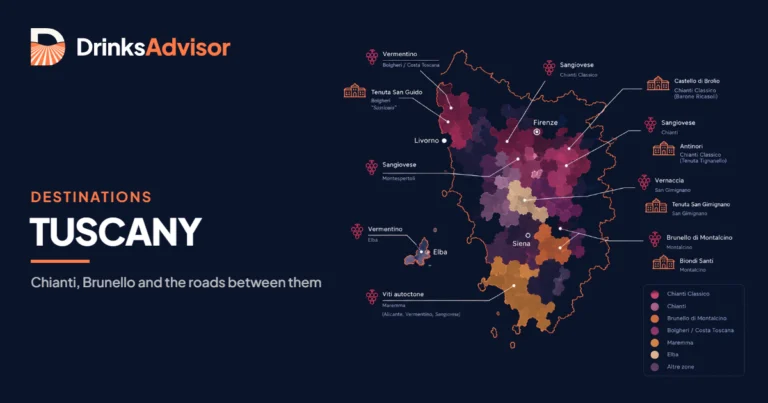
The number alone is less interesting than the geography behind it. Tuscany can put Bolgheri whites and reds, Chianti Classico, Brunello di Montalcino and wines from the Maremma into the same regional chapter without making them feel interchangeable. A traveler following the guide therefore has several very different trips available inside one region.
If this is the part of the 2027 results you plan to follow most closely, our Tuscany wine country guide explains how the major areas fit together. For the practical side, the vineyard hotels we would use as bases cover several of those zones, while our Chianti wine tours from Florence are the easier option when you would rather taste than drive.
What we would not do is publish a list of supposed 2027 Tuscan winners before Gambero Rosso does. Previous awards tell us which areas have depth; they do not tell us which bottle a tasting panel will select from a new vintage.
The first 2027 signal has already arrived from Sicily
The 2027 cycle is no longer entirely speculative. On September 19, Gambero Rosso published its Tre Bicchieri 2027 results for Sicily, giving the first concrete regional look at the new guide.
The editorial message is striking: white wines are taking a larger role in a region still strongly associated with powerful reds. Gambero Rosso describes the 2024 growing season for many red varieties as hot and dry, with uneven ripening in some areas, while the island’s whites provided a particularly effective way of reading Sicily’s range of altitude, coast, volcanic soils and local varieties.
Etna is naturally prominent in that conversation, but the broader point matters more. Sicily is too large and varied to reduce to a single style, and the first 2027 release reinforces that idea. For travelers, that is more useful than a national league table: it suggests paying attention to how a region is changing, not merely how many awards it collects.
More regional lists will fill in the picture before the Rome presentation. Until they are official, each new release should be read as another piece of the guide rather than evidence for a predicted national winner.
Planning a trip around the October 25 presentation
The presentation gives serious wine travelers a reason to be in Rome at an unusually useful moment. Producers and award-winning bottles converge in one place, and the 2027 guide arrives just as the main autumn harvest period has finished across much of Italy.
If the guide is the purpose of the trip, keep Rome as the base rather than trying to turn the event day into a wine-region excursion. La Nuvola is in the EUR district, well south of the historic center, so choose accommodation with a straightforward Metro B connection or allow enough time for a taxi across the city.
Staying in Rome for the Italian Wines presentation?
Compare places to stay in Rome for the October 25 event, then use the days around it for a longer wine-country trip.
The better extension comes after Rome. Tuscany works especially well if the 2027 results send you toward Chianti Classico or Montalcino: Florence is easily reached from Rome by high-speed train, and from there the trip can shift from an awards event to the vineyards themselves.
A second option is to use the guide as a filter rather than a schedule. Note the producers and denominations that genuinely interest you, then check which wineries receive visitors and build the route around those appointments. An award-winning wine does not automatically mean a useful cellar visit, and a great visit does not require a Tre Bicchieri label.
That distinction is central to how we use rankings at DrinksAdvisor. They are evidence, not a substitute for travel research. Our selection criteria, handling of ratings and approach to commercial links are explained in our editorial methodology.
Looking for a Car in Rome? Check on DiscoverCars →
By October 25, the interesting part of Gambero Rosso Italian Wines 2027 will not be a single winner. It will be the pattern created by hundreds of selections: which regions strengthened their position, where new producers arrived and which grapes gained ground. For travelers, that pattern is the useful part. It can turn an annual guide into a shortlist of places worth putting on the next itinerary.