What is orange wine? It is a white wine made more like a red: the juice ferments with the grape skins, and sometimes the seeds and stems, instead of being pressed away from them immediately. That skin contact gives the wine deeper color, tannin and a broader texture. For travelers, the most rewarding place to understand the style is northeastern Italy, especially Oslavia and the Collio hills of Friuli.
In this article
What is orange wine, exactly?
Despite the name, orange wine has nothing to do with oranges. It starts with white wine grapes. The difference is what happens after harvest: instead of separating the juice from the skins almost immediately, the winemaker leaves them together for part or all of fermentation. You may also see the same family of wines described as skin-contact white wine, amber wine or, in Italy, vino macerato.
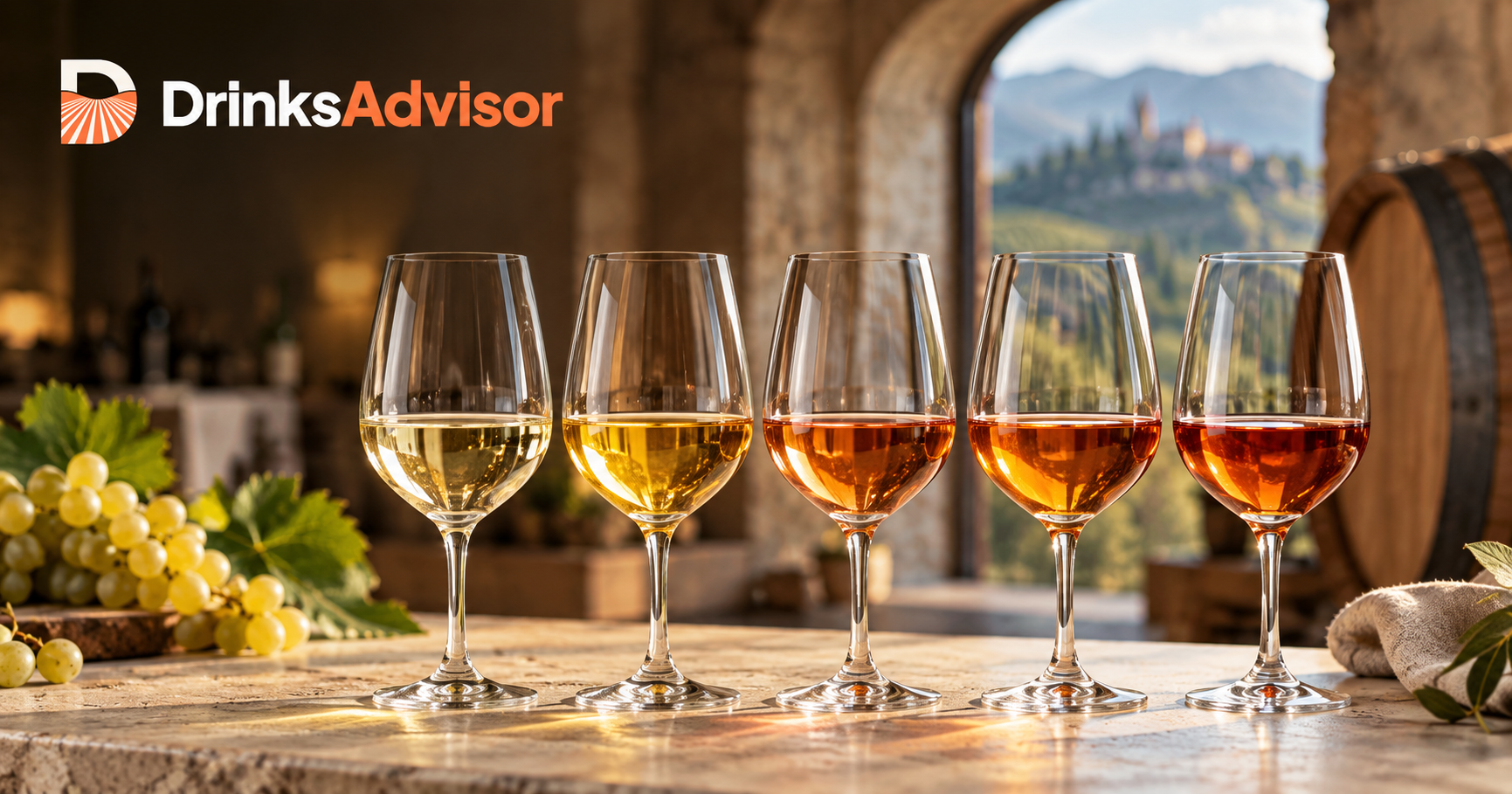
The method borrows from red-wine production. Red grapes usually ferment with their skins because the skins contribute color, tannin and flavor. Orange wine applies that logic to white grapes. The result can be pale gold, copper, amber or genuinely orange, but color alone does not tell you how intense the wine will taste.
It is also important not to confuse a winemaking technique with a philosophy. Orange wine is not automatically natural, organic, biodynamic, unfiltered or made without added sulfites. Some producers combine several of those choices; others do not. DrinksAdvisor treats wine style and wine philosophy as separate things for exactly that reason.
Rosé is different too. A rosé usually starts with red grapes and gets a short period of skin contact to extract a little color. Orange wine starts with white grapes and uses skin contact to build structure as well as color. If a restaurant lists both, expect the orange wine to feel more tannic and textural.
How skin contact changes a white wine
White-wine skins contain phenolic compounds that standard white-wine production usually leaves behind. Keep the juice on those skins and the wine picks up more texture, bitterness and tannin. It can also extract deeper color and a different set of aromas. The longer and warmer the maceration, the more obvious those effects tend to become, although grape variety, vessel, oxygen exposure and cellar technique matter just as much.
There is no single recipe. A producer may macerate for a few days and make something close to a structured white, or keep the wine on the skins for weeks or months and end up with a bottle that behaves more like a light red. That is why two wines sitting next to each other under an “orange” heading can feel unrelated in the glass.
Clay vessels are often associated with the style, but they are not required. Georgia’s traditional qvevri method is the clearest historical reference point: UNESCO describes wine fermented and stored in buried, egg-shaped earthenware vessels, traditionally with juice, skins, stalks and pips together for months. The qvevri tradition was inscribed by UNESCO in 2013.
In Friuli, the modern revival took its own path. Radikon’s published history records a decisive shift to macerated Ribolla in 1995, followed by progressively longer macerations; by 2002 the estate says its wines were macerating for three months. That timeline is useful because it shows that today’s orange-wine culture in the region is not a single ancient custom frozen in place. It is also the result of recent experimentation.
What does orange wine taste like?
The useful answer is: more varied than the color suggests. A light skin-contact Pinot Grigio may be floral, citrusy and gently grippy. A long-macerated Ribolla Gialla can move toward dried apricot, orange peel, tea, herbs and savory spice. Some wines show nuts, bruised apple or cider-like notes. Others stay bright and almost salty.
Texture is the common thread. Even when the aroma reads like a white wine, the palate often carries tannin, the drying sensation more commonly associated with reds. That changes how the wine works with food. Orange wines can handle dishes that flatten delicate whites: roast poultry, mushrooms, aged cheese, grilled vegetables, pork, richer fish and the herb-heavy cooking you find across northeastern Italy.
Do not assume that “funky” is part of the definition. Some orange wines are cloudy, oxidative or deliberately wild in aroma, but many are clean, precise and polished. If you are new to the style, tell the sommelier whether you want fresh and bright or deep and savory. That is more useful than asking for the darkest bottle.
Temperature helps. Serve a structured orange wine a little warmer than a refrigerator-cold white, roughly in the cool-cellar range rather than icy. Too cold and the tannin can feel hard while the aromas disappear.
Where to try orange wine in Italy
Friuli: start with Oslavia and the Collio
If the trip is built around orange wine, Friuli is the logical starting point. Oslavia sits just outside Gorizia, close to the Slovenian border, in the Collio hills. Ribolla Gialla is the grape to remember, and long skin contact here is not a passing fashion: it is what the hill is known for, and what its growers have built their reputations on.
The names are easy to learn, because there are not many of them. Josko Gravner is the producer most often credited with the modern revival of the style, after he turned to buried Georgian qvevri in his own cellar. The Ribolla growers of the hill are grouped in APRO, the Associazione Produttori Ribolla di Oslavia: Dario Princic, Fiegl, Gravner, Il Carpino, La Castellada, Primosic and Radikon. Seven estates in one small village is also the practical argument for going, since it is one of the few wine destinations you can understand properly in a weekend.
For a first visit, look for estates that make both conventional whites and macerated versions. The contrast teaches more than tasting four orange wines in a row. The official Friuli Venezia Giulia tourism listing for Primosic in Oslavia, for example, lists Ribolla Gialla Riserva, Friulano “Skin” and Pinot Grigio “Skin” as orange wines. The same page is the argument for planning ahead: the tasting room holds a maximum of 15 people, visits run Thursday to Saturday in two windows (10:00 to 12:00 and 15:00 to 17:00), booking goes through the winery by email, and English is spoken. Opening times checked on September 23, 2026.
Radikon is the other reference name. Its own winery history makes the evolution of maceration unusually transparent. Even if you do not arrange a visit there, reading that timeline before a Collio tasting gives you a vocabulary for the questions that follow: grape, days on skins, vessel, aging and sulfite use. The estate also lets rooms, which is worth knowing in an area where the memorable addresses are cellars rather than hotels.
Do not stop at the Collio boundary. The Carso, behind Trieste, has its own skin-contact culture, often around varieties such as Vitovska and Malvasia Istriana. Getting there is easier than the distances suggest: Trieste airport sits between the two areas, Venice is roughly two hours away by road, and Gorizia is the obvious base for Oslavia. A car is close to essential, because the cellars are rural and scattered, and appointments rarely line up neatly. Two serious visits in a day is usually enough if you also want lunch rather than a tasting marathon.
Tuscany: less central, still worth seeking out
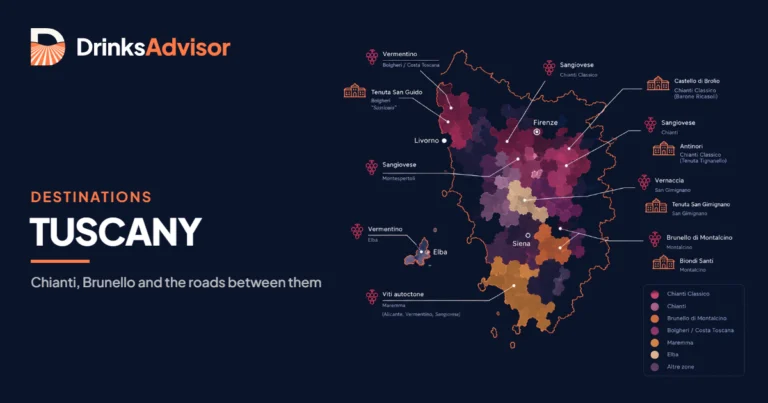
Tuscany is not the center of Italian orange wine, which is exactly why the interesting bottles feel more producer-specific. In Chianti, Montesecondo makes Tïn from Trebbiano: a review republished by the winery describes a wine matured in amphora after a long maceration on the skins. The estate takes tasting bookings at its own space in San Casciano Val di Pesa, half an hour south of Florence, which makes it a detour rather than a separate trip.
If Tuscany is already on your itinerary, use orange wine as a side route rather than the whole plan. Our Tuscany wine country guide explains the main areas, while the Chianti wine tours from Florence are the practical option when nobody in the group wants to drive after tasting.
The same approach works elsewhere in Italy. Skin-contact whites appear producer by producer rather than under one national style rule. When you are traveling, search the wine list for the method, not just the color: macerato sulle bucce, fermentato sulle bucce, amphora or clay-vessel references, and native white grapes are better clues than an orange icon next to the bottle.
How to order it, and what to read on the label
At a winery, three questions will tell you more than a technical monologue. First: how long was the wine on the skins? Second: did it ferment in steel, wood, concrete, amphora or qvevri? Third: was the wine protected from oxygen or allowed a more oxidative evolution? Those answers explain most of what you are about to taste.
At an Italian restaurant, ask for a vino bianco macerato sulle bucce, a white wine macerated on its skins. If the list is long, give the server a direction: lighter and fresher, or more tannic and savory. That avoids the common beginner mistake of assuming the deepest amber color must be the most authentic choice.
Order it with food if possible. Tannin makes skin-contact whites unusually flexible at the table, and the style often makes more sense with a plate than in a tasting flight. In Friuli, cured meats, frico, mushrooms and richer first courses are natural partners. In Tuscany, try it where a structured white would normally sit between antipasti and a lighter meat dish.
The label may not use the words “orange wine” at all. Italian producers are just as likely to describe the process in technical language, or to let the grape and the cuvée name do the work. The words worth knowing are macerato, sulle bucce, skin contact and sometimes amber. Amphora, clay or qvevri tell you about the vessel, not about how long the wine stayed on its skins.
Grape names help you navigate a tasting. In Friuli, Ribolla Gialla is the obvious reference, followed by Friulano, Pinot Grigio and Malvasia Istriana; in Tuscany, Trebbiano is the name to watch. None of them is an orange-wine grape, since each makes conventional whites too, which is why a good shop or tasting room matters more than a label shortcut. Ask for two contrasting bottles from the same grape: one short maceration and one long one will teach you more than a shelf organized only by color.
If you are buying a bottle to bring home, ask how the producer recommends serving it and how long it has been open in the tasting room. Some long-macerated wines benefit from air; others lose their lift if treated like a red that needs hours in a decanter. There is no universal rule here, and that is part of the point.
Common questions
Does orange wine contain oranges?
No. Orange wine is made from grapes, usually white grape varieties. The name refers to the amber-to-orange color that can develop when white grape juice spends time fermenting with the skins. No citrus fruit is required, and the wine should not taste like orange juice.
Is orange wine the same as natural wine?
No. Orange describes a winemaking method based on skin contact. Natural wine describes a broader production philosophy, and there is no single legal definition used worldwide. An orange wine can be low-intervention, organic or biodynamic, but none of those follows automatically from its color or maceration.
Is orange wine sweet?
Usually not. Most examples travelers encounter are dry. The impression of richness can come from ripe fruit, tannin, long maceration or oxidative aromas rather than residual sugar. If sweetness matters to you, ask the sommelier or producer rather than judging from the color.
Is orange wine the same as rosé?
No. Rosé is generally made from red grapes with limited skin contact, while orange wine is made from white grapes with skin contact. The methods move in opposite directions: rosé takes less extraction than a red, while orange wine takes more extraction than a conventional white.
Should orange wine be served chilled?
Yes, but not ice-cold. A light skin-contact white can be served like a fuller white wine. More tannic bottles often show better slightly warmer, when the aromas open and the texture feels less severe. If you are unsure, start cool and let the glass warm naturally.
What is orange wine called in Italy?
The most useful phrase is vino bianco macerato sulle bucce, meaning a white wine macerated on its skins. You may also see vino macerato or simply macerato. Some producers use the English term “orange wine,” while others avoid it completely and describe the grape, vessel and maceration instead.
For a first trip built around the style, start in Friuli and treat Tuscany as the contrast: one region where macerated whites are part of the modern wine identity, another where they remain a producer-by-producer discovery. The short answer to what is orange wine is a method rather than a color, so ask how long the wine stayed on its skins instead of whether it looks orange enough.
In Friuli, two well-spaced cellar appointments and a proper lunch make a better day than trying to collect tasting rooms. In Tuscany, make skin-contact wine one thread in a broader trip. Pair our regional guide with a day of Chianti tastings from Florence, then choose a base from our vineyard hotels in Tuscany.
Explore Chianti Wine Tours From Florence →