Etna contrade are the named vineyard districts on the slopes of Mount Etna, and they are the closest thing Sicily has to the crus of Burgundy. A contrada name on the label tells you where on the volcano the grapes grew: which slope, roughly what altitude, and which lava flow the vines root into. Learn a handful and an Etna wine list starts to make sense.
ⓘ We may earn a commission when you book through links on this page — at no extra cost to you. Affiliate Disclosure
- Official contrade
- 133 in the Etna DOC rules; 142 on the Consorzio’s 2022 map
- On the label
- Etna DOC, then the contrada name
- Biggest clusters
- Castiglione di Sicilia (46) and Randazzo (25)
- Vineyard altitude
- Mostly 300 to 900 m, up to 1,100 m
- White-wine exception
- Etna Bianco Superiore: Milo only
- Easiest to taste
- North slope, around Passopisciaro and Solicchiata
In this article
What Etna contrade are, and why they matter
A contrada (plural contrade) is an old Sicilian word for a rural district: a named stretch of countryside, often older than the roads that cross it. On Etna the word took on a second life once producers noticed that wines from neighboring districts tasted strikingly different, even when the grape, the winemaker and the vintage were the same.
The reason is the volcano itself. Every eruption lays down a new layer of rock and ash, so two vineyards a few hundred yards apart can sit on soils thousands of years apart in age: fine black sand in one, coarse pumice or broken basalt in the next. Add altitude, which on Etna runs from near sea level to above 3,000 m at the summit, and the exposure of each slope, and you get a patchwork that rewards close attention.
For a traveler, the Etna contrade are a map in disguise. Once you know that Feudo di Mezzo sits low on the north slope and Rampante reaches far higher above it, a tasting of two Nerello Mascalese reds stops being a blur of “volcanic” wines and becomes a comparison you can actually follow. It is also how the best cellar visits on the mountain are structured: one producer, several contrade, poured side by side.
How the Etna DOC rules define a contrada
The Etna DOC dates from 1968 and is the oldest appellation on the island. For four decades it said nothing about contrade. In the early 2000s producers such as Tenuta delle Terre Nere began bottling single-site wines anyway (its first, from the 2002 vintage, came out at a time when naming the vineyard was not allowed), and Marc de Grazia of Terre Nere was among those who pushed for formal recognition.
It arrived with a 2011 amendment to the production rules. The current text lets the DOC name be followed by a contrada, but only one listed in its annex, which names 133 districts in nine comuni. Legally they count as additional geographic units, the same tool other Italian appellations use for their crus. Every Etna DOC wine must also show its vintage, so a contrada bottle always tells you both where and when.
In November 2022 the Consorzio published an updated map with nine new districts, for 142 in all, including contrade in Piedimonte Etneo and Santa Venerina, two comuni the original list left out. You will see both numbers quoted. The 133 is the list in the legal text; the 142 is the Consorzio’s current map.
What the rules do not yet do is set stricter standards for contrada wines. Today a contrada Etna Rosso follows the same limits as any other, including a maximum of 9 tons of grapes per hectare. The application to upgrade Etna to DOCG would change that, with lower yields, a minimum vine age and two years of cellar aging for contrada wines. As of fall 2026, ministry approval was still pending, so treat those figures as a proposal, not the law.
The Etna contrade slope by slope
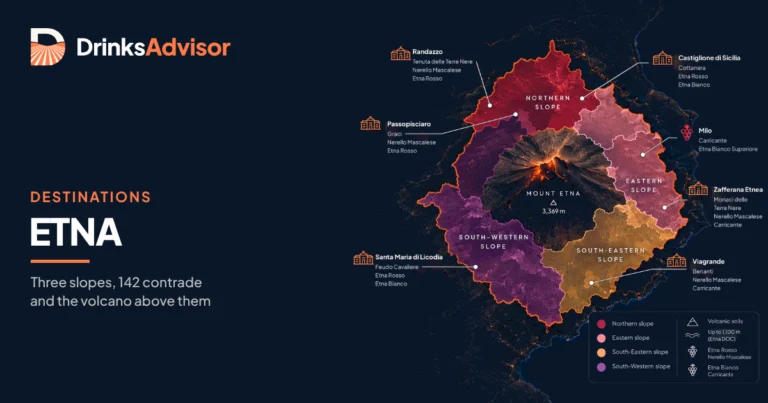
Etna’s vineyards form a horseshoe around the volcano, open to the west. Each side has its own climate and its own set of contrade, and each makes a different kind of wine. These are the districts worth knowing on each slope, with the producers whose bottles you are most likely to meet.
North slope: Castiglione di Sicilia and Randazzo
This is where the contrada idea took hold, and where most of them are: the rules list 46 in Castiglione di Sicilia and 25 in Randazzo. The north slope is drier and more sheltered than the east, and it is red-wine country, built on Nerello Mascalese. Most of the well-known names sit along the road between Solicchiata, Passopisciaro and Randazzo, which makes them easy to taste in a single day.
Feudo di Mezzo is one of the larger districts, around 600 m, known for supple reds; Girolamo Russo farms century-old bush vines there, partly on soil from the 1676 eruption. Calderara Sottana, on the Randazzo side, is stonier, with pumice and basalt, and gives firmer, spicier wines; Terre Nere has made it one of its signature bottlings. San Lorenzo, just outside Randazzo at 700 to 800 m, has pebbly soil from a more explosive eruption.
Higher up, Rampante spans roughly 740 to 1,000 m, and Tasca d’Almerita bottles a Nerello from its vineyard there. Santo Spirito, Guardiola, Arcuria (Graci’s best-known site) and Moscamento complete the list most visitors meet first. Moscamento’s edge is drawn by a lava flow from 1911, and Tenuta di Fessina works vines there planted in 1921 and 1932.
East slope: Milo and Zafferana Etnea
The east side faces the Ionian Sea and catches the most rain on the mountain. That suits Carricante, Etna’s white grape, and it is why the rules reserve Etna Bianco Superiore (at least 80% Carricante) for grapes from the comune of Milo alone. Milo has eight contrade, among them Villagrande, Caselle, Rinazzo, Volpare and Praino.
Two bottles show the idea clearly: Barone di Villagrande, the oldest winery on the mountain, makes its Etna Bianco Superiore in Contrada Villagrande, and Benanti labels one from Contrada Rinazzo. Neighboring Zafferana Etnea has 20 contrade on the list, the most of any comune outside the north slope, though few of its names have reached export labels yet. Our guide to staying on the east and south slopes covers bases in Milo and Zafferana.
South-east slope: Viagrande and Trecastagni
Closer to Catania, the south-east slope is dotted with extinct side cones, the monti, and many contrade are named after them. Viagrande’s nine include Monte Serra and Monte Rosso; Trecastagni’s nine include Monte Ilice and Cavotta. Benanti, based in Viagrande, makes an Etna Rosso from Contrada Monte Serra, a good reference for how the south-east differs from the north: warmer, rounder, often earlier to drink.
South-west slope: Biancavilla and Santa Maria di Licodia
The least visited side has the highest vineyards: the rules allow vines up to 1,100 m here, above the limit elsewhere. Biancavilla has five contrade (Maiorca, Torretta, Rapilli, Stella and Spadatrappo) and Santa Maria di Licodia just one, Cavaliere. It is a quieter detour for a second trip, with very few places to stay in the area.
How to read a contrada on a label
On the front label you will typically see the appellation (Etna Rosso, Etna Bianco or Etna Rosato), then “Contrada” followed by the name, sometimes with the producer’s own name for the wine. A contrada is not a single vineyard: it is a district, and several producers can own plots inside the same one. Calderara Sottana, Feudo di Mezzo and Santo Spirito each appear on labels from different wineries.
That makes for the most rewarding way to taste on Etna. Compare one producer across two or three contrade to see the land, or two producers within the same contrada to see the winemaking. Keep the slope in mind too: a north-slope Nerello and an east-slope Carricante from Milo are not competing for the same job at the table.
One caution: boundaries can be broad. Rampante alone covers a span of a few hundred meters in altitude, so the contrada name sets the frame and the producer’s vineyard details do the rest. Good cellar doors will tell you the altitude and age of the vines behind each bottle. Ask.
Where to taste the Etna contrade
Contrade are not attractions with a gate and a sign: you experience them through the wineries that farm them, and nearly all of those require a booking. The north slope is the easiest place to start, with several cellars along a short stretch of road that pour contrada wines side by side. Our Etna wine country guide explains how the three main slopes fit together and when to go.
If you would rather not drive between tastings, a guided day out of Taormina or Catania is the simplest option; we compare the best of them in Etna wine tours from Taormina and Catania. Some of those visits include a contrada tasting, so check the itinerary before you book. For two or three days of cellar visits, sleep close to the vines: our picks for where to stay on Etna’s north slope put you within minutes of Passopisciaro.
The north-slope wineries are spread out and public transport between them is thin, so a rental car from Catania airport is the practical choice for an independent trip. Pick one designated driver per day, or mix self-drive days with a guided one.
Compare Catania Rentals on DiscoverCars →
Timing matters as well. Every year the Contrade dell’Etna tasting, created in 2008 by the late Andrea Franchetti of Passopisciaro, brings the producers and their single-contrada wines together in one room. For background on individual districts and growers, the World of Fine Wine’s tour of the north-slope contrade is a good companion read, and the Consorzio Etna DOC publishes the official map.
Common questions
How many contrade does Etna have?
The Etna DOC production rules list 133 contrade in nine comuni, recognized in 2011. The Consorzio’s updated map of November 2022 counts 142, after adding nine new districts. Both figures are correct; they come from different documents.
Is a contrada the same as a single vineyard?
No. A contrada is a named district that can hold many vineyards and many owners, much like a cru in Burgundy. Different producers often bottle wines from the same contrada, and their versions can differ as much as the districts themselves.
Which Etna contrade should a first-time visitor know?
On the north slope, Feudo di Mezzo, Calderara Sottana, Santo Spirito and Rampante appear on labels from several well-known producers. For whites, look for the Milo contrade such as Villagrande and Rinazzo on bottles of Etna Bianco Superiore.
Can you visit a contrada?
You visit the wineries that farm it. Most Etna cellars take visitors by appointment only, so book ahead, ask which contrade the tasting covers, and plan no more than two or three visits a day. The north slope is the most convenient base for a contrada-focused trip.